

On this page
The term "quasi-static" comes from Latin *quasi* ("almost") and *static* ("at rest"). In thermodynamics, a quasi-static process is an idealized transition carried out so slowly that the system departs only infinitesimally from equilibrium at every stage. As defined in OpenStax University Physics, the system moves through a continuous succession of equilibrium states.
If a gas cylinder's piston is suddenly released, the gas expands violently. Near the piston, pressure drops instantly, while gas at the cylinder base remains compressed, creating non-uniform turbulence. But if the load is reduced by removing one microscopic grain of sand at a time, pressure changes by an imperceptible fraction of a millinewton. The gas equilibrates almost instantly after each grain, keeping pressure and temperature uniform throughout.
Why do PV diagrams require a quasi-static process?
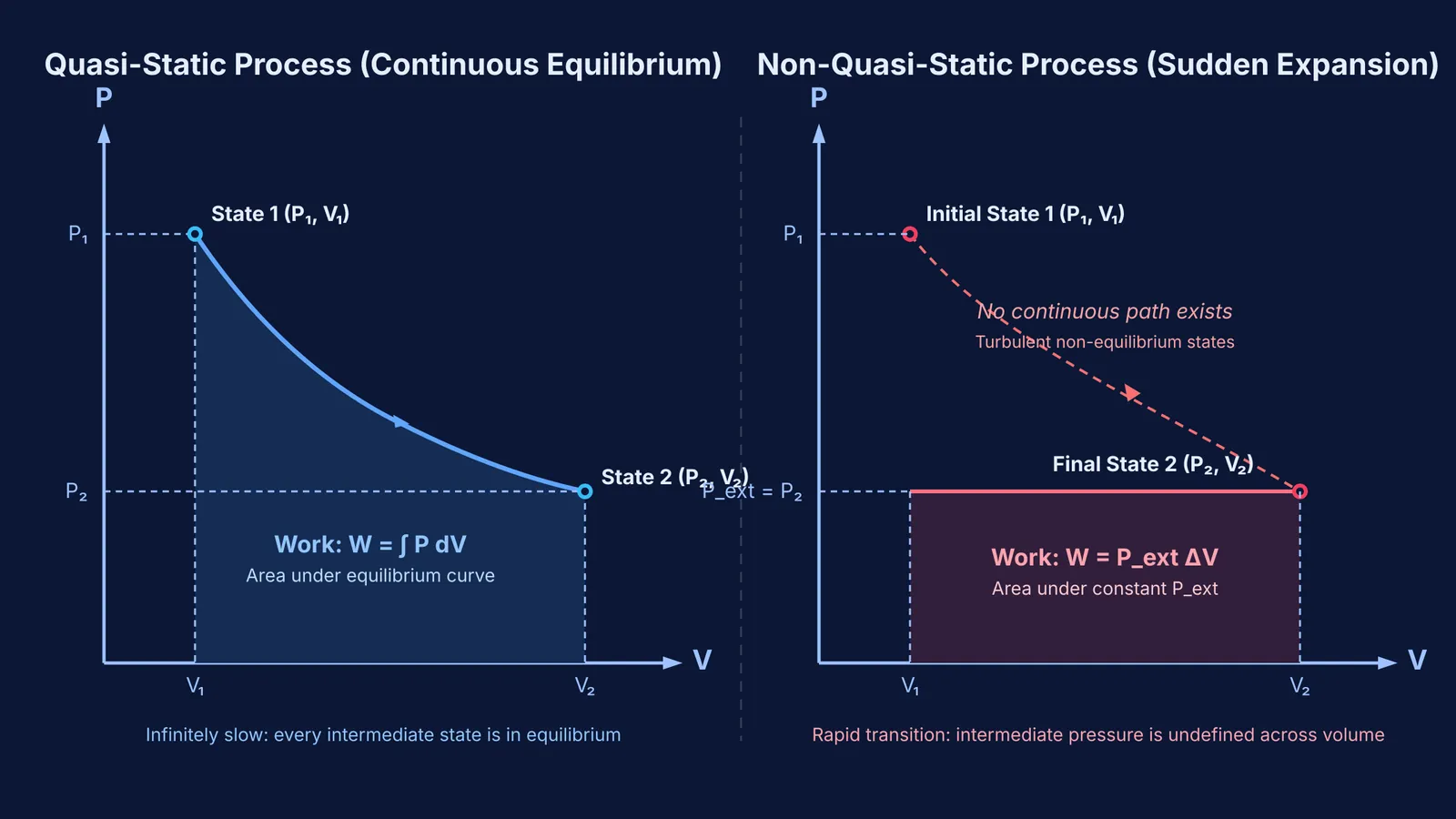
An indicator diagram plots pressure P against volume V. A single point (V, P) assumes a uniform, well-defined pressure throughout the volume.
In a rapid, non-quasi-static expansion, that assumption fails. Turbulent vortices, shock fronts, and temperature gradients mean the gas lacks a single pressure value. Because intermediate states are non-equilibrium states without definite thermodynamic coordinates, a non-quasi-static process cannot be drawn as a continuous line on a PV diagram. Only initial and final equilibrium points can be plotted, connected at best by a dashed line indicating an undefined path.
This controls how work is calculated. As detailed in OpenStax University Physics, the integral W = ∫ P dV is valid only when internal pressure P is defined across each step dV. In non-quasi-static expansions, work on the surroundings must be calculated using external boundary pressure: W = ∫ P_ext dV. In free expansion of an ideal gas into a vacuum, P_ext = 0, so work is zero despite high internal pressure. In the Fermi Concept Library, every concept in physics has its own lesson and its place in the map, helping students verify when equilibrium constraints allow continuous path integrals.
How slow must a process be to stay quasi-static?
As explained in OpenStax thermodynamics principles, a process can be treated as quasi-static when departures from equilibrium are infinitesimally small. In physical systems, this condition is satisfied whenever the process duration, t_process, is much longer than the system's internal relaxation time τ (t_process ≫ τ).
For mechanical equilibrium, pressure disturbances propagate at the speed of sound, v_s. In air at 300 K, v_s is approximately 347 m/s. For a cylinder of length L = 0.1 m (10 cm), the mechanical relaxation time is:
τ_mech ≈ L / v_s ≈ 0.1 / 347 ≈ 2.9 × 10⁻⁴ s
Because pressure equalizes in under 0.3 milliseconds, a piston moving at 0.01 m/s (1 cm/s) takes 10 seconds—roughly 34,000 times longer than τ_mech. The gas easily keeps pace.
Is every quasi-static process reversible?
Many students confuse quasi-static and reversible processes, but they are not identical.
As physicist Mohammad Samiullah showed in the American Journal of Physics, reversibility requires total entropy constancy (ΔS_univ = 0). John S. Thomsen demonstrated in the American Journal of Physics that a piston moving with friction against cylinder walls can move infinitely slowly through valid equilibrium states yet remain irreversible: work dissipated into heat cannot be returned. Furthermore, John D. Norton noted in Studies in History and Philosophy of Modern Physics that reversible operations are idealized limits where driving gradients approach zero.
Under OpenStax thermodynamics principles:
All reversible processes are quasi-static, avoiding turbulence and finite gradients.
Not all quasi-static processes are reversible; friction and finite temperature drops generate entropy.
For ideas that are easier to see than to read, the Fermi Simulation Lab provides interactive simulations showing how molecular distributions adjust to moving boundaries.
How do you test whether an exam problem is quasi-static?
When solving Class 11, JEE Main, or NEET-UG problems based on standard OpenStax work principles, check these three conditions:
Words like "slowly" or "in equilibrium": Quasi-static; integrate W = ∫ P dV.
Words like "suddenly released" or "against constant external pressure": Non-quasi-static; calculate work in irreversible expansion via W = P_ext ΔV.
Friction or finite temperature difference present: Quasi-static but irreversible.
Consider 1.0 mol of an ideal gas at 300 K expanding from 0.01 m³ (10 L) to 0.02 m³ (20 L):
Quasi-static isothermal path: W = nRT ln(V₂ / V₁) = 1.0 × 8.314 × 300 × ln(2) ≈ 1729 J.
Sudden expansion against P_ext = P₂ = 124,710 Pa: W = P_ext ΔV = 124,710 × 0.01 = 1247 J.
The quasi-static route yields 482 J more work because gas pressure remains balanced at higher values throughout the stroke. When analyzing converting PV, PT and VT graphs, the Fermi Problem Library provides worked problems with a step-by-step solver that explains the reasoning behind path constraints.


