

On this page
Plastic scales break easily in school bags, often snapping right at the thin ends. Even if the ruler is not broken, the printed numbers at the zero edge can rub off over time from constant use. When the zero mark is missing, trying to guess where zero used to be will give you a wrong measurement. This missing or damaged starting point creates a systematic discrepancy, which in physics is known as a type of zero error.
In standard measurement of length and motion in Class 6, learning to place the scale correctly is the very first step in laboratory work. Fortunately, a broken ruler is still perfectly usable and highly accurate if you just change where you start your measurement.
How do you measure with a broken ruler?
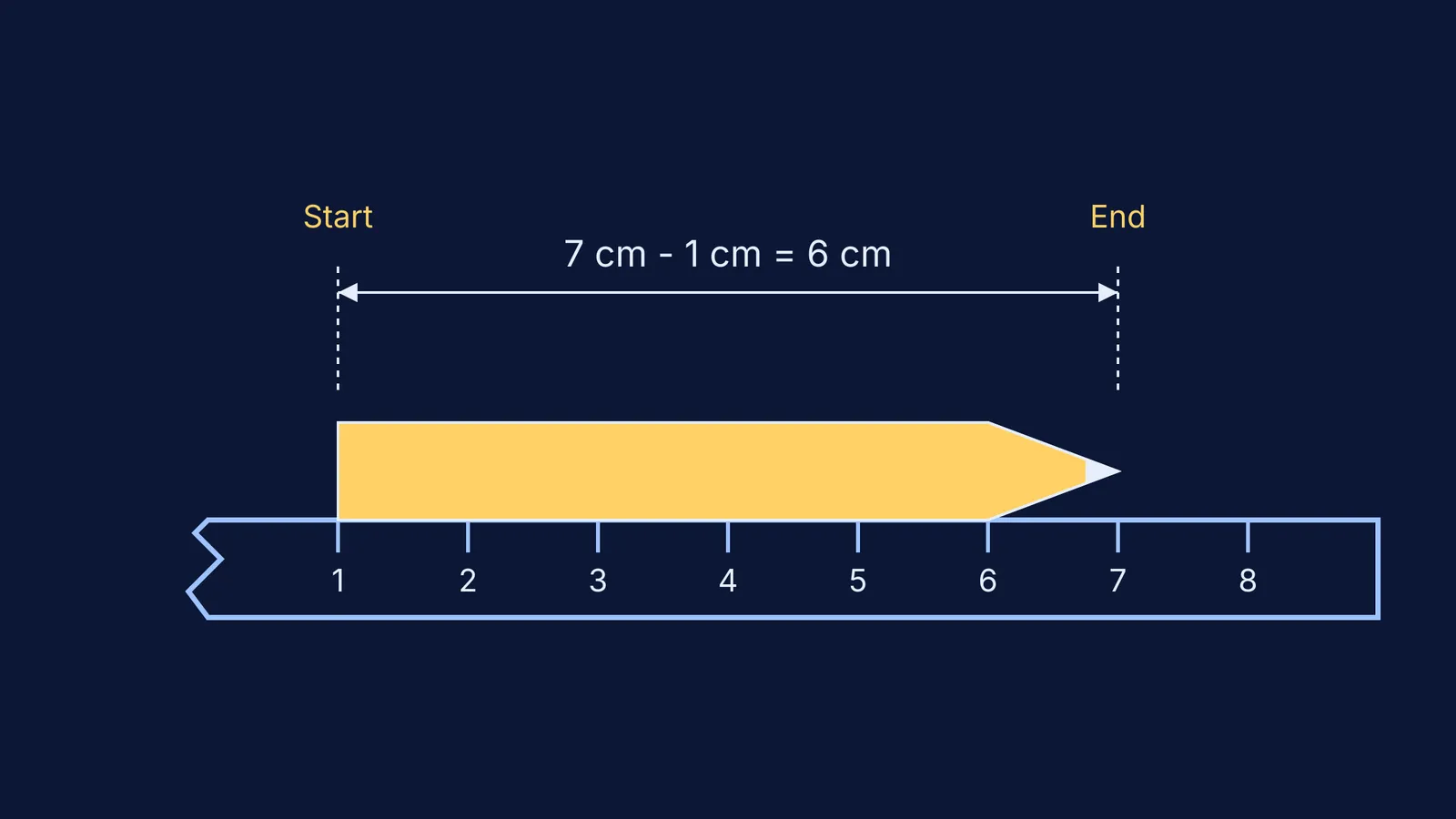
Instead of starting from the broken or jagged edge, align one end of the object with a full, clear mark on the scale. The 1.0 cm or 2.0 cm marks are usually the best choices because they are easy to subtract later.
Here is the exact method you should follow:
Ignore the damaged zero end of the ruler entirely.
Place the object completely flat against the edge of the scale.
Align the starting edge of the object exactly with a whole number mark (for example, the 1 cm mark).
Ensure the object runs parallel to the scale.
This procedure mathematically "resets" the scale. Because the exact starting point of a broken end is completely unknown or uneven, moving away from it ensures your baseline measurement is precise.
How do you calculate the actual length?
Because you did not start at zero, the number you read at the other end of the object is not its true length. You must subtract your starting mark from the final reading.
According to the National Council of Educational Research and Training (NCERT) Class 6 Science textbook on distances, you simply subtract the initial reading from the final reading to find the accurate length.
A step-by-step worked example:
Initial reading: You place the flat back of a pencil perfectly parallel at the 1.0 cm mark.
Final reading: You look at where the sharp tip of the pencil reaches. Let us say it aligns with the 14.3 cm mark.
Calculation: Subtract the start from the end: 14.3 cm − 1.0 cm = 13.3 cm.
Actual length: The true length of the pencil is 13.3 cm.
This basic logic remains exactly the same for larger objects or different starting marks. For instance, if you start measuring from the 2.0 cm mark and the object ends at 15.5 cm, the length is calculated as 15.5 cm − 2.0 cm, giving 13.5 cm.
Why keep your eye straight above the mark?
When reading any physical scale, your eye must be exactly in front of (or directly above) the specific point where the measurement is being taken.
If you look at the printed scale from an angle rather than straight on, the mark will appear to shift relative to the physical object below it. This optical effect is called parallax error. Keeping your eye straight down ensures you are reading the exact alignment and not adding a few accidental millimetres to your result.
This simple procedure of subtracting from a non-zero baseline is a fundamental form of correcting measurement errors. As you move to more advanced measuring instruments in higher classes, you will face similar principles. You will need to account for zero offsets when reading a vernier calliper and screw gauge, with zero error, or when managing complex error propagation in measurement during higher-level lab experiments.
When studying error analysis and measurement for school physics practicals, the mathematical theory can sometimes feel tricky. Fermi's AI tutor can work out what you already know and build a plan for the session to clear up these core concepts. If you need more practice dealing with zero errors or finding precise lengths under tricky conditions, the Fermi Problem Library has worked problems with a step-by-step solver that explains the reasoning rather than printing an answer.
Next time your plastic ruler snaps at the end, do not throw it away. Just shift your starting point to a whole number, keep your eye straight above the mark to avoid parallax error, and subtract the difference.


