On this page
A common Class 10 maths question goes like this: "The circumferences of two circles are in the ratio 3:4. Find the ratio of their areas." The tempting answer is 3:4, and it is wrong. The right answer is 9:16, and once you see why, you can do these quickly.
Why is the area ratio the square of the circumference ratio?
Start with the two formulas. The NCERT Class 10 chapter Areas Related to Circles uses πr² for the area of a circle and 2πr for its whole length, the circumference.
Now put two circles side by side, with radii r₁ and r₂.
Circumference ratio: C₁/C₂ = 2πr₁ / 2πr₂ = r₁/r₂. The 2π cancels, so the circumference ratio equals the radius ratio.
Area ratio: A₁/A₂ = πr₁² / πr₂² = (r₁/r₂)². The π cancels, so the area ratio is the radius ratio squared.
Put those together and you get the one line to remember: A₁/A₂ = (C₁/C₂)². Length scales once; area scales twice, because area is length times length.
This is a very old result. Proposition 2 of Book XII of Euclid's Elements states that "circles are to one another as the squares on their diameters" (Euclid's Elements, Book XII, Proposition 2). Diameter, radius and circumference are all lengths in the same ratio, so the rule is the same whichever one you are given.
How do you find the ratio of areas from the ratio of circumferences?
Use this three-step routine on every question of this type.
Write the given ratio as a fraction, for example C₁/C₂ = 3/4.
Say out loud: "same as the radius ratio". So r₁/r₂ = 3/4.
Square it for area: A₁/A₂ = 9/16. Write the answer as 9:16.
You never needed π or the actual radii.
Worked examples, from easy to tricky
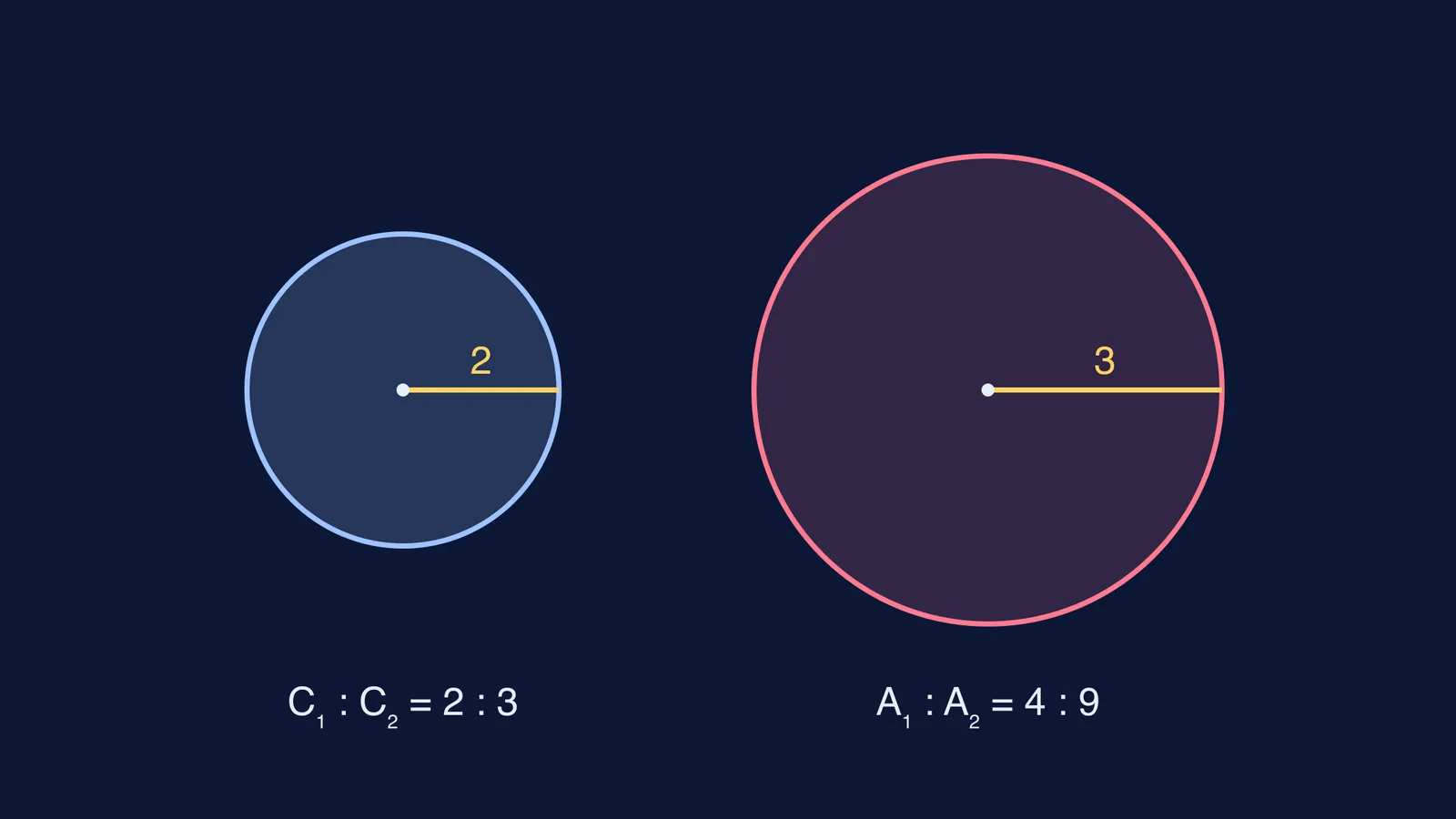
Example 1 (direct). Circumferences are in the ratio 2:3. Radii are in 2:3, so areas are in 4:9. The diagram above shows exactly this pair: the bigger circle is only 1.5 times as wide but holds 2.25 times the area.
Example 2 (with numbers). Two circles have circumferences 44 cm and 88 cm. Take π = 22/7. The long way: 2πr = 44 gives r = 7 cm, and 2πr = 88 gives r = 14 cm. Areas are 22/7 × 49 = 154 cm² and 22/7 × 196 = 616 cm². The ratio is 154:616 = 1:4. The short way: 44:88 = 1:2, squared is 1:4. Same answer, no arithmetic with π.
Example 3 (reverse). The areas of two circles are in the ratio 16:25. Find the ratio of their circumferences. Take the square root: 4:5. Students who square instead of rooting get 256:625, which should look wrong just from its size.
Example 4 (percentage). A circle's circumference grows by 10%. By what percentage does its area grow? The new-to-old length ratio is 1.1, so the area ratio is 1.1² = 1.21. The area grows by 21%, not 10%.
What mistakes do students make with circle ratios?
Copying the circumference ratio as the area ratio (3:4 instead of 9:16).
Squaring when going from area back to length, instead of taking the square root.
Mixing a diameter of one circle with a radius of the other without converting first.
Cancelling π in one place but not the other, then getting a stray π in the answer.
For percentage changes, adding percentages (10% + 10% = 20%) instead of multiplying (1.1 × 1.1 = 1.21).
If you keep getting the method right but the answer wrong, take a few problems to the Fermi Problem Library, where a step-by-step solver explains the reasoning rather than printing an answer, so you can see the step where your working went off.
Where does this idea show up next?
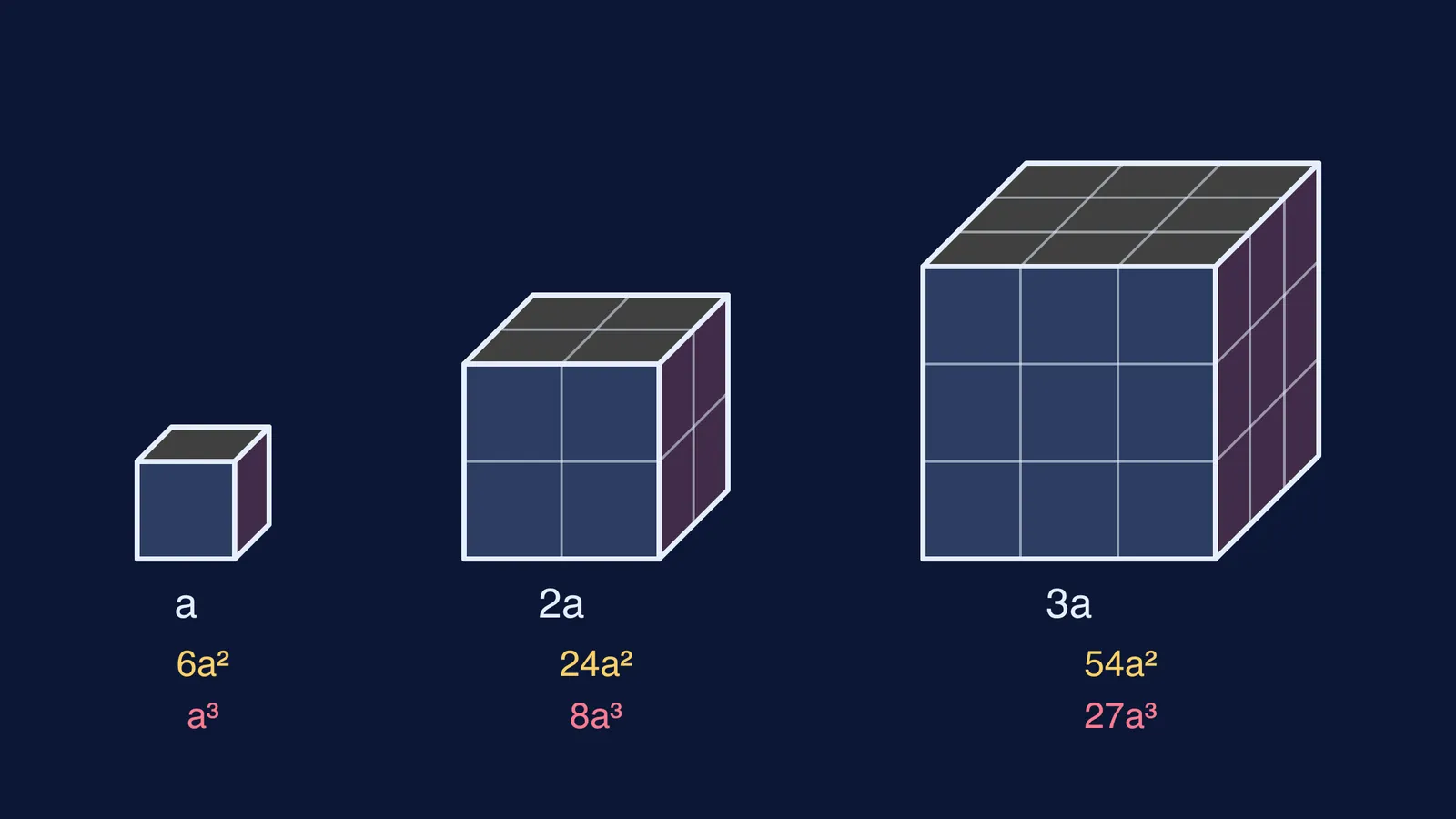
The same squaring rule works for any pair of similar shapes, and cubes appear when you move to volume; our explainer on scale factors for area and volume takes it further. If the circumference formula itself feels shaky, start with why circumference is π times the diameter, and for sectors, segments and shaded regions see our guide to areas related to circles in Class 10.
When you want to see where ratio and proportion sit among the rest of school geometry, the Fermi Concept Library has every mathematics concept with its own lesson and its place in the map.
Try it now: circumferences in the ratio 5:7. Your answer should be 25:49.