On this page
Picture a drop falling through still mist, tiny droplets hanging at rest. Every droplet it hits sticks to it, so the drop gets heavier as it falls. Ignore air resistance for now. Gravity pulls with mg, so it is tempting to say the acceleration is still g. It is not, because Newton's second law is really a statement about momentum.
Why does a raindrop gaining mass accelerate less than g?
Each droplet the drop swallows starts at rest. To join the drop it has to be sped up from zero to the drop's speed v, and that takes force. Gravity is the only force available, so part of it goes into speeding up new water instead of speeding up the drop.
Written properly, the rate of change of the drop's momentum equals the force on it: d(mv)/dt = mg. Expanding the left side gives m dv/dt + v dm/dt = mg, which is equation (5) in Alan Sokal's paper "The falling raindrop, revisited", obtained by following the same collection of water particles at two nearby times. The extra term v dm/dt is the cost of accelerating the new mass, so the acceleration dv/dt = g − (v/m) dm/dt is always less than g while the drop is growing.
This works because the mist is at rest. If the gathered mass were already moving with the drop, there would be no extra term at all, which is why sand leaking from a moving cart does not change its speed. Rockets are the opposite case, with mass leaving at high relative speed; our guide to variable mass systems, rocket thrust and conveyor belts covers that side.
What acceleration does a growing raindrop have?
That depends on how fast the drop collects mass. The two standard models are set out in Sokal's paper, published in the American Journal of Physics in 2010:
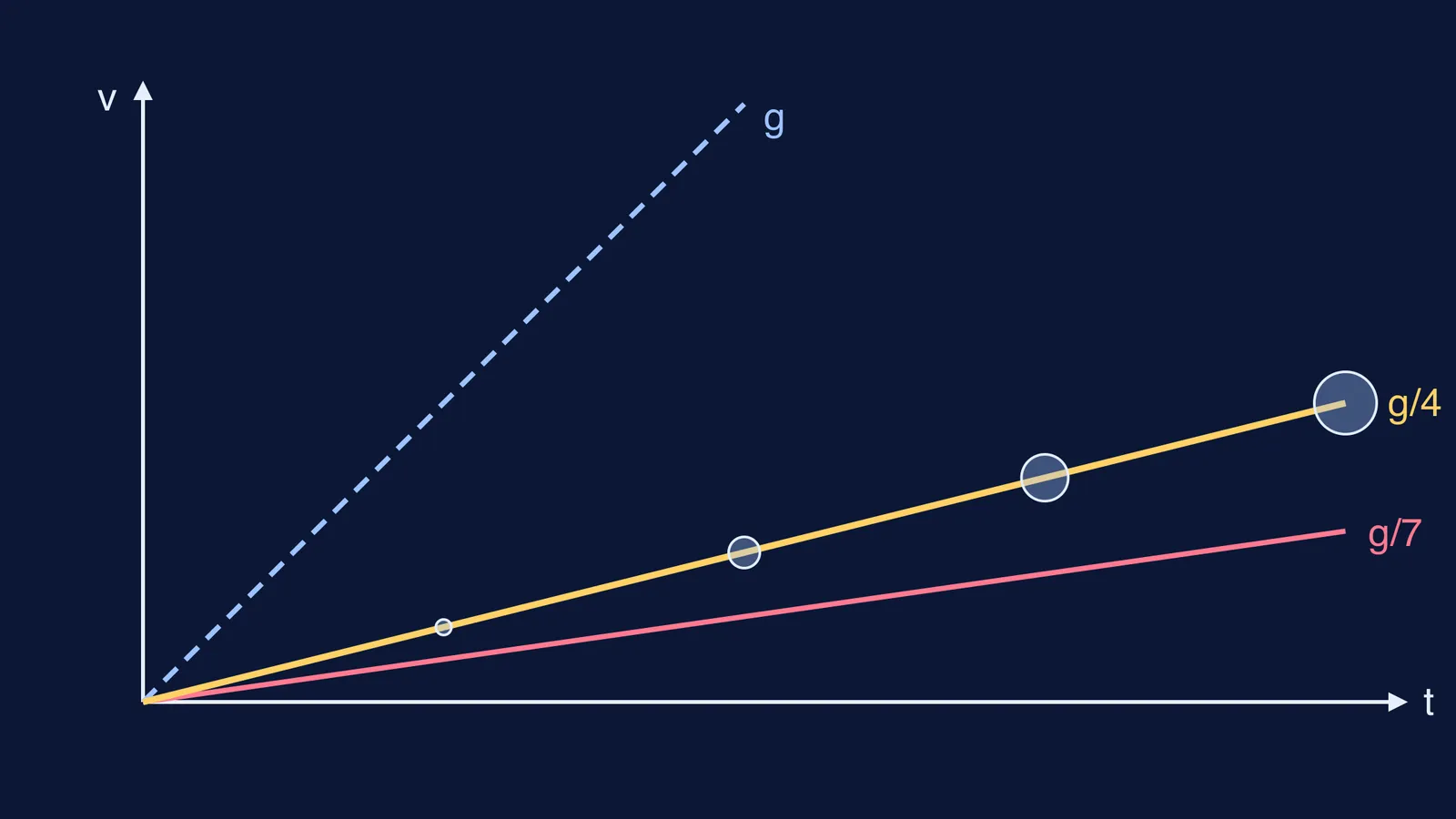
If the drop gains mass in proportion to its surface area, its acceleration is g/4.
If the drop gains mass in proportion to the volume of mist it sweeps out (so faster drops collect more), its acceleration is g/7.
Both results are for the simplest solution in the paper, where the drop has zero mass when its speed is zero. Then the acceleration is constant: the drop falls with uniform acceleration, just a smaller one than a stone would have.
How do you derive g/4 step by step?
Here is the surface-area case, as you would write it in an exam.
Mass grows with surface area: dm/dt = k(4πr²). With m = (4/3)πρr³, dm/dt = 4πρr² dr/dt. Comparing the two, dr/dt = k/ρ, a constant. So the radius grows steadily: r = ct.
Then m = (4/3)πρc³t³, which we write as m = Kt³.
Use d(mv)/dt = mg = Kgt³. Integrate from t = 0, when both m and v are zero: mv = Kgt⁴/4.
Divide by m = Kt³: v = gt/4. Speed grows linearly with time, so the acceleration is g/4.
You can check the t⁶ claim yourself. In the swept-volume model dm/dt is proportional to r²v, that is to m^(2/3)v. Try m = Bt⁶ and v = at: the left side goes as t⁵, and the right side as t⁴ × t = t⁵, so the powers match. The shortcut then gives a = g/7, the same as Sokal's result.
What if the drop starts with some mass?
Exam questions often give a constant rate instead. Say a drop starts from rest with mass 1 g and gains 0.5 g every second, with g = 9.8 m/s². After 2 s its mass is 2 g. Integrating d(mv)/dt = mg gives mv = g(m₀t + λt²/2) = 9.8 × (1 × 2 + 0.5 × 4/2) = 29.4 g·m/s. So v = 29.4/2 = 14.7 m/s, three quarters of the 19.6 m/s a constant-mass drop would reach.
Where do students go wrong on variable mass problems?
Run this checklist first:
Is the mass changing? If yes, start from d(mv)/dt, not m dv/dt.
What is the velocity of the mass being added or lost? Zero (still mist) means the full v dm/dt term; the same as the body (leaking cart) means no term.
What are the starting conditions? In the power-law models above, zero initial mass gives a constant acceleration; a starting mass m₀ gives an acceleration that changes with time.
Is this the idealised problem or real rain? Real drops are slowed mainly by air, which is why raindrops do not hurt even after falling from clouds.
If you keep landing on g, the gap is the method, not the algebra. The Fermi Problem Library has worked problems with a step-by-step solver that explains the reasoning rather than printing an answer, so you can see where the v dm/dt term enters. To revise momentum and Newton's second law first, the Fermi Concept Library gives each concept its own lesson and its place in the map.
Try the constant-rate example with 3 s, and check your answer is still less than gt.