

On this page
The quotient rule has one built-in trap: the order of the numerator. The other way to lose marks is using it when you didn't need it. Here is the rule, the usual slips, and three ways around it.
What is the quotient rule, and why does the order matter?
If y = f(x)/g(x), then y′ = [f′(x)g(x) − f(x)g′(x)] / [g(x)]². OpenStax Calculus Volume 1, Section 3.3 puts it in words: the derivative of the numerator times the denominator, minus the derivative of the denominator times the numerator, all divided by the square of the denominator.
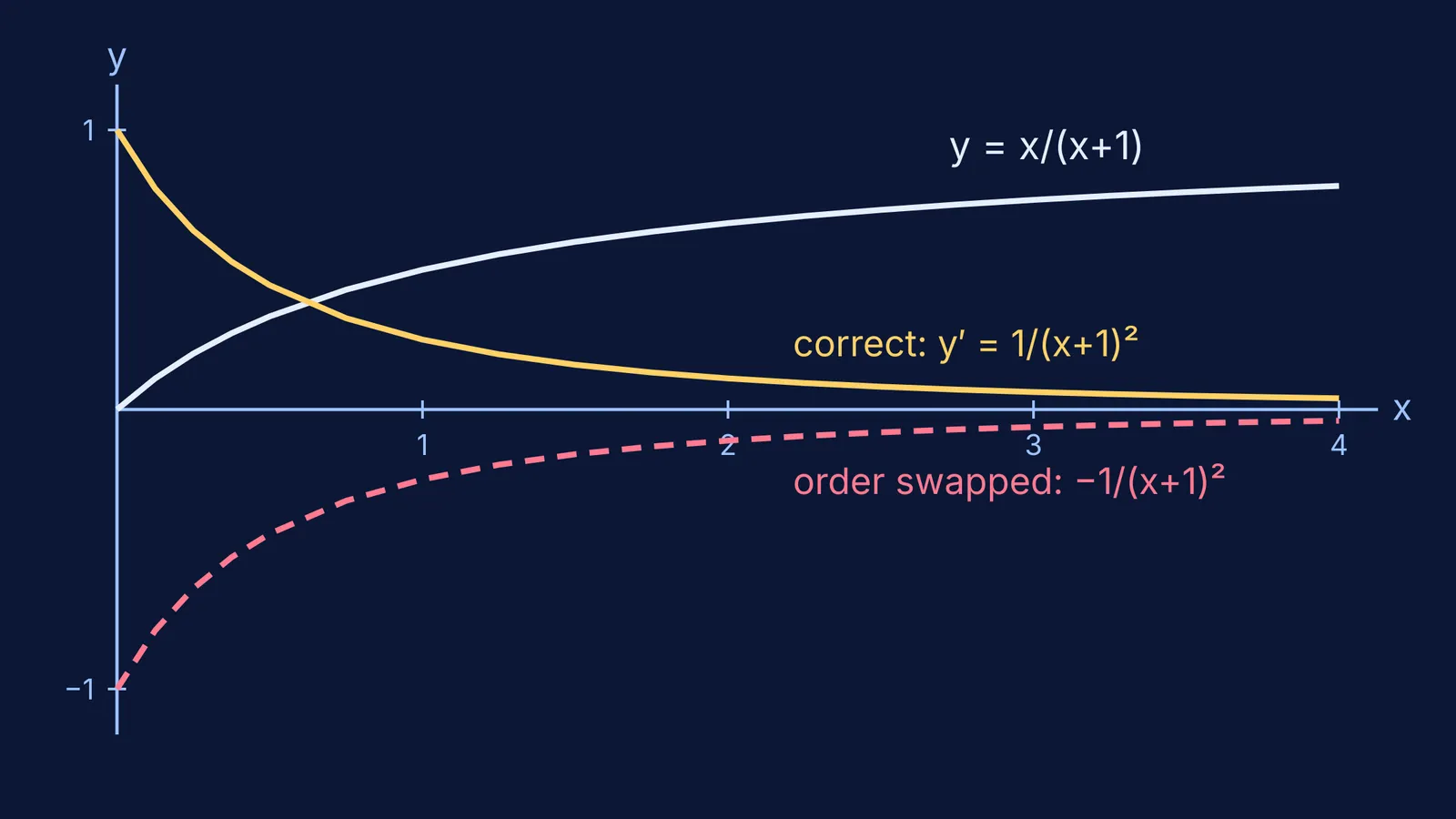
The order matters because the numerator is a subtraction. Swap the two terms and you get exactly the negative of the right answer.
Take y = x/(x + 1). Here f = x, f′ = 1, g = x + 1 and g′ = 1. The correct numerator is 1·(x + 1) − x·1 = 1, so y′ = 1/(x + 1)². The swapped version gives −1/(x + 1)², the dashed curve in the diagram at the top of this post.
To remember the order: the rule starts with the derivative of the top, just as the product rule starts with the derivative of the first function.
What are the most common quotient rule mistakes?
Swapping the order of the numerator, so the sign flips.
Differentiating top and bottom separately and writing f′/g′. That is not a rule at all.
Losing the bracket after the minus sign. If g′ = 2x + 3, you subtract f·(2x + 3), not f·2x + 3.
Forgetting to square the denominator, or squaring it and then expanding it. Leave g² factored; it often cancels with something in the numerator.
Using the rule when the numerator is a constant. It works, but one step would do.
When should you avoid the quotient rule?
Before you start, look at the shape of the fraction and go down this list:
Constant on top. Write it as a negative power and use the chain rule. 5/(x² + 1) = 5(x² + 1)^(−1), so y′ = −10x/(x² + 1)². OpenStax does the same with 6/x², rewriting it as 6x^(−2) before differentiating (Section 3.3).
A single term on the bottom. Divide each term on top by it first. (x³ + 2x − 7)/x² = x + 2x^(−1) − 7x^(−2), so y′ = 1 − 2x^(−2) + 14x^(−3). No quotient rule, and no long simplification afterwards.
Linear over linear. For (ax + b)/(cx + d), the derivative is (ad − bc)/(cx + d)²; we explain the ad − bc shortcut for linear-over-linear functions in its own post.
Many factors, powers or roots. Take logs (next section).
Two genuinely different functions, such as sin x/(x² + 1). Here the quotient rule is the right tool, so use it carefully.
How does logarithmic differentiation shorten a messy fraction?
Logs turn products into sums, quotients into differences and powers into multipliers, so you differentiate each factor on its own. OpenStax, Section 3.9 sets the method out in five steps: take the natural log of both sides, expand with log rules, differentiate both sides, multiply by y, and replace y with the original function.
NCERT Class 12 Mathematics Part I covers this in Section 5.5, Logarithmic Differentiation, and its Example 27 is exactly the kind of fraction that makes the quotient rule painful (NCERT Chapter 5 PDF):
y = √[(x − 3)(x² + 4) / (3x² + 4x + 5)]
The quotient rule route nests the chain rule, product rule and quotient rule. With logs:
log y = ½[log(x − 3) + log(x² + 4) − log(3x² + 4x + 5)]
(1/y)(dy/dx) = ½[1/(x − 3) + 2x/(x² + 4) − (6x + 4)/(3x² + 4x + 5)]
dy/dx = (y/2)[1/(x − 3) + 2x/(x² + 4) − (6x + 4)/(3x² + 4x + 5)], then write the original y back in.
Each term is a one-line chain rule, and a factor on the bottom simply becomes a minus sign. There is no numerator order to get wrong.
For more practice with log rules, see our post on simplifying logs before differentiating.
What should you check before moving on?
Run this short list on any derivative of a fraction:
Did you pick the shortest method: rewrite, divide, logs, or the rule?
If you used the rule, does the numerator start with the derivative of the top?
Is there a bracket around g′ after the minus sign?
Does the sign agree with the two-value test?
Is the denominator still squared and factored?
Some quotient rule errors are really chain rule errors inside g′; see the missing inner derivative in chain rule mistakes. If you keep getting the same sign wrong, the Fermi Problem Library has worked problems with a step-by-step solver that explains the reasoning rather than printing an answer, so you can see which line went wrong. To revisit the rule itself, the Fermi Concept Library gives every concept in mathematics its own lesson.


