

On this page
Faced with a function like y = log(√((1 + x) / (1 − x))), your first instinct might be to differentiate from the outside in. First, the derivative of log u is 1/u. Then, multiply by the derivative of the square root, 1/(2√v). Finally, apply the quotient rule to (1 + x) / (1 − x).
This creates a huge, multi-tier fraction that you must simplify by finding common denominators and cancelling terms. Students rarely fail calculus because they do not know the derivative of a logarithm; they fail due to algebraic mistakes when simplifying.
Why do students fail calculus?
Teachers often note that students pass calculus but fail the algebra. Differentiating a nested function using the chain and quotient rules simultaneously forces your brain to track multiple moving parts at once:
The outer derivative formula.
The inner derivative formula.
The numerator and denominator of the quotient rule.
Negative signs and fractional exponents.
As Nelson Cowan's 2001 study on human cognition showed, human working memory has a rigid capacity limit. On average, we can actively hold only about four independent "chunks" of information in our minds at one time. When a mathematics problem asks you to hold five or six pieces of information—such as a negative sign, an exponent, a quotient rule denominator, and the outer function—your working memory overflows.
Exceeding this limit causes you to drop negative signs, distribute factors incorrectly, or incorrectly cancel added terms. These are not careless mistakes, but a direct consequence of cognitive overload. Simplifying first keeps the number of moving parts well below your memory limit.
How do you simplify logs before differentiating?
Instead of rushing to differentiate, look at the properties of the logarithm. Logarithms turn exponents into multipliers, and division into subtraction. By using these rules, you break the complex fraction apart into independent terms.
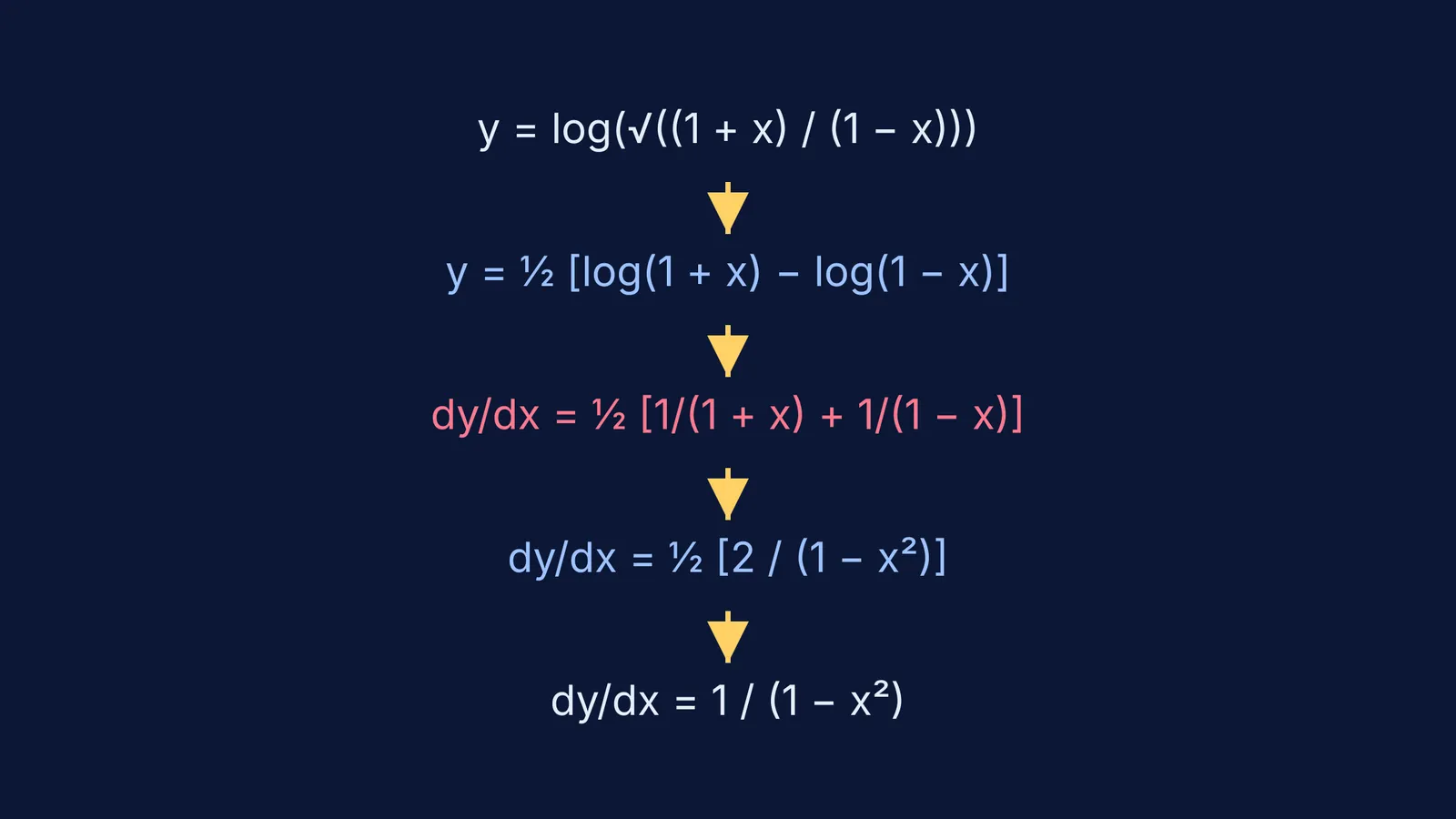
Start by writing the square root as a power of ½: y = log(((1 + x) / (1 − x))^(½))
Bring the power to the front: y = ½ log((1 + x) / (1 − x))
Split the division into subtraction: y = ½ [log(1 + x) − log(1 − x)]
Now, take the derivative dy/dx. The chain rule is almost completely gone. The derivative of log(1 + x) is simply 1/(1 + x). The derivative of log(1 − x) is 1/(1 − x) multiplied by −1, because the derivative of −x is −1.
dy/dx = ½ [1/(1 + x) − (−1)/(1 − x)] dy/dx = ½ [1/(1 + x) + 1/(1 − x)]
To combine them, cross-multiply the fractions inside the bracket: dy/dx = ½ [(1 − x + 1 + x) / ((1 + x)(1 − x))] dy/dx = ½ [2 / (1 − x²)] dy/dx = 1 / (1 − x²)
This calculation took just a few lines, and every step was manageable. There were no complex nested fractions to juggle, and the cognitive load was kept low.
When should you use logarithmic differentiation?
Any time you see a logarithm wrapped around a product, a quotient, or a power, simplify using log properties before doing any calculus.
If a function lacks a logarithm initially, take the natural logarithm of both sides. Logarithmic differentiation is a standard tool for complex products or functions with variables in the exponent.
For example, differentiating y = (x² √(x+1)) / (x-2)³ using the product and quotient rules together creates a massive algebraic mess. Instead, take the natural logarithm: log y = log(x²) + log((x+1)^(½)) − log((x-2)³)
Bring all the powers down to the front: log y = 2 log x + ½ log(x+1) − 3 log(x-2)
Now differentiate both sides with respect to x. Remember that the derivative of log y is (1/y) × (dy/dx): (1/y) dy/dx = 2/x + 1/(2(x+1)) − 3/(x-2)
Finally, multiply both sides by y to get the final answer: dy/dx = y × [2/x + 1/(2(x+1)) − 3/(x-2)]
This saves you from combining product and quotient rules and finding common denominators. Knowing when to reshape the problem is as vital as knowing how to differentiate parametric functions or prove relations with second-order derivatives. The same proactive approach helps when differentiating one expression with respect to another.
How does Fermi build better problem-solving habits?
In exams like JEE Main, where speed matters as much as accuracy, forcing a brute-force chain rule costs valuable minutes. When you enter a calculus question into the Fermi Problem Library, it does not just print the final answer. Fermi's AI tutor notices where a student is stuck and decides whether to explain, ask, or show the next step. It will nudge you to check if an algebra rule could split the function apart first.
By teaching you to hold a line of reasoning rather than rushing to apply formulas, Fermi builds the habit of looking for the elegant path before you start writing.


