

On this page
Public Facilities is Chapter 7 of NCERT's Class 8 civics textbook, Social and Political Life III, in its 2024-25 edition of the chapter. It uses water in Chennai to ask one question: who should make sure everyone gets the basics?
Textbooks change, so first check the NCERT rationalised syllabus your school follows.
What are public facilities in Class 8?
The NCERT chapter defines public facilities as essential facilities that need to be provided for everyone, such as water, healthcare, sanitation, electricity, public transport, schools and colleges.
Their key feature, in the chapter's words, is that once a public facility is provided, its benefits can be shared by many people. One village school educates many children; electricity supplied to an area lets farmers run pumpsets, people open small workshops and students study more easily.
Why is water part of the right to life?
The NCERT chapter states that the Constitution of India recognises the right to water as part of the Right to Life under Article 21. That means every person, rich or poor, should have enough water for daily needs at a price they can afford. The textbook calls this universal access.
The chapter gives the reason it matters: over 1,600 Indians, most of them children under five, reportedly die every day because of water-related diseases that safe drinking water could prevent.
In 2007, the Andhra Pradesh High Court, hearing a case based on a villager's letter that a textile company was discharging poisonous chemicals into a stream in Mahbubnagar district, directed the district collector to supply 25 litres of water to each person in the village.
If Article 21 and Fundamental Rights feel shaky, revise them with our post on the key features of the Indian Constitution for Class 8.
What is the government's role in public facilities?
The chapter's argument runs in three steps:
Companies work for profit, and most public facilities earn none, like keeping drains clean.
Where companies do step in, such as tankers or bottled water, only some people can afford the price.
So the government must bear the responsibility, paying for water supply partly from taxes and partly by charging a price set so most people can afford a minimum amount.
The government may hire private firms but must keep a close watch: Chennai's private tankers work "on contract", at a rate the government water supply department sets. The next chapter continues this idea; see our notes on law and social justice for Class 8.
What does the Chennai water example show?
The chapter follows four people:
Ramagopal, a senior government official in Anna Nagar: tap water for most of the day, and a tanker arranged through a contact at the water board when supply falls short.
Subramanian in Mylapore: municipal water once in two days, brackish borewell water for toilets and washing, and up to Rs 500-600 a month on tankers.
Siva in Madipakkam: water once in four days, and bottled water for drinking.
Padma in a Saidapet slum: one common tap for 30 hutments, borewell water for 20 minutes twice a day, and at most three buckets per family in that time.
On average, municipal supply meets only about half of the city's needs, according to the chapter, and areas near storage points get more water than colonies further away.
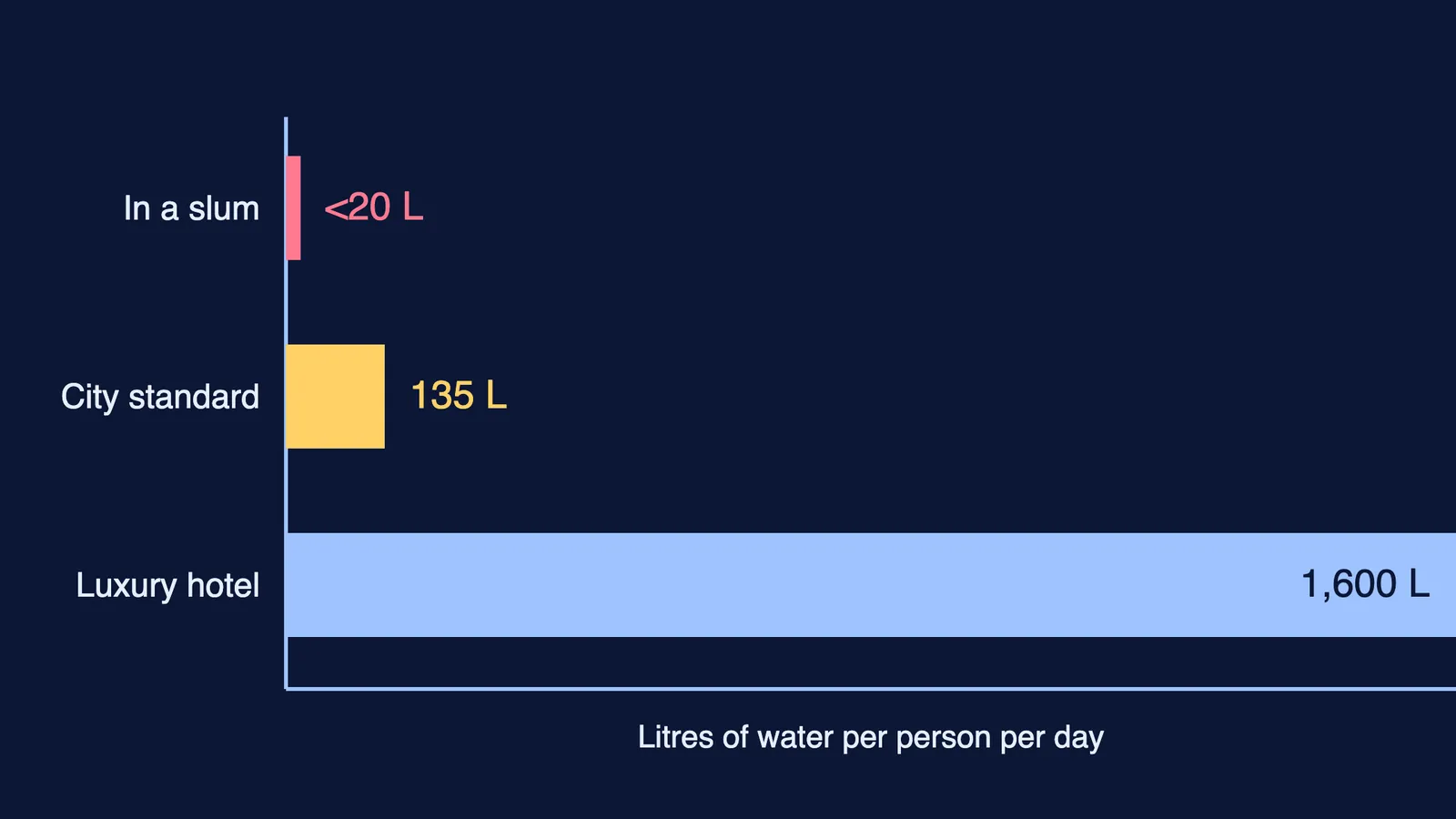
The chapter then says Chennai is not unique and puts numbers on the gap in Indian cities: the Urban Water Commission's standard is about 135 litres per person per day in urban areas, people in slums make do with less than 20 litres, and people in luxury hotels may consume as much as 1,600 litres a day.
How do you write a 5-mark answer on public facilities?
Use four steps from the NCERT chapter:
Define: public facilities are essential services, like water and schools, whose benefits are shared by many.
Right: the Constitution treats water as part of the Right to Life under Article 21.
Government: companies seek profit and charge prices many cannot pay, so the government must take overall responsibility, funded by taxes and a price for water most people can afford.
Example: in Chennai, Padma's family fills at most three buckets at a tap shared by 30 hutments; across Indian cities, slum residents get under 20 litres a day against a 135-litre standard.
Here is a worked answer to the chapter's own question, "Why should the government be responsible for providing public facilities?": Public facilities such as water and schools meet basic needs, and the Constitution recognises water as part of the Right to Life. Most earn no profit, so companies will not provide them, and where they do, the price shuts out the poor. The government collects taxes and can price water so most people afford a minimum amount. In Chennai, Padma's family shares one tap with 29 other hutments while Anna Nagar has tap water most of the day.
Then close the book and list the four Chennai names, the three numbers (20, 135, 1,600) and Article 21 from memory. If a whole term of chapters feels like too much, Fermi's AI tutor can work out what you already know and build a plan for the session, so you start with a clear next step.
Next time you open a tap, ask who paid to bring the water there: that is the whole chapter in one question.


