

On this page
"If a, b, c are in AP, prove that b + c, c + a, a + b are also in AP" is a standard algebra exercise on progressions. It needs no clever idea, just one translation and patient algebra.
What does "a, b, c are in AP" mean as an equation?
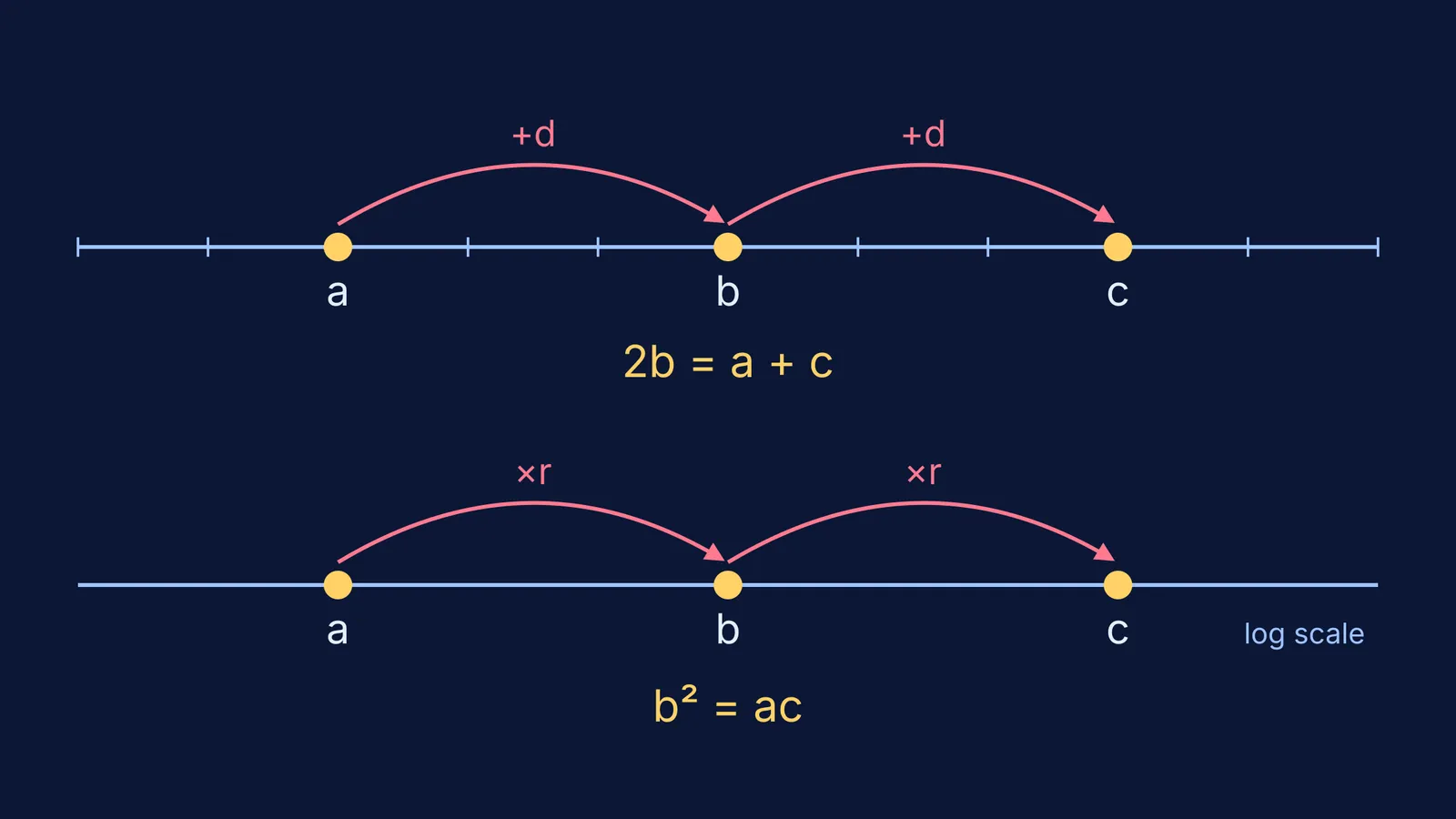
NCERT's Class 10 textbook defines an arithmetic progression as a list of numbers in which each term is obtained by adding a fixed number, the common difference, to the preceding term (NCERT Class 10 Mathematics, Chapter 5). For three terms that means b − a = c − b. Rearranged:
a, b, c are in AP if and only if 2b = a + c.
The middle term is the average of its neighbours. Use this line twice: to rewrite what you are given, and to rewrite what you must prove.
How do you prove that new expressions are in AP?
Translate the given: 2b = a + c.
Translate the target: for new terms P, Q, R, you need 2Q = P + R.
Simplify the target until it becomes the given.
Check every step reverses, so the logic runs from given to target.
Worked example 1: b + c, c + a, a + b.
Target: 2(c + a) = (b + c) + (a + b).
The right side is a + 2b + c. So the target says 2a + 2c = a + 2b + c, which simplifies to a + c = 2b. That is the given. Each step only added or subtracted the same quantity on both sides, so it reverses.
Worked example 2: a²(b + c), b²(c + a), c²(a + b).
Expanding gets messy, so use the difference form: P, Q, R are in AP exactly when Q − P = R − Q.
Q − P = b²c + ab² − a²b − a²c = c(b² − a²) + ab(b − a) = (b − a)(ab + bc + ca).
R − Q = c²a + bc² − b²c − ab² = a(c² − b²) + bc(c − b) = (c − b)(ab + bc + ca).
Since b − a = c − b (the given), the two differences are equal, so the three expressions are in AP.
Worked example 3: 1/bc, 1/ca, 1/ab.
These fractions only exist if a, b and c are all non-zero. Multiply every term by abc to get a, b, c, which are in AP. Scaling every term of an AP by the same non-zero number gives another AP, so the reciprocals are in AP.
What changes when a, b, c are in GP?
NCERT's Class 11 textbook defines a geometric progression as a sequence of non-zero terms in which each term divided by the one before it is a constant r, the common ratio (NCERT Class 11 Mathematics, Chapter 8). For three terms, b/a = c/b, so:
a, b, c are in GP if and only if b² = ac, with all three terms non-zero.
For four or more terms, write them as a, ar, ar², ar³ and let r do the work. Exercise 8.2, question 25 asks: if a, b, c, d are in GP, show that (a² + b² + c²)(b² + c² + d²) = (ab + bc + cd)².
Left side: a²(1 + r² + r⁴) × a²r²(1 + r² + r⁴) = a⁴r²(1 + r² + r⁴)².
Right side: ab + bc + cd = a²r + a²r³ + a²r⁵ = a²r(1 + r² + r⁴), and squaring gives a⁴r²(1 + r² + r⁴)².
The sides match. The same substitution settles question 8 of the chapter's Miscellaneous Exercise: aⁿ + bⁿ, bⁿ + cⁿ, cⁿ + dⁿ become aⁿ(1 + rⁿ), aⁿrⁿ(1 + rⁿ), aⁿr²ⁿ(1 + rⁿ), with common ratio rⁿ.
Unsure whether a question is about an AP or a GP? See how to tell an AP from a GP, choosing unknowns for three numbers in AP or GP and the mean proportional, which is b² = ac in ratio form.
Which method should you use for which question?
Sums or simple multiples: write 2Q = P + R and simplify.
Squares or products: compare Q − P with R − Q and pull out the common factor.
Fractions or reciprocals: scale every term to get back to a, b, c.
Three terms in GP: use b² = ac.
Four or more terms in GP: write a, ar, ar², ar³ and factor out powers of r.
If you get stuck mid-expansion, the Fermi Problem Library has worked problems with a step-by-step solver that explains the reasoning rather than printing an answer. To revise the definitions, the Fermi Concept Library gives each mathematics concept its own lesson.
Next time you read "in AP", write 2b = a + c before anything else.


