

On this page
When you study sequences and series, geometric progressions (GPs) often seem more demanding than arithmetic ones because they involve powers and roots instead of simple addition. However, they share a deep structural symmetry.
If you insert n geometric means between two numbers, you do not need to calculate every single mean to find their product. By understanding the symmetry of the progression, you can skip the algebra and write the answer directly.
What does it mean to insert geometric means?
Inserting n geometric means between two numbers, a and b, means creating a sequence where the first term is a, the last term is b, and the n terms in the middle make the entire sequence a geometric progression.
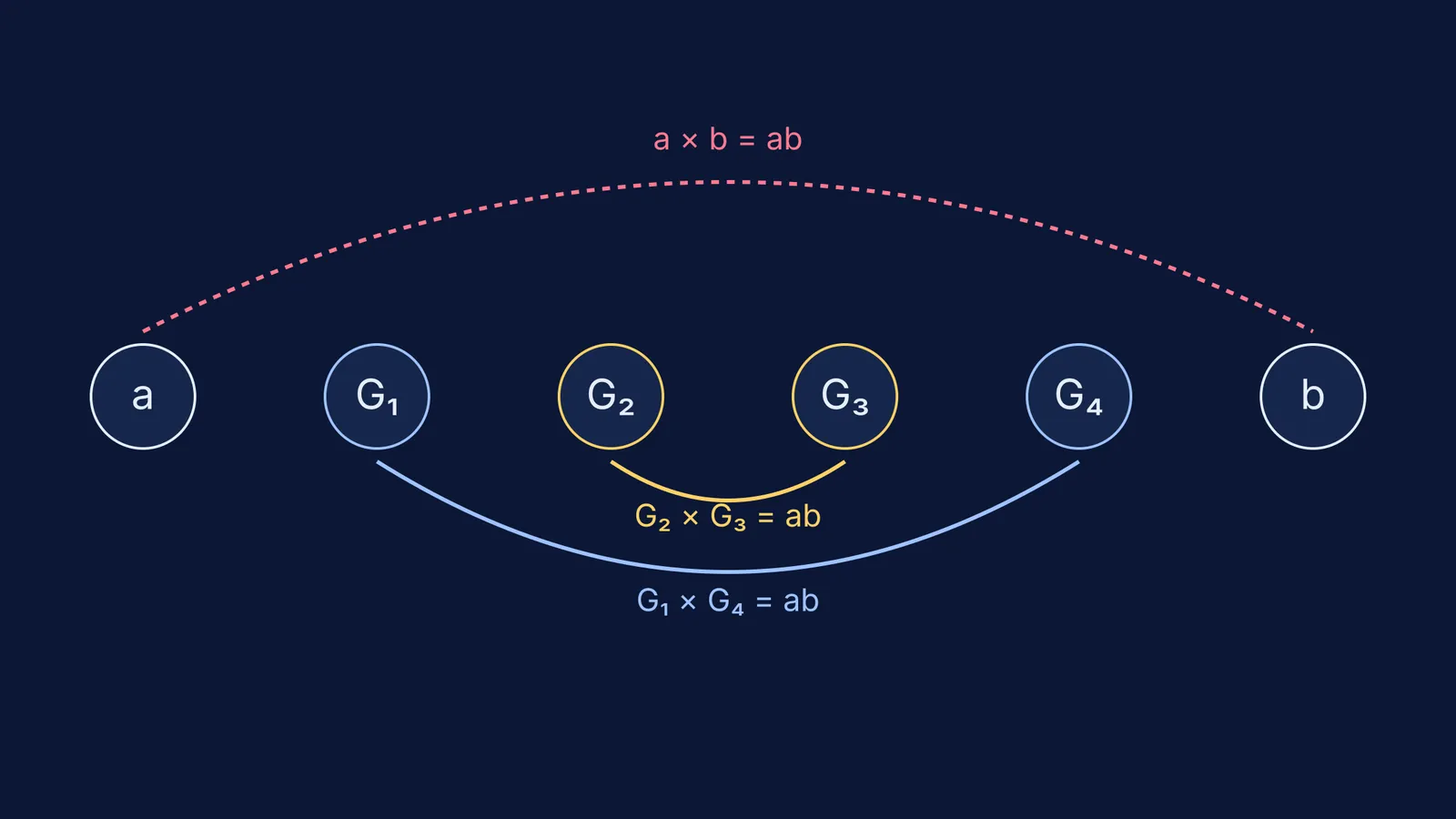
If we call the means G₁, G₂, ..., Gₙ, the full progression looks like this: a, G₁, G₂, ..., Gₙ, b
Because this is a geometric progression, each term is multiplied by a common ratio r to get the next. The single geometric mean between a and b is simply √ab.
Why is the product always (√ab)ⁿ?
To find the product of all n means (G₁ × G₂ × ... × Gₙ), we can use a property of geometric progressions: terms equidistant from the beginning and the end multiply to the same constant value.
Let's pair the means from the outside in:
The first mean and the last mean multiply to ab (G₁ × Gₙ = ab).
The second mean and the second-to-last mean also multiply to ab (G₂ × Gₙ₋₁ = ab).
If n is an even number, you get exactly n/2 pairs, each evaluating to ab. The total product is (ab) raised to the power of n/2, which can be rewritten as (√ab)ⁿ.
The partial product of a geometric progression is equivalent to taking the geometric mean of its first and last terms and raising it to the power of the number of terms (Wikipedia). Thus, the product of n geometric means between a and b is simply (√ab)ⁿ.
What is the arithmetic symmetry?
This rule is not an isolated trick; it mirrors the rule for arithmetic means.
If you insert n arithmetic means between a and b, their sum (A₁ + A₂ + ... + Aₙ) is exactly n times the single arithmetic mean. The sum of n arithmetic means is n(a + b)/2.
In mathematics, multiplication in a geometric progression corresponds to addition in an arithmetic progression.
Arithmetic: Sum = n × Single AM
Geometric: Product = (Single GM)ⁿ
If you understand the ratio of nth terms of two APs from the ratio of their sums, you will recognise this pattern of using the properties of the whole sequence to bypass finding individual terms.
A worked example
Let's apply the rule to a practical problem.
Question: Find the product of 5 geometric means inserted between 2 and 128.
Step 1: Find the single geometric mean The single geometric mean between 2 and 128 is √(2 × 128). √256 = 16
Step 2: Apply the product rule Since we are finding the product of 5 geometric means (n = 5), we raise the single geometric mean to the 5th power. Product = 16⁵ = 1,048,576
We found the product in seconds without needing to calculate the common ratio or the 5 individual terms (which are 4, 8, 16, 32, and 64). When you are revising your Binomial theorem for negative and fractional index or sequences, looking for symmetries like this saves time and reduces calculation errors.
If you want to practice problems like this and have the steps explained when you get stuck, the Fermi Problem Library provides a step-by-step solver that explains the reasoning rather than just printing an answer. For a deeper dive into the derivations, you can explore the progressions module in the Fermi Concept Library.


