

On this page
When you look at a triangular prism, which face is its base? If you answered "the rectangle it is resting on," you are not alone—and that is the exact trap that makes volume problems so difficult.
The formula for the volume of any uniform prism is beautifully simple: Volume = Base Area × Height (or V = B × h). But to use it correctly, you have to change how you see the shape.
What is the volume of a triangular prism formula?
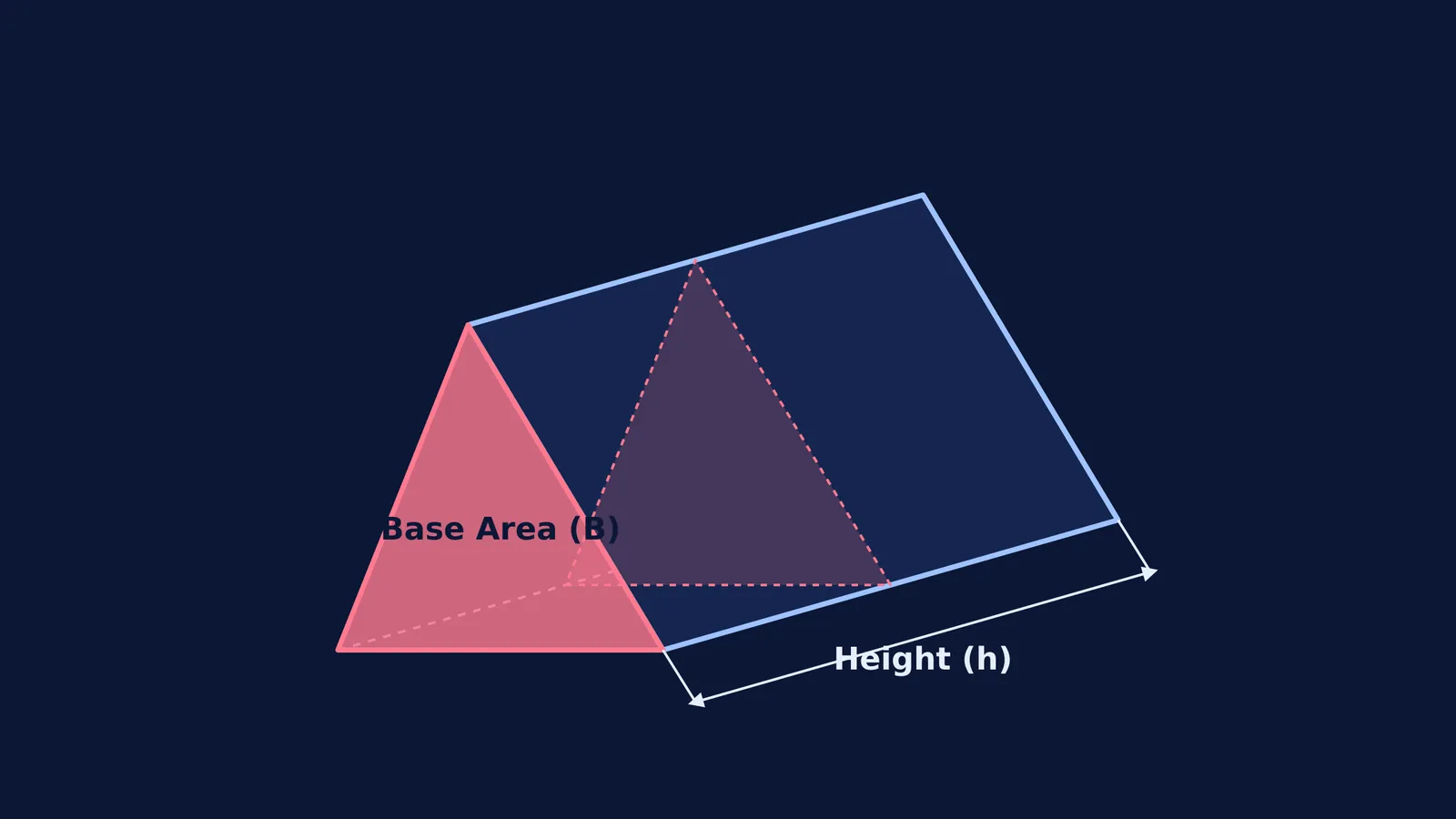
To find the volume of a triangular prism, you multiply the area of its triangular face by the length of the prism. In mathematics, the "Base" of a prism is not the face it happens to be sitting on. Instead, it is the uniform cross-section—the shape that stays exactly the same from one end of the prism to the other.
If you slice a triangular prism like a loaf of bread, every slice is an identical triangle. That triangle is the Base. Once you find its area (using ½ × base of triangle × height of triangle), you simply multiply it by how far that triangle has been stretched through space (the Height of the prism, h).
This rule is universal. If the cross-section is a hexagon, the volume is the area of that hexagon multiplied by the prism's length.
A worked example: calculating the volume
Let us put this method into practice. Imagine you have a triangular prism where the triangular face has a base of 6 cm and a height of 4 cm. The total length of the prism (how far it stretches back) is 15 cm.
First, ignore the 15 cm length and focus solely on the triangle. You calculate the Base Area (B) using the standard triangle formula, which is ½ × base × height. That gives ½ × 6 cm × 4 cm, resulting in 12 cm². This tells you that the 2D area of your "slice" is 12 square centimetres.
Next, you multiply this Base Area by the prism's length (h). You take your 12 cm² and multiply it by the 15 cm length. The final volume is 180 cm³. By keeping the 2D area calculation clearly separate from the 3D depth, you completely avoid the trap of multiplying all the numbers together blindly.
Why do so many students get prism volume wrong?
The confusion between the area of a flat face and the space inside a 3D object is a major hurdle in geometry. A 2016 study by researchers Sisman and Aksu found that approximately 50% of students struggle to coordinate more than two dimensions, often confusing surface area with volume. They simply add up the squares on the outside, missing the concept of filling the space entirely.
Many students fall back on multiplying every number they see—a habit picked up from the length × width × height rule for rectangular boxes. When faced with a triangular prism, they might multiply the edges of the triangle by the length, which does not yield the volume.
If you find yourself mixing up 2D and 3D formulas, the Fermi Concept Library is a strong place to build a better mental model. Instead of giving you a list of equations to memorise, Fermi's AI tutor teaches you how to reason through the geometry. If you use the wrong face as the base, the tutor will write on its board, draw the figure, and ask guiding questions until you spot the constant cross-section yourself.
How to picture area as a layer
The easiest way to stop making these errors is to think of the Base Area as a single, ultra-thin layer.
Imagine you cut a triangle out of a piece of paper. That paper has an area. Now, imagine stacking 500 identical paper triangles perfectly on top of one another. The stack becomes a solid 3D triangular prism. The area of one piece of paper is your Base Area (B), and the thickness of the entire stack is your Height (h).
This "layering" logic works regardless of how the prism is turned. Even if the triangular prism is lying on its side (so it looks like a tent), the "Height" in the formula is still the distance between the two triangular faces, not how tall the tent stands from the ground.
This layered thinking is a critical step for your spatial reasoning, especially when you move on to curved objects in Surface area and volume in Class 9: cones, spheres and hemispheres.
A checklist for finding the volume of any prism
Whether you are tackling a simple triangle or Combined solids in Class 10: surface area and volume, worked, follow this sequence to avoid the common traps:
Identify the uniform cross-section. Ignore how the prism is resting. Find the two identical, parallel faces.
Shade the base. Lightly shading this face on your exam paper prevents you from accidentally using one of the rectangular sides.
Calculate the Base Area (B). Use the 2D formula for that specific shape.
Identify the Height (h). This is always the straight-line distance connecting your two shaded bases.
Multiply them together. The volume is B × h, giving you a result in cubic units.


