

On this page
One method handles every V_A − V_B question. Choose a path from A to B, write down every change in potential on the way, and add them up. Then walk a different path and check that you get the same number.
What does potential difference between two points actually mean?
Electric potential is a property of a location, like height on a hill. The NCERT Class 12 chapter on Current Electricity states the loop rule in Section 3.12: "The algebraic sum of changes in potential around any closed loop involving resistors and cells in the loop is zero." NCERT's reason: potential depends on where a point is, so returning to the start means a total change of zero.
So V_A − V_B does not depend on the path, and any second path is a free check.
How do you add rises and drops across cells and resistors?
The sign rules in OpenStax University Physics, Volume 2 fit on four lines:
Crossing a resistor in the direction of the current: the potential falls by IR, so write −IR.
Crossing a resistor against the current: the potential rises by IR, so write +IR.
Crossing a cell from its negative to its positive terminal: write +ε.
Crossing a cell from its positive to its negative terminal: write −ε.
A real cell is an emf ε in series with an internal resistance r. NCERT gives the potential difference between its positive and negative terminals as V = ε − Ir when current flows through the cell from the negative to the positive terminal, and V = ε + Ir when it flows from positive to negative, as in a cell being charged (NCERT, Section 3.12). Treat r as one more resistor and you will not forget it.
A worked example: two cells facing each other
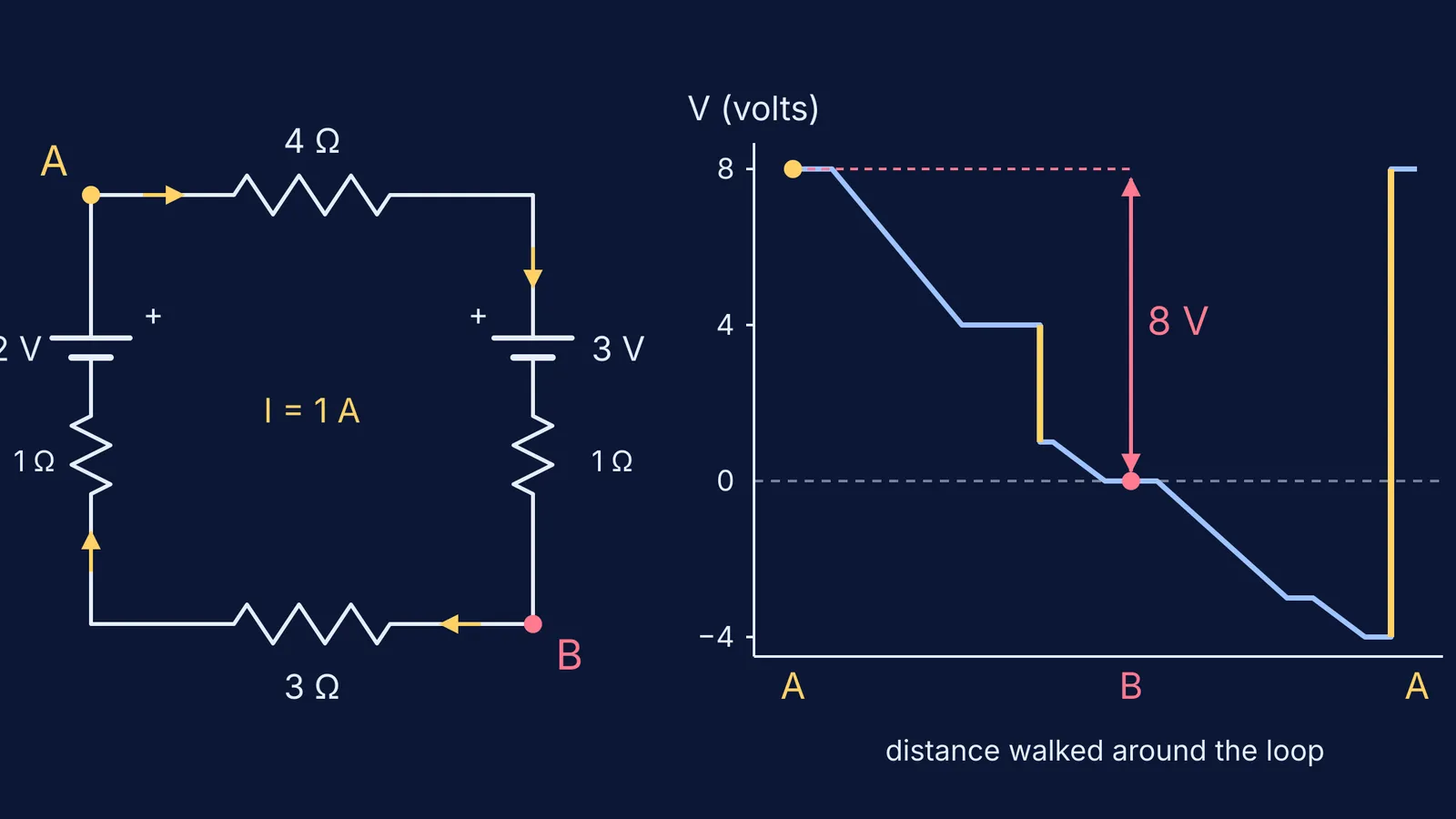
Take a single loop. On the left is a 12 V cell (internal resistance 1 Ω), positive terminal up, with A at the top-left corner. A 4 Ω resistor runs along the top. On the right is a 3 V cell (1 Ω), also positive up, with B at the bottom-right corner. A 3 Ω resistor runs along the bottom. Find V_A − V_B.
Find the current. The cells oppose each other, so the net emf is 12 − 3 = 9 V. The total resistance is 4 + 3 + 1 + 1 = 9 Ω. So I = 9/9 = 1 A, flowing clockwise because the 12 V cell wins.
Path 1, clockwise from A to B. Through the 4 Ω resistor with the current: −4 V. Into the 3 V cell from + to −: −3 V. Through its 1 Ω with the current: −1 V. Total: V_B − V_A = −8 V.
Path 2, anticlockwise from A to B. Down through the 12 V cell from + to −: −12 V. Through its 1 Ω against the current: +1 V. Along the bottom through the 3 Ω against the current: +3 V. Total: −12 + 1 + 3 = −8 V.
Both paths agree: V_A − V_B = 8 V, and A is at the higher potential. The 12 V cell's terminal voltage is 12 − 1 = 11 V, while the 3 V cell, being charged, shows 3 + 1 = 4 V. Our post on why terminal voltage is more than emf when a battery charges explains that second result.
How do you cross-check your answer by another path?
NCERT does this itself. After solving a three-loop network in Example 3.6, it confirms the currents by applying the loop rule to a loop it had not used and showing the drops add to zero (NCERT, Example 3.6). Build the same habit:
Write V_B − V_A for your first path, in symbols first.
Pick a path through the components you did not use.
If the answers differ, look for one sign error, usually a cell crossed the wrong way or a forgotten internal resistance.
If they agree, say which point is at the higher potential.
For longer networks, give every junction a potential, starting from a point set at 0 V, as in our guide to unbalanced capacitor bridges using node potentials.
Which sign mistakes should you watch for?
Using the current direction to decide the sign of an emf. Only the terminal order matters.
Dropping the internal resistance, which makes the terminal voltage equal to the emf.
Flipping a current that came out negative. NCERT says a negative I simply means the current flows opposite to your arrow, so keep the arrow and the minus sign in every later step.
Answering V_B − V_A when the question asked for V_A − V_B.
If your signs still slip, practise on worked circuits. The Fermi Problem Library has a step-by-step solver that explains the reasoning rather than printing an answer, so you can compare each rise and drop with yours. If Kirchhoff's rules feel shaky, start with the lesson in the Fermi Concept Library, then walk the loop again.


