

On this page
You learnt V = ε − Ir in the cells chapter. Then a board question says a battery is "being charged", and the answer comes out bigger than the emf. Nothing has gone wrong: the current has changed direction, and so has the sign of Ir.
Why is terminal voltage more than emf while charging?
The emf ε is the energy the cell's chemistry gives each coulomb moving from its negative to its positive terminal. The internal resistance r takes energy from every coulomb, whichever way it goes.
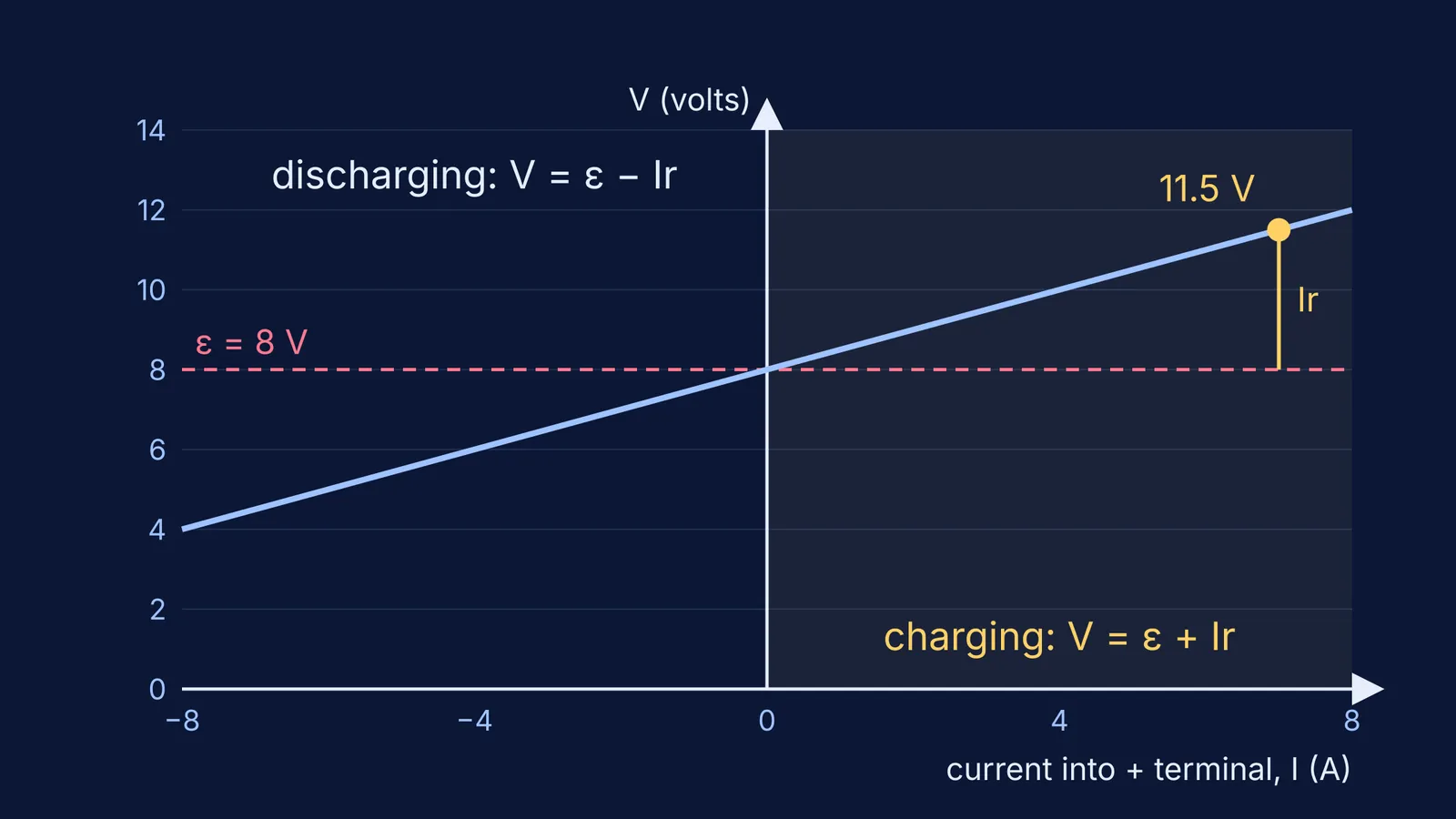
When the cell drives a circuit, current flows inside it from the negative terminal N to the positive terminal P, and the NCERT Class 12 physics textbook, Chapter 3 writes the terminal voltage as V = V(P) − V(N) = ε − Ir.
When a charger forces current the other way, in at P and out at N, it has to push against the emf and also pay for the drop across r. The same NCERT chapter (section 3.12) says that if the current goes through the cell from P to N, then V = ε + Ir, its Eq. (3.60). OpenStax University Physics Volume 2 puts it from the charger's side: its output "must be greater than the emf of the battery to reverse the current through it".
One sign rule covers both cases: in V = ε − Ir, count I positive when current leaves the positive terminal. Charging makes I negative, and the minus becomes a plus.
If loop signs feel shaky, read our guide to Kirchhoff's sign conventions.
How do you solve NCERT's battery charging question?
Exercise 3.8 in the NCERT Current Electricity chapter gives a storage battery of emf 8.0 V and internal resistance 0.5 Ω, charged by a 120 V dc supply through a series resistor of 15.5 Ω. It asks for the terminal voltage while charging and the purpose of the resistor.
Draw the loop. For charging, positive meets positive, so the two emfs oppose.
Net emf driving the current: 120 − 8 = 112 V.
Total resistance: 15.5 + 0.5 = 16 Ω.
Current: I = 112 ÷ 16 = 7 A, entering the battery at its positive terminal.
Terminal voltage: V = ε + Ir = 8 + 7 × 0.5 = 11.5 V.
Check round the loop: the resistor drops 7 × 15.5 = 108.5 V, and 108.5 + 11.5 = 120 V.
The resistor limits the current. Take it out and the same steps give 112 ÷ 0.5 = 224 A through the battery, with I²r of about 25 kW turned to heat inside it.
To practise the same steps on fresh numbers, the Fermi Problem Library has worked problems with a step-by-step solver that explains the reasoning rather than printing an answer.
Where does the power go while a battery charges?
The usual follow-up asks about power. Multiply each voltage by the 7 A current from NCERT Exercise 3.8:
Power from the supply: 120 × 7 = 840 W.
Power stored as chemical energy: εI = 8 × 7 = 56 W.
Heat in the internal resistance: I²r = 49 × 0.5 = 24.5 W.
Heat in the series resistor: I²R = 49 × 15.5 = 759.5 W.
The last three add up to 840 W, which is your check. Power entering the battery's terminals is VI = 11.5 × 7 = 80.5 W, of which 56 W is stored, so efficiency at the terminals is ε ÷ V = 8 ÷ 11.5, about 70%. From the supply it is 56 ÷ 840, under 7%: the resistor protects the battery by wasting most of the power.
For the discharging side, including maximum power to a load, see our post on cells, emf and internal resistance.
How long does a battery take to charge?
Charge delivered equals current × time, so t = Q ÷ I. Battery capacity is usually quoted in ampere-hours, and 1 Ah = 3600 C.
Suppose the question adds that the battery in NCERT Exercise 3.8 needs 14 Ah, a value we have assumed. Then:
Time: t = 14 Ah ÷ 7 A = 2 h.
Energy stored: εQ = 8 V × 14 Ah = 112 Wh, or 8 × 14 × 3600 = 403,200 J.
Heat in the internal resistance: 24.5 W × 2 h = 49 Wh.
This is the idealised exam picture with fixed ε and r. OpenStax notes that a battery's internal resistance increases as it is depleted. If emf, internal resistance and Kirchhoff's rules still feel like three separate topics, the Fermi Concept Library gives each concept its own lesson and its place in the map. For the history, read about Gaston Planté and the lead battery that could be recharged.


