

On this page
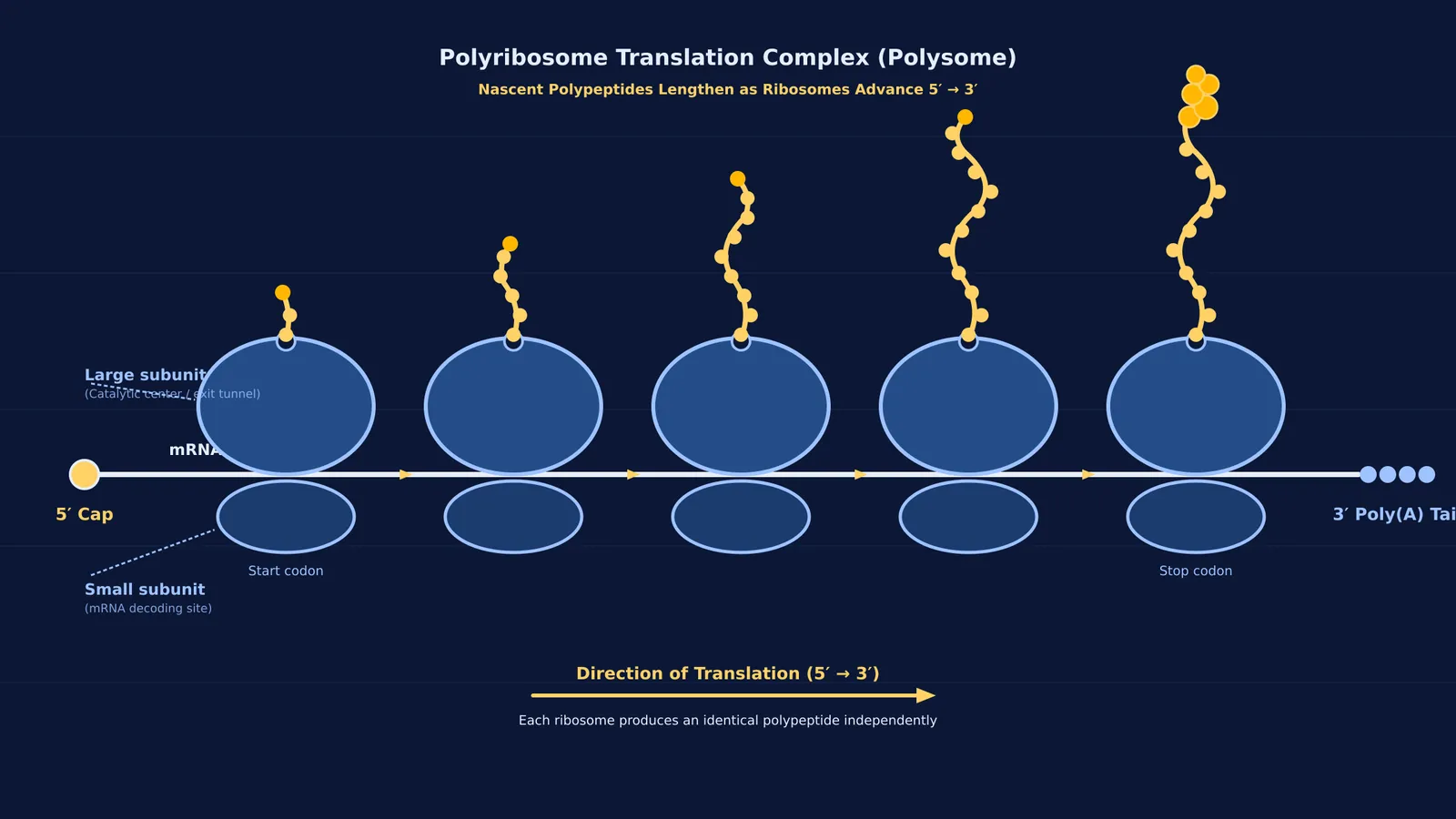
When a living cell requires an enzyme, waiting for one ribosome to read an entire messenger RNA transcript before another can start would stall biochemical pathways. A polysome, or polyribosome, is an assembly where multiple ribosomes bind a single mRNA strand simultaneously, translating in the 5′-to-3′ direction to produce multiple copies of the same polypeptide. In rabbit reticulocytes synthesizing hemoglobin, Jonathan Warner, Paul Knopf, and Alexander Rich showed in their 1963 PNAS study that protein synthesis occurs primarily on clusters of 4 to 6 ribosomes held together by an RNA strand rather than on isolated single ribosomes.
Translation begins when a small ribosomal subunit binds an mRNA's 5′ untranslated region, identifies the start codon, recruits the large subunit, and begins elongating the polypeptide chain. Once that ribosome moves roughly 30 codons downstream, the start site clears. Another ribosome can assemble immediately behind it. High-resolution ribosome profiling by Nicholas Ingolia and colleagues in their 2009 Science study revealed that an active ribosome protects approximately 28 to 30 nucleotides of mRNA from enzymatic cleavage. This compact footprint lets ribosomes pack closely along the transcript without colliding, creating a continuous assembly line.
If you are mapping out how ribosomes coordinate protein synthesis, the Fermi Concept Library has every concept in biology, each with its own lesson and its place in the map.
Why does polysome translation speed up protein production?
Many students studying the molecular basis of inheritance assume that a polysome speeds up translation by making individual ribosomes travel faster along the transcript. That is a misconception. Ribosomal elongation speed remains unchanged. In eukaryotic cells, a single ribosome translates at roughly 3 to 8 amino acids per second, as established in ribosome profiling studies led by Nicholas Ingolia and colleagues in their 2009 Science study. Polysomes accelerate protein synthesis by multiplying the production rate—the number of completed proteins released per minute—rather than reducing the transit time of any single ribosome.
A worked comparison demonstrates this difference in output:
Assume an mRNA transcript encodes a typical protein containing 300 amino acids.
At a eukaryotic elongation speed of 5 amino acids per second, one ribosome requires 60 seconds of transit time to travel from the start codon to the stop codon.
If only one ribosome translated the transcript at a time, completing 1 protein molecule would take 60 seconds. In a 5-minute interval (300 seconds), it would produce at most 5 completed protein molecules.
In a polysome where ribosomes initiate every 6 seconds, spaced roughly 30 codons apart along the mRNA, the first ribosome finishes at 60 seconds. Each subsequent ribosome then finishes every 6 seconds.
Over the remaining 240 seconds of that 5-minute window, 40 additional ribosomes release completed polypeptides, yielding 41 completed protein molecules from the same transcript.
This output is vital because mRNA molecules degrade quickly. A global decay analysis by Jonathan Bernstein and colleagues in their 2002 PNAS study found that approximately 80% of *Escherichia coli* mRNAs have half-lives between 3 and 8 minutes. Producing dozens of protein copies from a single transcript before it breaks down maximizes the cellular return on transcription.
When working through quantitative problems on translation rates, the Fermi Problem Library offers worked problems with a step-by-step solver that explains the reasoning rather than printing an answer.
How are polyribosomes organized inside living cells?
Polyribosomes are far more organized than simple beads on a string. In bacterial cells, cryo-electron tomography by Florian Brandt and colleagues in their 2009 Cell study showed that ribosomes adopt ordered pseudohelical and planar configurations. This arrangement aligns the mRNA exit site of one ribosome with the entry channel of the next while pointing polypeptide exit tunnels outward so emerging chains can fold without tangling.
In eukaryotic cells, polysomes frequently adopt circular configurations. As shown by Sandra Wells and colleagues in their 1998 Molecular Cell study80122-7), initiation factors eIF4E and eIF4G bind simultaneously to the 5′ cap and poly(A)-binding protein on the 3′ tail. This protein bridge bends the mRNA into a closed loop. When a ribosome finishes translation, its released subunits remain close to the 5′ cap, facilitating immediate re-initiation on the same transcript.
In bacteria, polysomes form while mRNA is still being synthesized. Because bacteria lack a nucleus, translation couples directly to transcription. In their classic 1970 Science study, Oscar Miller, Barbara Hamkalo, and C. A. Thomas Jr. published electron micrographs showing polyribosomes actively translating nascent mRNA chains while RNA polymerase was still copying the DNA template.
When exploring molecular mechanisms where you are unsure where to begin, Fermi's AI tutor works out what you already know, builds a plan for the session, draws the figure, and checks understanding as it goes.
What do NEET and board exams ask about polyribosomes?
In CBSE Class 12 biology and the NEET-UG entrance exam, polyribosomes connect George Palade's discovery of ribosomes to the mechanics of the genetic code and translation.
Entrance examinations frequently test these core concepts:
Direction and polarity: Ribosomes move along mRNA strictly in the 5′-to-3′ direction.
Identical products: All ribosomes on a polysome produce identical polypeptides because they translate the same mRNA sequence.
Chain lengths: Polypeptides near the 5′ end are short, while those near the 3′ end are near full length.
Coupled translation: Bacteria translate nascent mRNA during transcription; eukaryotes separate nuclear transcription from cytoplasmic translation.
Biological purpose: Polysomes maximize protein synthesis from unstable mRNA transcripts before cellular enzymes degrade them.
Mastering these distinctions helps you navigate both factual and assertion-reason questions with precision.


