

On this page
A standard coordinate geometry question gives you a line and two points and asks whether they sit on the same side. You do not need a graph, just one substitution per point and a look at the signs.
How do you check if two points are on the same side of a line?
A line divides the plane into two half-planes, and a strict linear inequality such as ax + by + c > 0 describes one of them (Half-space, Wikipedia)). So every point off the line makes ax + by + c either positive or negative, and the sign tells you the side.
Write the line as L(x, y) = ax + by + c = 0, with every term on one side.
Substitute the first point (x1, y1) to get L1 = ax1 + by1 + c.
Substitute the second point (x2, y2) to get L2.
Compare signs: L1 × L2 > 0 means the same side, L1 × L2 < 0 means opposite sides, and a zero means that point lies on the line.
Why does the sign of ax + by + c decide the side?
Walk from P to Q. Because L is linear, its value changes steadily from L1 to L2. If the signs differ, L passes through zero, so the segment crosses the line. If they match, it never does.
The section formula makes this exact. If the line meets PQ at the point dividing it in the ratio k : 1, that point is ((x1 + kx2)/(k + 1), (y1 + ky2)/(k + 1)). Putting it into L gives L1 + kL2 = 0, so k = -L1/L2.
Worked example: the line 2x + 3y - 6 = 0
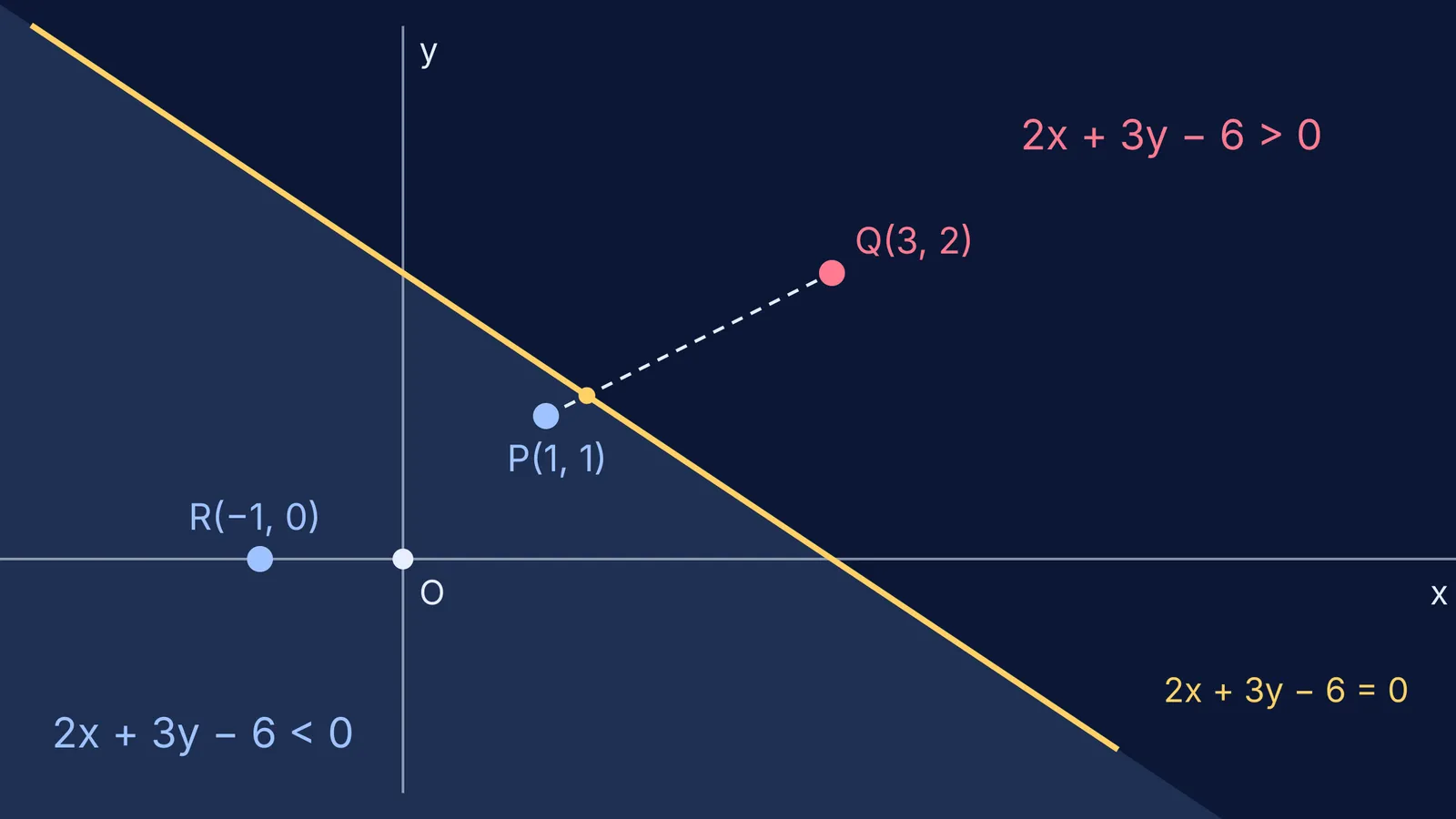
Take P(1, 1), Q(3, 2) and R(-1, 0), and let L = 2x + 3y - 6.
L(P) = 2 + 3 - 6 = -1
L(Q) = 6 + 6 - 6 = 6
L(R) = -2 + 0 - 6 = -8
P and R are both negative, so they are on the same side. Q is positive, so the line runs between P and Q.
The ratio check agrees: k = -(-1)/6 = 1/6, so the line cuts PQ internally in the ratio 1 : 6, at (9/7, 8/7). Check: 2(9/7) + 3(8/7) = 42/7 = 6, so that point is on the line.
What is the origin side test for linear inequalities?
Substituting (0, 0) into ax + by + c leaves just c, so the origin is the quickest test point. Here L(0, 0) = -6, so P and R are on the origin side and Q is not. To shade ax + by + c < 0, shade the origin side if c is negative and the other side if c is positive.
NCERT's Class 12 Linear Programming chapter describes the feasible region as the points common to all the half-planes set by the constraints (NCERT Class 12 Mathematics, Chapter 12). Its furniture-dealer example uses 5x + y ≤ 100, x + y ≤ 60, x ≥ 0 and y ≥ 0, and names (10, 50) a feasible solution and (25, 40) an infeasible one.
Confirm both in seconds: (10, 50) gives 100 and 60, both allowed, while (25, 40) gives 5(25) + 40 = 165, which breaks the first constraint.
For the next step, see how to find the area of a region defined by inequalities and how to tell whether a linear programming region is unbounded with the open half-plane test.
Where do students lose marks on this?
Skipping the rearrangement. For 2x + 3y = 6, test 2x + 3y - 6, not 2x + 3y.
Forgetting to flip the sign. Multiplying both sides of an inequality by a negative number reverses it, as Rule 2 in NCERT Class 11 Mathematics, Chapter 5 states. So -2x - 3y + 6 > 0 becomes 2x + 3y - 6 < 0.
Mixing strict and non-strict inequalities. A strict inequality gives an open half-plane; a non-strict one adds the line itself (Half-space, Wikipedia)). Draw the boundary dashed for < and >, solid for ≤ and ≥.
Comparing sizes instead of signs. L = -1 and L = -8 are on the same side. The size only gives the distance from the line, |L|/√(a² + b²).
The same sign idea also picks out which angle bisector of two lines contains the origin.
If a step in a problem like this goes wrong and you cannot see why, the Fermi Problem Library has worked problems with a step-by-step solver that explains the reasoning rather than printing an answer.


