

On this page
A question like "find the area of the region {(x, y) : |x| + |y| ≤ 1}" looks as if it needs calculus. Usually it does not. Many such questions in Class 12 and JEE Main come down to three moves: sketch the boundary, use symmetry, and integrate only the part that is not a standard shape.
What does |x| + |y| ≤ 1 look like?
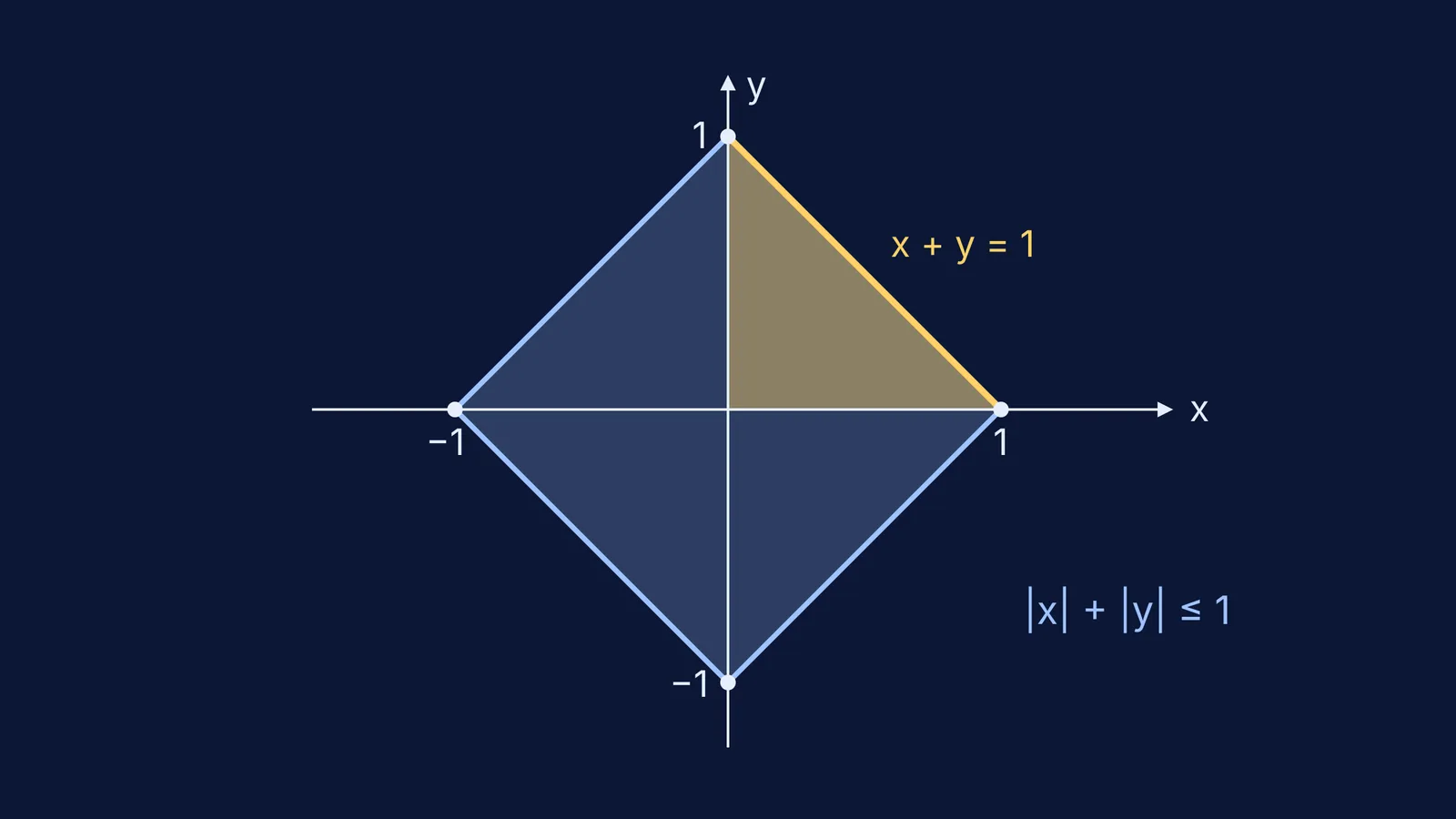
Start in the first quadrant, where x ≥ 0 and y ≥ 0. There the modulus signs drop away and the inequality becomes x + y ≤ 1. That is a triangle with vertices (0, 0), (1, 0) and (0, 1), and its area is ½.
Replacing x by −x leaves the inequality unchanged, so the region mirrors itself in the y-axis. Replacing y by −y does the same for the x-axis. So the four quadrants hold four copies of that triangle, forming a square standing on a corner. The area is 4 × ½ = 2. As a check, the diagonals are both 2, and a rhombus has area (d₁ × d₂)/2 = 2.
The same reasoning gives general results:
|x| + |y| ≤ a has area 2a².
|x|/a + |y|/b ≤ 1 is a rhombus with diagonals 2a and 2b, area 2ab.
|x − h| + |y − k| ≤ a is the same square moved to centre (h, k), so its area does not change.
If the modulus case-split feels slow, see equations and inequalities with modulus and graph transformations for JEE.
How do you sketch a region from inequalities?
Use these five steps:
Replace each ≤ or ≥ by = and draw the boundaries. Solve them together to find where they meet.
Test a point off the boundary, usually the origin. If it satisfies every inequality, shade its side.
Check symmetry by substitution: x → −x unchanged means symmetric about the y-axis; y → −y, the x-axis; swapping x and y, the line y = x.
Name the shape. Triangles, rhombi, sectors, segments and ellipses (area πab) have formulas.
Integrate only what is left, with strips chosen so one formula covers the whole piece.
Which regions can you find without integrating?
Many hard-looking regions are standard shapes:
|x + y| + |x − y| ≤ 2. Since |x + y| + |x − y| = 2 × max(|x|, |y|), this is a square of side 2, area 4.
x² + y² ≤ 1 and |x| + |y| ≥ 1. The unit disc minus the square: π − 2.
x² + y² ≤ 1 ≤ x + y. A quarter disc minus a triangle: π/4 − ½, one of the four pieces above.
The CBSE mathematics syllabus for 2025-26 describes the Class 12 chapter as "Applications in finding the area under simple curves, especially lines, circles/ parabolas/ellipses (in standard form only)", and gives the Calculus unit 35 of the paper's 80 marks.
When do you actually need an integral?
You need one when a boundary is curved and the piece is not a sector, segment or ellipse. Worked example: find the area of {(x, y) : x² ≤ y ≤ 2 − |x|}.
Boundaries: the parabola y = x² and the V-shape y = 2 − |x|, peaking at (0, 2).
Test (0, 1): 0 ≤ 1 ≤ 2 is true, so the region lies between the curves.
Symmetry: x → −x changes nothing, so double the right half.
For x ≥ 0, x² = 2 − x gives (x + 2)(x − 1) = 0, so they meet at (1, 1).
The right half is ∫₀¹ (2 − x − x²) dx = 2 − ½ − ⅓ = 7/6, so the total is 7/3.
Check by splitting at y = 1: above it is a triangle with vertices (−1, 1), (1, 1) and (0, 2), area 1; below it, ∫ from −1 to 1 of (1 − x²) dx = 4/3. That makes 7/3 again.
Horizontal strips would need two integrals here, because the side edges change at y = 1. For regions where they help, see area using horizontal strips.
What if your limits keep coming out wrong?
Usually the sketch is at fault, not the integration. Redraw, mark every meeting point, and write the top and bottom curve beside the strip before integrating. To practise the set-up, the Fermi Problem Library has worked problems with a step-by-step solver that explains the reasoning rather than printing an answer. If modulus graphs or conics are the weak spot, the Fermi Concept Library gives each concept its own lesson and its place in the map.
Try one tonight: find the area of |x| + 2|y| ≤ 4, then check it against 2ab.


