

On this page
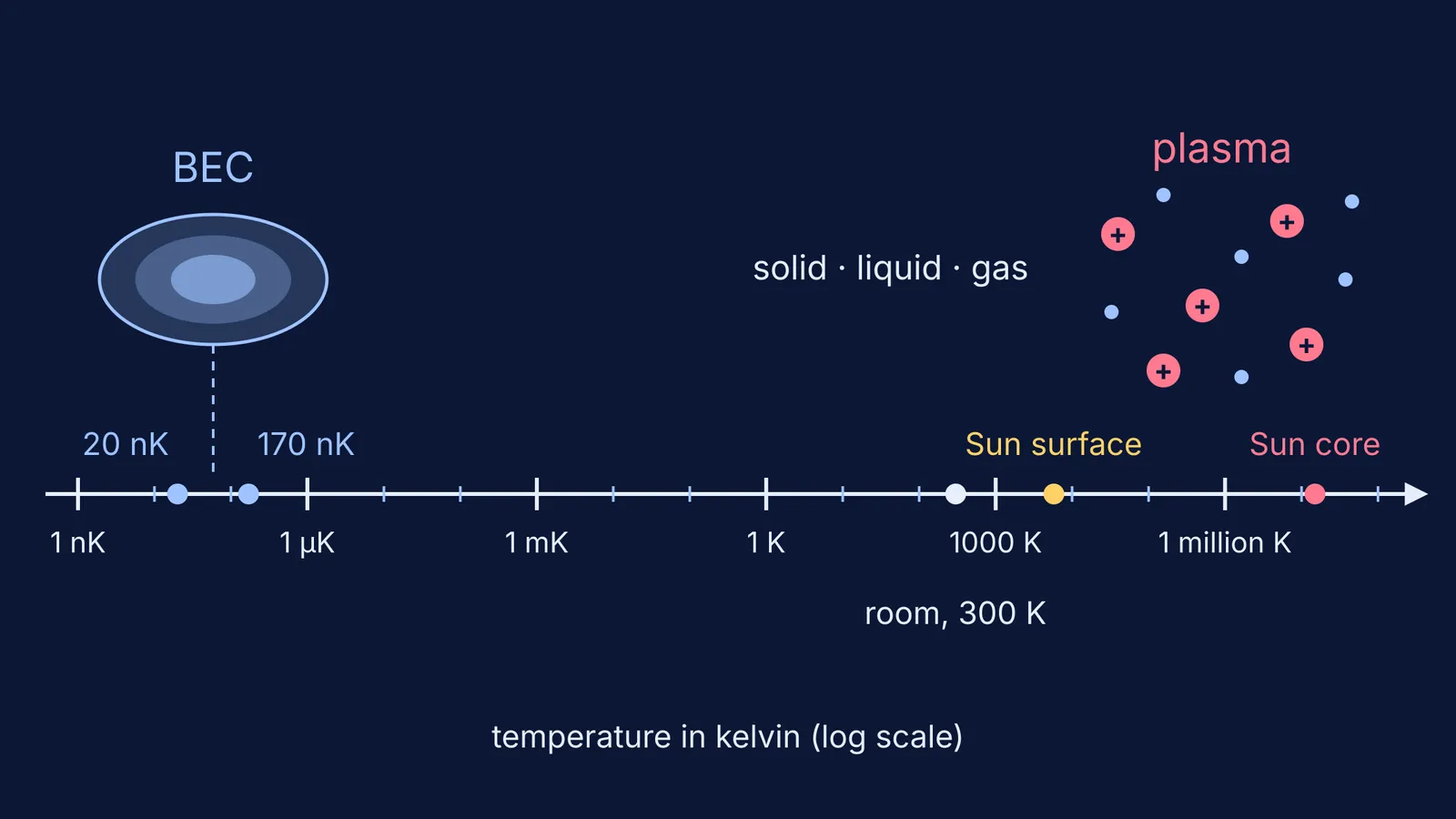
At school you learn three states of matter: solid, liquid and gas. Physics adds two more, one at each end of the temperature scale. Heat a gas hard enough and it becomes plasma. Cool a gas of the right atoms to a whisker above absolute zero and it becomes a Bose-Einstein condensate (BEC). Both test whether you really understand kinetic theory and matter waves.
What is plasma, the fourth state of matter?
Plasma is superheated matter, so hot that electrons are ripped away from atoms, forming an ionised gas (MIT Plasma Science and Fusion Center). What is left is a mix of free electrons and positive ions, and because they carry charge, researchers can hold plasma in place with magnetic fields.
You have seen plasma more often than you think. Lightning is plasma, so are the neon signs along city streets, and so is the Sun (MIT PSFC). In a neon sign, electricity running through the low-pressure gas in the tube keeps part of it ionised, and the glow is that plasma giving off light. Read how it was invented in Georges Claude and neon lighting.
The Sun is made of super-hot, electrically charged gas called plasma, with a core of about 15 million degrees Celsius and a surface of about 5,500 degrees Celsius (NASA). Plasma makes up over 99% of the visible universe (MIT PSFC).
What is a Bose-Einstein condensate?
In 1924 the Indian physicist Satyendra Nath Bose made important calculations about particles of light and sent them to Einstein, who extended the theory to a certain type of atom (Nobel Prize press release, 2001). Einstein predicted that if a gas of such atoms were cooled to a very low temperature, all the atoms would suddenly gather in the lowest possible energy state. More in our profile of Satyendra Nath Bose.
It took about 70 years to make one. In 1995 a team led by Eric Cornell and Carl Wieman saw a condensate first appear in a vapour of rubidium-87 atoms near 170 nanokelvin, at a density of 2.5 × 10¹² atoms per cubic centimetre (Anderson et al., Science, 1995). They then produced a pure condensate of about 2,000 rubidium atoms at 20 nanokelvin, that is 0.000 000 02 degrees above absolute zero (Nobel Prize press release). Wolfgang Ketterle did matching work with sodium; the three shared the 2001 Nobel Prize in Physics. How they did it: Cornell, Wieman and the first condensate.
Ketterle, a physics professor at MIT, explains the key idea simply: "When the temperature is sufficiently low and the de Broglie wavelength of the atoms becomes comparable to the distance between atoms, then almost all the atoms occupy a single quantum state. They become one giant matter wave all oscillating in phase" (Ketterle, MIT Physics Annual 2001).
Why does cooling atoms make them act as one?
You can check Ketterle's condition yourself with two Class 11-12 formulas: the de Broglie wavelength λ = h/mv, and the root-mean-square speed from kinetic theory, v = √(3kT/m). The constants are h = 6.626 × 10⁻³⁴ J s (NIST), k = 1.381 × 10⁻²³ J/K (NIST) and 1 u = 1.661 × 10⁻²⁷ kg (NIST), so a rubidium-87 atom has m ≈ 87 u ≈ 1.445 × 10⁻²⁵ kg.
At room temperature (300 K): v = √(3kT/m) ≈ 293 m/s, so λ = h/mv ≈ 1.6 × 10⁻¹¹ m. As Ketterle notes, that is smaller than the atom itself.
At 170 nK, the temperature is about 1.8 billion times lower. Speed goes as √T, so v drops about 42,000 times, to roughly 7 mm/s.
λ grows by the same factor: λ ≈ 6.6 × 10⁻⁷ m, or about 0.66 micrometres.
The gap between atoms is roughly d ≈ n^(−1/3). With n = 2.5 × 10¹⁸ per cubic metre (the 1995 density from Anderson et al.), d ≈ 7.4 × 10⁻⁷ m, about 0.74 micrometres.
Compare: λ ≈ 0.66 µm and d ≈ 0.74 µm. Neighbouring matter waves overlap, just as Ketterle describes.
This is an order-of-magnitude check, not the exact criterion, but it shows why nanokelvin temperatures are needed: slower atoms have longer waves.
If the de Broglie step felt shaky, the Fermi Concept Library covers every concept in physics and chemistry, each with its own lesson and its place in the map.
How do plasma and a Bose-Einstein condensate differ?
Temperature: plasma is the hot extreme; a BEC sits at billionths of a kelvin (Nobel Prize press release).
Atoms: plasma tears them into ions and free electrons; a BEC keeps them whole but in one shared state.
Where you meet it: plasma in lightning, neon signs and the Sun; a BEC only in specialised laboratories.
Physics you need: ionisation and charge for plasma; kinetic theory and de Broglie waves for a BEC.
To practise, try redoing the worked example for sodium atoms. For more practice, the Fermi Problem Library has worked problems with a step-by-step solver that explains the reasoning rather than printing an answer.


