

On this page
In December 1910, visitors to the Paris Motor Show saw two glowing red tubes, each 12 metres long. Their maker, French engineer Georges Claude, had found a use for a gas his air liquefaction business already produced as a by-product. That gas was neon.
Who was Georges Claude and what did he show in 1910?
Georges Claude (1870–1960) was a Paris-born engineer who devised the Claude system for liquefying air in 1902 and, with businessman Paul Delorme, founded Air Liquide, according to his Wikipedia biography. His first French patent filing for neon lighting was on 7 March 1910, and his first public demonstration of a large neon light was at the Paris Motor Show, 3–18 December 1910 (same source).
The two tubes were 12 metres long and bright red, and the demonstration lit a peristyle (a row of columns) of the Grand Palais (Neon lighting, Wikipedia). Glowing gas tubes were not new: Moore tubes, filled with nitrogen or carbon dioxide, had some commercial success in the US in the early 1900s (same source). What was new was a sealed neon tube that kept glowing.
A full account includes his later life too: in 1945 Claude was convicted of propaganda work favouring collaboration with Nazi Germany, and he was released in 1950 (Wikipedia).
Why did Claude have spare neon?
William Ramsay and Morris Travers discovered neon in London in 1898 by chilling air until it became liquid, then warming it and catching the gases as they boiled off (Neon, Wikipedia). After 1902, Air Liquide produced neon in industrial quantities as a by-product of its air liquefaction business (same source).
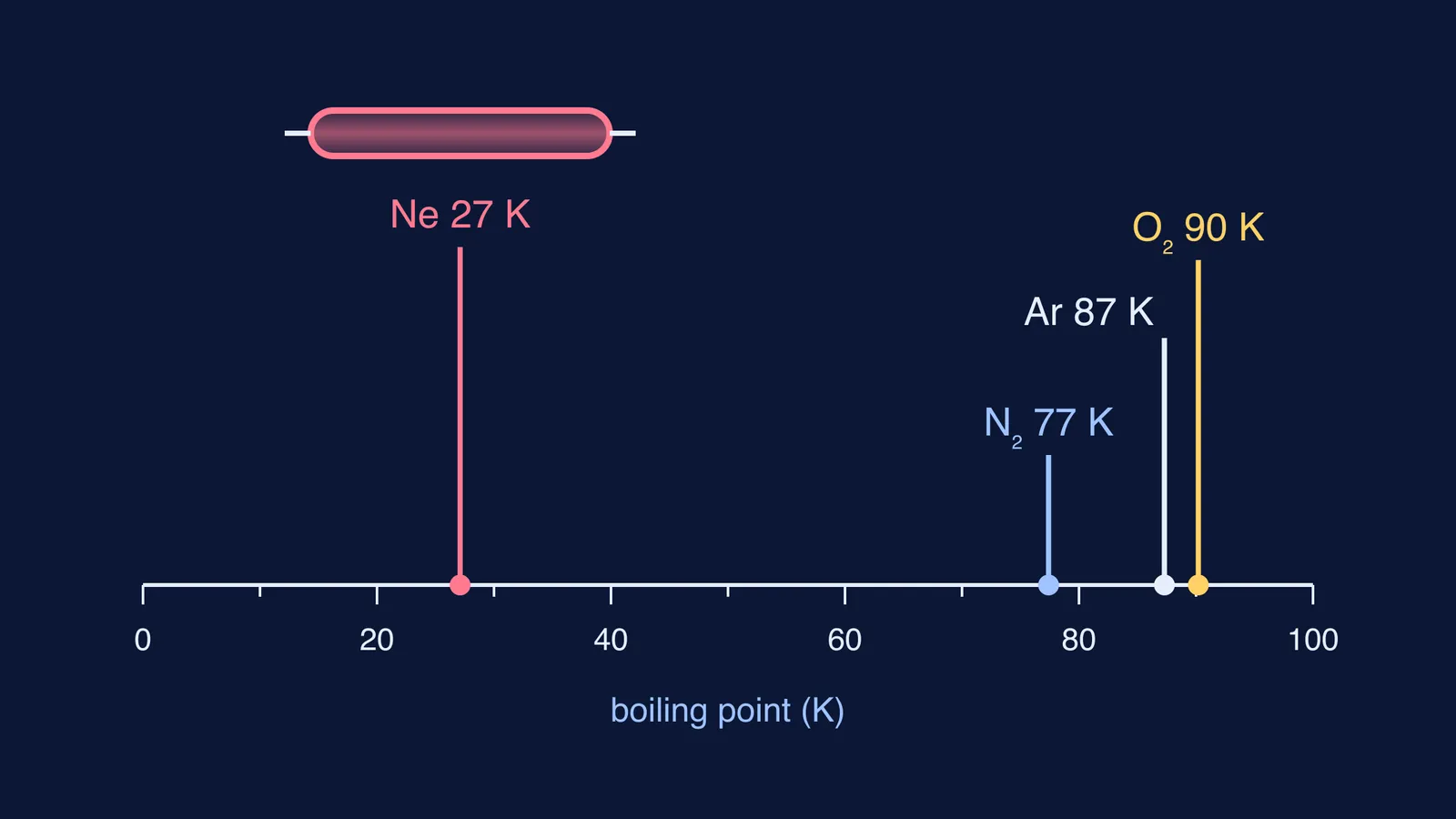
The reason is boiling points. Neon boils at 27.1 K (−246 °C) (Neon). Nitrogen boils at 77.4 K, argon at 87.3 K and oxygen at 90.2 K (Air separation, Wikipedia). So when air is cold enough for nitrogen and oxygen to be liquid, neon is still a gas and can be drawn off. Distilling air is still the only viable source of neon (same source). Our post on how gases are separated from air by fractional distillation walks through the column step by step.
Worked example: how much air holds one litre of neon?
Dry air is 18.2 parts per million neon by volume (Atmosphere of Earth, Wikipedia).
Write the fraction: 18.2 ppm = 18.2 / 1,000,000.
Air needed for 1 litre of neon = 1,000,000 ÷ 18.2 litres.
That is about 55,000 litres, or 55 cubic metres, matching the "1 part in 55,000" figure in the Neon article.
Nobody would liquefy 55 cubic metres of air just for one litre of neon. But a plant already liquefying air for oxygen and nitrogen can collect it as a by-product.
How did Claude make the neon lamp last?
The hard part was the electrodes, the metal ends that carry current into the tube. In his US patent, filed on 9 November 1911 and granted on 19 January 1915, Claude wrote that with electrodes that were too small, "the neon disappears somewhat rapidly, the resistance of the tube increases and after some score hours it becomes extinguished" (US patent 1,125,476).
His fix was size: the patent sets the electrode area at a minimum of 1.5 square decimetres per ampere (same patent). Purity mattered too. The patent notes that traces of other gases, "particularly of nitrogen", greatly weaken neon's properties, and it recalls his method of purifying the gas with charcoal cooled in liquid air, which absorbs the impurities (US 1,125,476).
Even Claude was not fully happy with the colour. The patent says neon's light "leaves something to be desired owing to its orange tint partaking too much of a red" (same patent).
Why does neon glow red?
When current passes through the gas, electrons hit neon atoms and push them to higher energy levels. As the atoms fall back, each gives off light only at its own fixed wavelengths, and for neon the result is a bright reddish-orange light (Neon, Wikipedia). Our explainer on emission and absorption spectra shows why each element has its own lines. If that is easier to see than to read, the Fermi Simulation Lab has interactive simulations for ideas like this.
What can you learn from Claude's neon lamp?
This one story links three school chemistry topics: separating gases, noble gases and atomic spectra. A quick checklist:
Source: fractional distillation of liquid air.
Reason: neon boils far below nitrogen and oxygen, so it stays a gas.
Scale: 18.2 ppm, about 1 part in 55,000 (Neon, Wikipedia).
Glow: excited atoms emit light only at fixed wavelengths.
Engineering: electrodes wore out, fixed with larger electrodes and purer gas.
For the cooling side of the story, read about Carl von Linde and the liquefaction of air. If noble gases still feel shaky, the Fermi Concept Library gives each concept its own lesson and shows its place in the map.
Next time a red sign glows, think of it as distilled air: the small part a factory had left over.


