

On this page
Three points that are not on one line fix exactly one plane. Below we work one example, A(3, 2, 0), B(0, 2, 1) and C(3, 0, 1), several ways, so you can see how the methods connect and pick the quickest one in an exam.
What do you need to check before you start?
Find two edge vectors from the same point: AB = (−3, 0, 1) and AC = (0, −2, 1). If AB × AC is the zero vector, the points are collinear and infinitely many planes pass through them. Here it is not zero, so there is exactly one plane.
How do you find the plane with the normal-vector method?
A plane is fixed by one point on it and a normal vector n = (a, b, c), and its scalar equation is a(x − x₀) + b(y − y₀) + c(z − z₀) = 0, as set out in OpenStax Calculus Volume 3, section 2.5. Both edge vectors lie in the plane, so their cross product is perpendicular to it. The book's Example 2.49 finds a normal the same way, by crossing two vectors that lie in the plane.
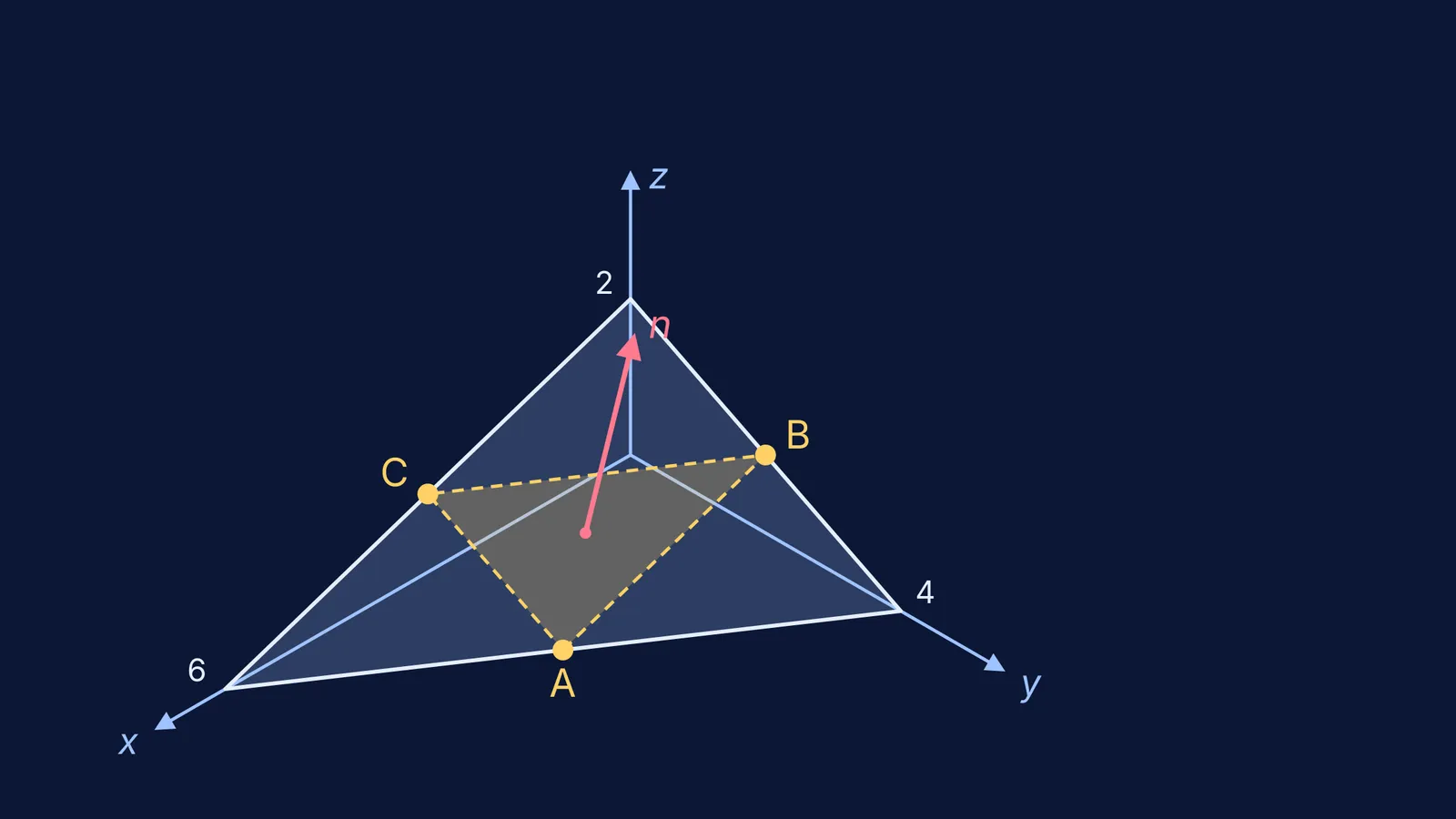
Normal: n = AB × AC = (0·1 − 1·(−2), 1·0 − (−3)·1, (−3)(−2) − 0·0) = (2, 3, 6).
Use point A: 2(x − 3) + 3(y − 2) + 6(z − 0) = 0.
Simplify: 2x + 3y + 6z = 12.
Check B: 0 + 6 + 6 = 12. Check C: 6 + 0 + 6 = 12. Both work.
If the cross product is shaky for you, our explainer on the dot and cross product in 3D shows why it gives a perpendicular vector.
How does the determinant method work?
Put a general point P(x, y, z) on the plane, then set to zero the 3×3 determinant whose rows are AP, AB and AC:
Row 1: x − 3, y − 2, z
Row 2: −3, 0, 1
Row 3: 0, −2, 1
Expand along the first row: (x − 3)(0 + 2) − (y − 2)(−3 − 0) + z(6 − 0) = 0. That gives 2(x − 3) + 3(y − 2) + 6z = 0, the same plane as before.
You may also see a 4×4 version, with rows (x, y, z, 1), (x₁, y₁, z₁, 1), (x₂, y₂, z₂, 1) and (x₃, y₃, z₃, 1) set equal to zero, which is listed as equation 18 on Wolfram MathWorld's Plane page. For quick 3×3 expansions, see our guide to Sarrus' rule for 3×3 determinants.
When can you use the intercept form?
A plane through (a, 0, 0), (0, b, 0) and (0, 0, c) has the equation x/a + y/b + z/c = 1 (MathWorld, equation 15). To get it, divide the general form by its constant. Here, 2x + 3y + 6z = 12 becomes x/6 + y/4 + z/2 = 1, so the plane cuts the axes at 6, 4 and 2.
The form fails in two cases: when the plane passes through the origin (the constant is zero) and when it is parallel to an axis (that intercept does not exist).
How do you check that a fourth point is coplanar?
Four points are coplanar if and only if the tetrahedron they define has zero volume, which means their 4×4 coordinate determinant is zero (MathWorld, Coplanar). In practice you already have the plane, so there is a shorter test: find AD and check whether n · AD = 0.
D(6, −2, 1): AD = (3, −4, 1), and n · AD = 6 − 12 + 6 = 0. D is coplanar with A, B and C.
E(1, 1, 1): AE = (−2, −1, 1), and n · AE = −4 − 3 + 6 = −1. E is not on the plane.
The number n · AD is the scalar triple product [AD, AB, AC]. The same idea extends to lines: our post on checking whether two lines are coplanar uses it on two direction vectors and the gap between the lines.
Which method should you use in an exam?
You are given three points: use the cross product for the normal, then substitute one point.
The answer options are in determinant form: use the determinant method and expand.
You are given axis intercepts, or asked for them: use the intercept form.
You are asked whether a fourth point is coplanar: substitute it into the plane, or check n · AD = 0.
Whichever method you use, finish by putting all three given points into your final equation. If any point fails, look for a sign slip.
If you keep landing on the wrong normal, the Fermi Problem Library has worked problems with a step-by-step solver that explains the reasoning rather than printing an answer. To revise the underlying idea first, the Fermi Concept Library gives each mathematics concept its own lesson.


