

On this page
A rattlesnake can find a warm mouse by the infrared it gives off, not only by sight. Its heat sense rests on two ideas from school physics: warm objects give off infrared, and a small hole in a dark box forms an image.
How do snakes see heat?
Pit vipers sense heat with loreal pit organs, one between the eye and nostril on each side of the face, according to a 2010 Nature study by Gracheva and colleagues. Inside each hollow pit hangs a thin membrane that "serves as an infrared antenna". Infrared means wavelengths from 750 nm to 1 mm, the range the same paper gives.
The study concluded that snakes detect infrared "through a mechanism involving radiant heating of the pit organ, rather than photochemical transduction". Radiation from warm prey warms the membrane, and its nerve endings carry an ion channel, TRPA1, that opens when heated. Rattlesnake TRPA1 switched on at 27.6 °C in lab recordings, against 37.2 °C for the version from a rat snake, which has no pits (Gracheva et al., 2010).
Why is the pit organ a pinhole camera?
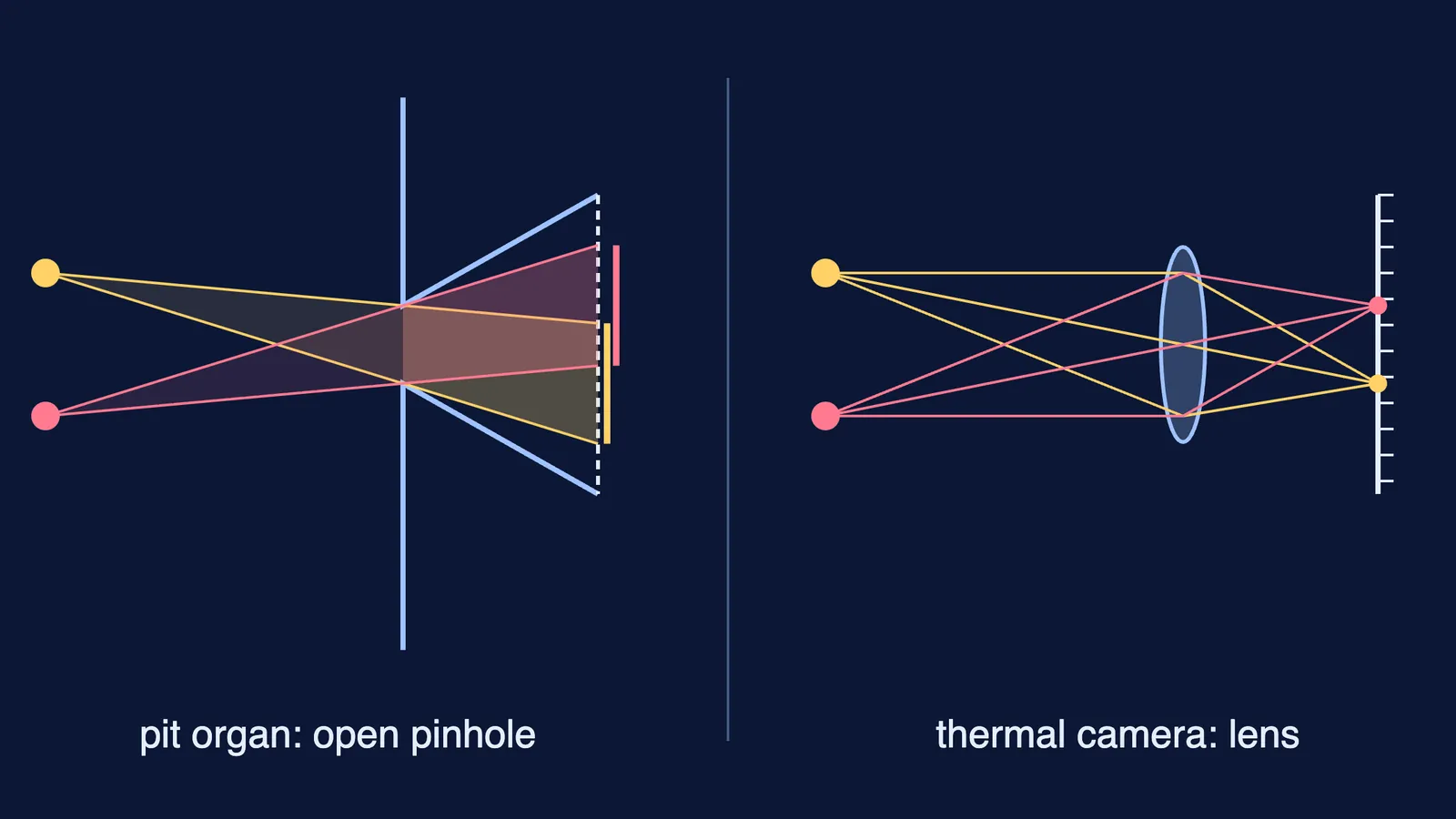
A pinhole camera is a dark box with a small hole and no lens; each outside point casts a small patch on the back wall, upside down. Bakken and Krochmal (2007) modelled the pit's optics and heat flow and wrote that "the facial pit is essentially a pinhole camera". Its opening is 1 to 3 mm across, with the membrane behind it as the back wall.
Every pinhole faces one trade-off: the image "is either sharp but dim when the optical pupil is small, or bright but blurred when it is large", as the same paper puts it. The pit sits on the wide side: its opening "appears to be larger than is optimal for detecting small targets such as prey at 0.5 m". Bakken and Krochmal found the image "poorly focused and of very low temperature contrast", and estimated that the membrane's sensory endings must respond to temperature contrasts of 0.001 °C or less.
How blurry is a pit viper's heat image?
Clark, Bakken, Reed and Soni (2022) moved warm targets in front of western rattlesnakes, against plain backgrounds and backgrounds patterned with two contrasting temperatures. The snakes responded strongly to targets in front of plain backgrounds but showed no significant response to those in front of patterned ones, and the team found "no evidence that the pit organ system can resolve spatial details subtending an angle of 9 deg or less".
Here is what 9° means at striking range. A detail spanning angle θ at distance d is about 2d·tan(θ/2) wide, and tan 4.5° ≈ 0.0787.
At 0.5 m: 2 × 0.5 m × 0.0787 ≈ 7.9 cm.
At 1 m, the greatest prey distance biophysical studies suggest, per Gracheva et al.: 2 × 1 m × 0.0787 ≈ 15.7 cm.
So at half a metre, a feature smaller than about 8 cm, such as a mouse's head, may merge with its body into one warm blob.
How is a pit organ different from a thermal camera?
A thermal camera uses a lens, which sends every ray from one scene point to one point on the sensor (right half of the diagram above), so it stays sharp with a wide, bright aperture. The lensless pit pays for brightness with blur (left half).
The gap is large. One small commercial module, Teledyne FLIR's Lepton 3.5, has 160 × 120 pixels across a nominal 57° horizontal field of view.
Camera: 57° ÷ 160 ≈ 0.36° per pixel, about 3 mm at 0.5 m.
Pit organ: no sign of resolving 9° or less (Clark et al., 2022), about 8 cm at 0.5 m.
Ratio: the camera's pixel is about 25 times finer in angle than that 9° (9 ÷ 0.36 ≈ 25).
Clark and colleagues note that thermal-camera images are often used to infer what pit vipers perceive; their results suggest a much blurrier view. For the camera side, read how a thermal camera works and why night vision is a different device.
Contrast is the other difference. Wien's law, λmax = b/T with b = 2.898 × 10⁻³ m K (NIST CODATA), puts a 37 °C surface (310 K) peak at 9.35 µm and 25 °C ground (298 K) at 9.72 µm. Both sit inside the 5 to 30 µm band the membrane absorbs, and fur is "actually closer to air temperature" than the body core (Bakken and Krochmal).
How do you explain pit organs in an exam answer?
Use this five-line frame:
Source: warm bodies emit infrared, peaking near 9 to 10 µm by Wien's law.
Detector: radiation warms the pit membrane; TRPA1 channels in its nerve endings open and the nerves fire.
Optics: no lens, so a pinhole camera; a wide hole gives a bright, blurred image.
Brain: pit signals combine with visual signals in the optic tectum (Clark et al., 2022).
Contrast: a thermal camera's lens focuses point to point, so it is far sharper.
If pinhole and lens ray diagrams still feel abstract, the Fermi Simulation Lab has interactive simulations for ideas that are easier to see than to read, and Fermi's AI tutor can work out what you already know about optics and build a plan for the session.


