

On this page
If your Class 10 practical file or board paper asks how to show that a leaf makes starch, the answer is a chain of six steps, and examiners like to ask why each one is there. Here is the method, the chemistry of the colour change, and how two classic set-ups prove that chlorophyll and carbon dioxide are needed.
How do you test a leaf for starch, step by step?
The test works because a leaf that has been photosynthesising stores food as starch, and iodine turns blue-black where starch is present. The order below follows these GCSE revision notes on starch testing and the NCERT Class 10 activity in Life Processes, reproduced by Bank of Biology.
Destarch the plant. Keep it in a dark room; the NCERT activity uses three days "so that all the starch gets used up". Why: otherwise any blue-black could be old starch, and the test proves nothing.
Put it in light. The NCERT variegated-leaf activity uses about six hours of sunlight. Why: new starch is made only while the leaf photosynthesises.
Dip the leaf in boiling water for 1-2 minutes. Why: this kills the leaf and stops its chemical reactions, including photosynthesis.
Heat it in alcohol (ethanol) in a hot water bath for 5-10 minutes. Why: alcohol removes the chlorophyll, so the leaf goes pale and the iodine colour is easy to see.
Rinse it in warm water. Why: alcohol leaves the leaf brittle, and the rinse softens it so you can spread it flat without cracking.
Spread it on a white tile and add iodine solution. Blue-black means starch; yellow-brown means none.
The idea behind the test goes back to the botanist Julius Sachs, who showed that starch forms in the green parts of leaves in light.
Why is the leaf boiled in alcohol inside a water bath?
A dark green leaf hides the colour of the iodine. Alcohol extracts the chlorophyll, and the alcohol itself turns green as it does, as the Preproom.org practical sheet describes.
Ethanol boils at about 78 °C (PubChem), well below the boiling point of water, so a tube of ethanol standing in a beaker of very hot water will boil without any flame under it. This matters because ethanol is flammable; the same sheet says to keep it away from naked flames.
Why does iodine turn starch blue-black?
Starch contains amylose, a molecule that coils into a helix. A 2022 paper in Molecules by Szilárd Pesek and colleagues at Babeş-Bolyai University (read the study) describes the accepted view: a mixture of iodine molecules and iodide ions inside the amylose helix produces the blue. Their own data confirm that iodide is needed for the colour to form.
For your answer sheet: yellow-brown iodine turns blue-black wherever starch is present.
What do the variegated-leaf and KOH experiments prove?
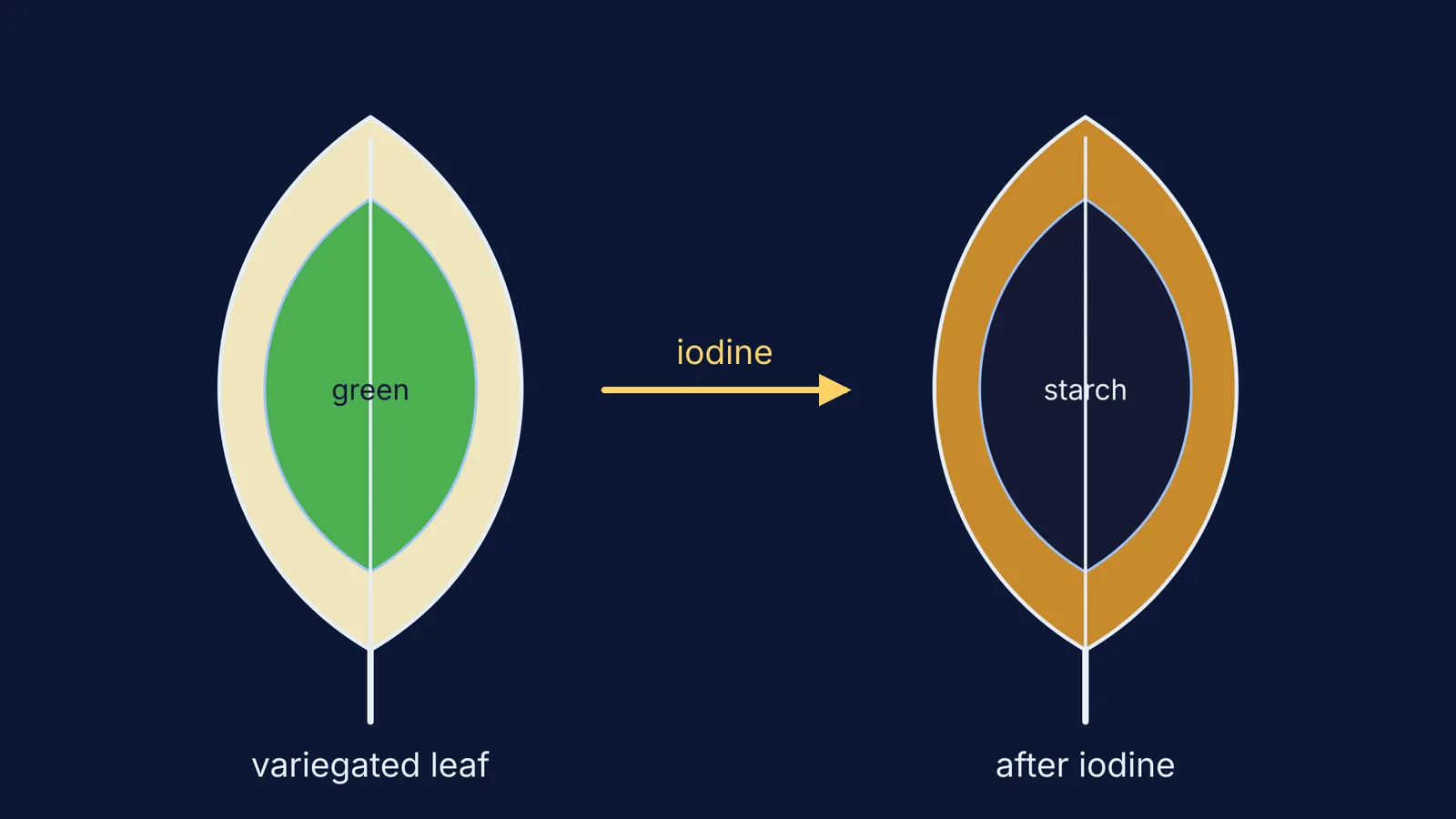
The variegated leaf shows that chlorophyll is needed. In the NCERT activity as reproduced by Bank of Biology, a potted plant with variegated leaves, such as money plant or crotons, is kept in the dark for three days, then in sunlight for about six hours. You mark the green areas of a leaf before testing it. After iodine, the green parts turn dark blue and the pale parts do not. The pale parts got the same light, air and water as the green parts, so the only difference is chlorophyll.
Potassium hydroxide (KOH) shows that carbon dioxide is needed. In the version on this CBSE Class 10 lesson page, two plants are kept in the dark for three days, and a watch glass of KOH, which absorbs carbon dioxide, is placed beside one of them. After about two hours of sunlight, the leaf from the KOH plant stays brown with iodine and the other turns blue-black. The plant without KOH is the control, so the missing starch must be down to the missing carbon dioxide. Carbon dioxide is also one of the limiting factors described by Blackman's law.
What if your starch test result looks wrong?
These are the usual explanations to check, not the only ones.
Both leaves turned blue-black in the KOH experiment. Either destarching was too short, so old starch remained, or the KOH did not take up enough carbon dioxide from the air around the leaves.
Even the control leaf shows no blue-black. The plant may not have had enough time in light, or the leaf was still green and hid the colour.
The leaf cracked when you spread it. You probably skipped the warm-water rinse after the alcohol.
If the steps are clear but the bigger picture of photosynthesis is not, the Fermi Concept Library gives each biology concept its own lesson and its place in the map. For practice, the Fermi Problem Library has worked problems with a step-by-step solver that explains the reasoning rather than printing an answer.
Next, our photosynthesis explainer on light reactions, the Calvin cycle and C4 plants picks up where the starch test leaves off.


