

On this page
Most simple carbonyl compounds sit almost entirely in the keto form. Phenol does the opposite: it is an enol, an OH group on a C=C, and it stays that way. If you were taught that keto is always more stable, phenol shows that the rule is really a comparison of energies, and aromaticity can win that comparison. If you need a refresher on what tautomers are, start with our guide to keto-enol tautomerism.
Why does phenol exist in the enol form and not the keto form?
Phenol's main keto tautomer is cyclohexa-2,4-dienone. Move the hydrogen from oxygen to the ortho carbon and the ring now has a C=O, two C=C bonds and one sp3 CH2 group. That CH2 breaks the continuous loop of p orbitals, so the ring is no longer aromatic.
So the trade is simple. The keto form gains a C=O bond, which is the usual reason keto wins. It loses the aromatic stabilisation of a benzene ring. Phenol's six π electrons meet the 4n+2 count only while all six ring carbons stay sp2 and conjugated; our post on how Hückel's rule decides aromaticity walks through that test.
This has been measured. Marco Capponi, Jakob Wirz and colleagues made both keto tautomers of phenol by flash photolysis in water and timed how fast they turned back into phenol; the reverse rates came from hydrogen exchange on phenol itself, and the ratio of the two gives the equilibrium constant (Capponi et al., Canadian Journal of Chemistry, 1999). For cyclohexa-2,4-dienone going to phenol, the enolization constant is pKE = −12.73 ± 0.12 at 25 °C. The other keto tautomer, cyclohexa-2,5-dienone, has pKE = −10.98 ± 0.15 in the same paper. Neither lasts long in water: the paper reports lifetimes of 260 microseconds for the 2,4-dienone and 13 milliseconds for the 2,5-dienone, roughly the same from pH 3 to 10.
How is acetone different from phenol?
Acetone has no ring to lose. Its enol, prop-1-en-2-ol, swaps a strong C=O for a weaker C=C and gets nothing back. The LibreTexts organic chemistry text states that acetone is more than 99.999% keto tautomer (LibreTexts, Keto-Enol Tautomerism/22%3A_Carbonyl_Alpha-Substitution_Reactions/22.01%3A_Keto-Enol_Tautomerism)). The same page explains why: keto tautomers are usually more stable by about 45–60 kJ/mol, mainly because the C=O double bond (749 kJ/mol) is stronger than the C=C double bond (611 kJ/mol).
Phenol has that same bond-strength bias working against it, and the enol still wins. That tells you how much the aromatic ring is worth.
How big is the gap, in numbers?
Here is the worked example, using the constants from Capponi et al. and the relation ΔG° = −2.303RT log K.
pKE = −12.73 means KE = [phenol]/[dienone] = 10^12.73, which is about 5.4 × 10^12.
At 298 K, 2.303RT = 2.303 × 8.314 × 298.15 J/mol, which is 5.71 kJ/mol.
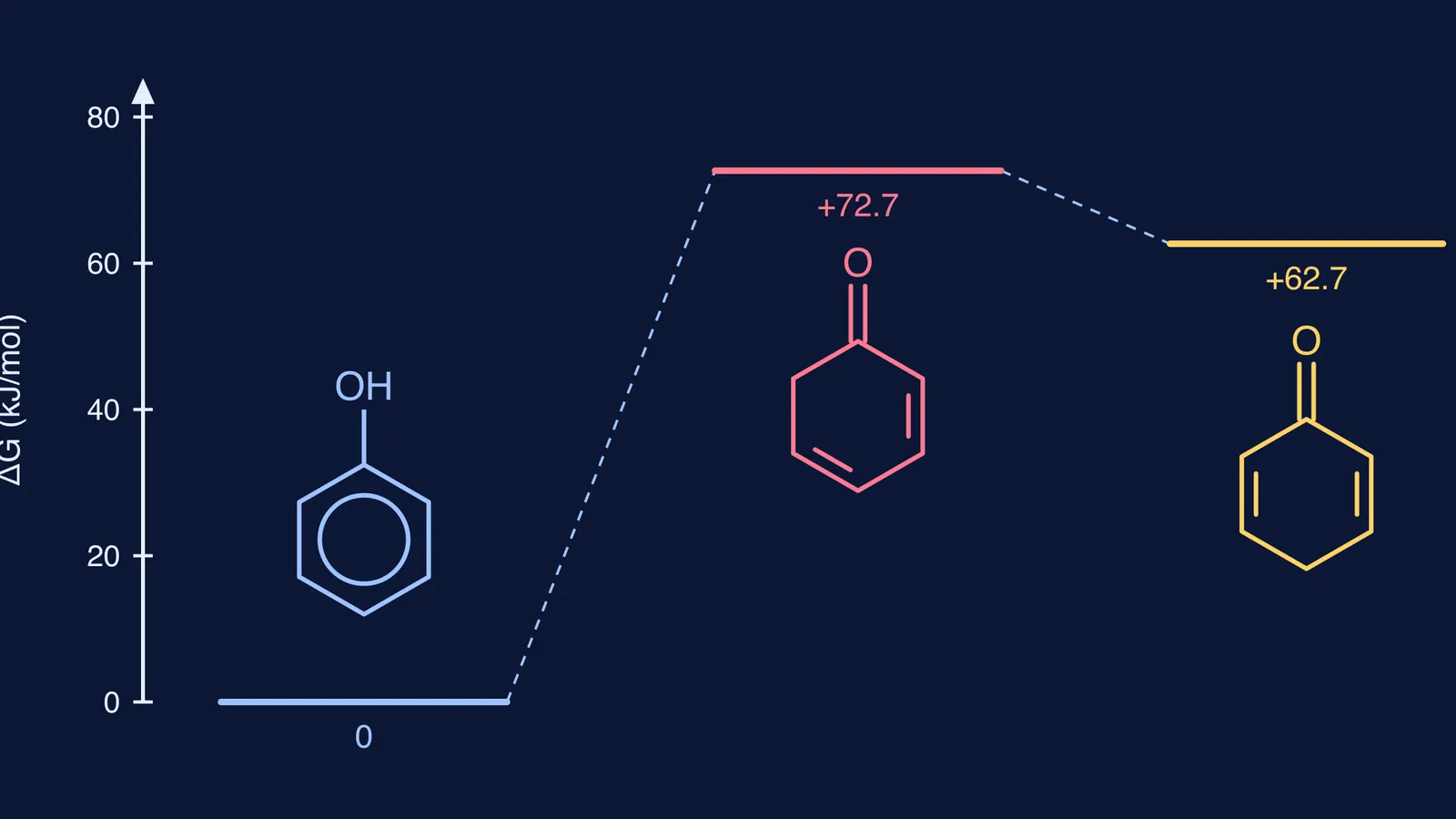
ΔG° = −5.71 × 12.73, or about −72.7 kJ/mol, for dienone going to phenol. The keto form sits roughly 73 kJ/mol above phenol.
For the 2,5-dienone, 5.71 × 10.98 gives about 62.7 kJ/mol above phenol.
The diagram at the top is drawn to that scale. Aromaticity does more than cancel the usual keto advantage; it reverses it.
How do you rank tautomers in an exam question?
Work through these checks in order and stop at the first one that settles it.
Does one tautomer have an aromatic ring (planar, fully conjugated, 4n+2 π electrons)? That tautomer wins.
Is the enol conjugated with a second C=O and held by an internal hydrogen bond, as in 1,3-dicarbonyls? The enol share rises sharply; see why acetylacetone has so much enol.
If neither applies, the keto form wins, because C=O beats C=C.
Practice set:
Rank by enol content: acetone, phenol, pentane-2,4-dione.
Cyclohexanone or phenol: which exists mainly as the enol?
Of phenol's two keto tautomers, which is less unstable, and by roughly how much?
Acetone or ethyl acetoacetate: which has more enol at equilibrium?
True or false: cyclohexa-2,4-dienone formed in water is still there one second later.
Answers:
Phenol > pentane-2,4-dione > acetone. Aromaticity beats conjugation plus hydrogen bonding, which beats nothing.
Phenol. Cyclohexanone's enol has one isolated C=C and no aromatic ring, so check 3 applies.
Cyclohexa-2,5-dienone. Its pKE is 1.75 units less negative (Capponi et al., 1999), and 5.71 × 1.75 is about 10 kJ/mol. Both are still far above phenol.
Ethyl acetoacetate, a 1,3-dicarbonyl (check 2).
False. Its measured lifetime in water is about 260 microseconds (Capponi et al., 1999).
If you get the order right but cannot explain why, the Fermi Problem Library has worked problems with a step-by-step solver that explains the reasoning rather than printing an answer. If aromaticity itself feels shaky, the Fermi Concept Library gives each concept its own lesson and its place in the map.


