

On this page
Some motions come back again and again, on time. Others happen once and are over, like a cricket ball rolling to a stop. Chapter 8 of the Class 7 science textbook, Measurement of Time and Motion, is built on this difference, because every clock depends on the first kind. Below: examples, a three-question test and a worked pendulum activity.
What is periodic motion in Class 7?
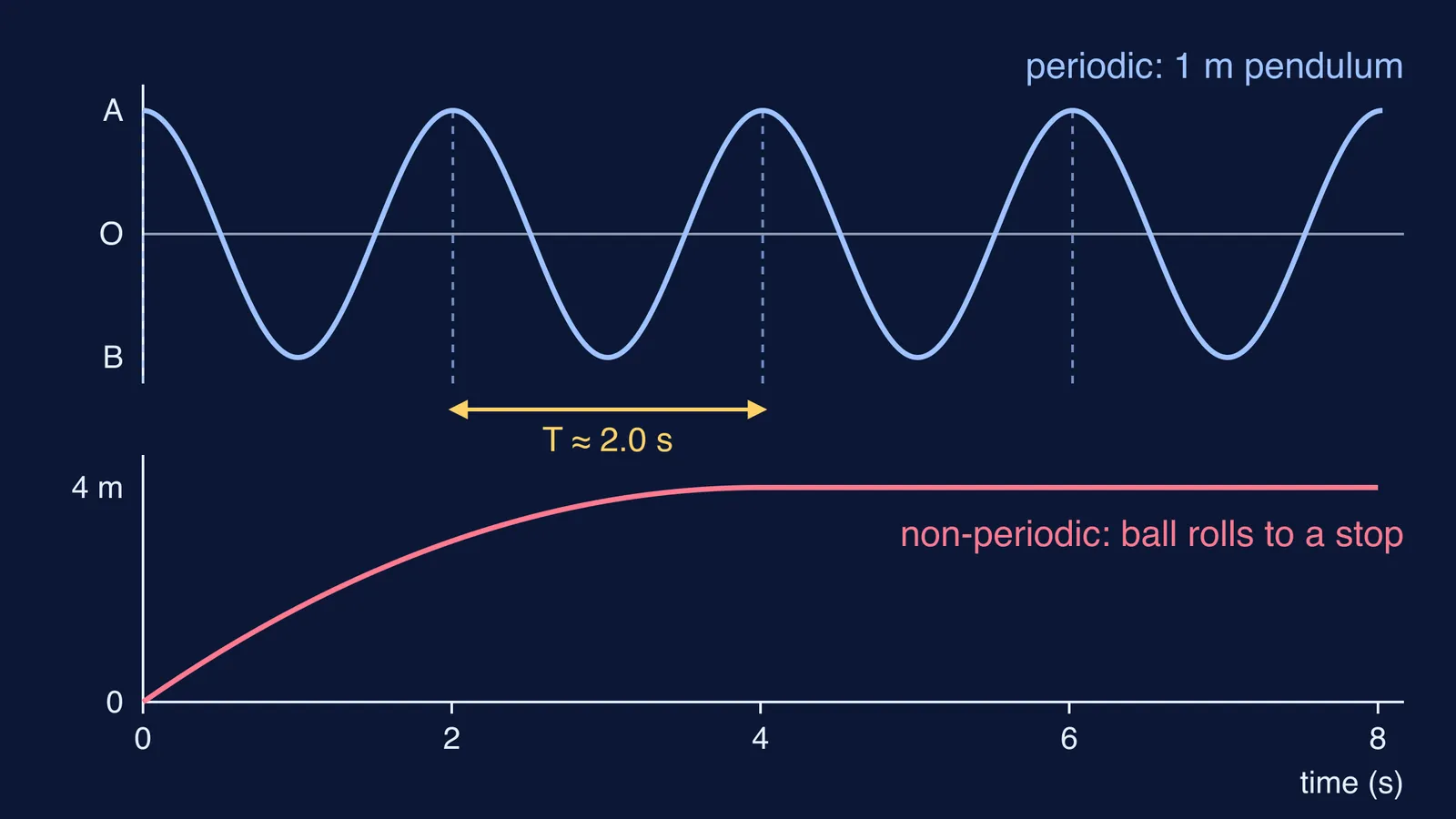
In NCERT's Grade 7 textbook, the motion of a pendulum is called periodic "because it repeats its path after a fixed interval of time" (NCERT Curiosity, Chapter 8). Non-periodic motion is any motion that does not repeat itself after equal intervals of time.
Two more words from the same chapter carry most of the marks:
One oscillation: the bob starts at its mean position O, goes to one extreme A, back through O to the other extreme B, and returns to O.
Time period: the time taken to complete one oscillation, measured in seconds (s), the SI unit of time.
If you remember the swinging eraser from Class 6, that back-and-forth was oscillatory motion; our guide to types of motion with Class 6 examples is a quick refresher.
What are some examples of periodic motion?
Periodic (repeats in equal time):
A simple pendulum, or the pendulum of a wall clock.
The second hand of a clock, which makes one full round every minute, since 60 s = 1 min (NCERT Curiosity, Chapter 8).
The rising and setting of the Sun, the phases of the Moon and the changing seasons, which the same chapter lists as events that "repeat themselves after definite intervals of time".
A swing pushed gently at a steady rhythm.
Non-periodic (does not repeat in equal time):
A ball rolling along the ground until it stops.
A car moving through city traffic.
A leaf falling from a tree.
A sprinter running a 100 m race.
Your heartbeat sits close to the first list. For children aged 10 and older and for adults, a normal resting heart rate is 60 to 100 beats per minute (MedlinePlus, US National Library of Medicine). At 72 beats per minute, one beat comes every 60 ÷ 72 ≈ 0.83 seconds.
How do you tell if a motion is periodic?
Ask three questions, in this order:
Does the object come back to the same position? If it never returns, the motion is non-periodic.
Does it repeat the same path again and again? A ball bounced once and caught does not count.
Does each repeat take the same time? Time two or three repeats. If the times match, the motion is periodic.
A ceiling fan at a fixed speed passes all three. A football kicked across a field fails at question 1.
How do you measure the time period of a pendulum?
The textbook activity uses a string about 150 cm long, a heavy bob or stone and a watch, with about 100 cm of string between the support and the bob (NCERT Curiosity, Chapter 8). Pull the bob slightly to one side, release it without pushing, and time 10 oscillations.
Worked example. Say your three readings for 10 oscillations are 20.1 s, 19.9 s and 20.0 s.
Average: (20.1 + 19.9 + 20.0) ÷ 3 = 20.0 s.
Time period: 20.0 s ÷ 10 = 2.0 s.
Check: physicists use T = 2π√(L/g) for a pendulum with small swings (HyperPhysics, Georgia State University). With L = 1 m and g = 9.8 m/s², T works out to about 2.0 s, which matches your reading.
Why time 10 swings? Starting and stopping a watch by hand adds a small error; spread over 10 oscillations, it shrinks to a tenth in your answer.
NCERT's key result: the time period of a simple pendulum depends on its length but not on the mass of the bob.
Why do clocks need periodic motion?
The chapter tells the story: Galileo Galilei, watching a lamp swing in a church, used his own pulse to time it and found that each swing took the same time; Christiaan Huygens then invented the pendulum clock in 1656 (NCERT Curiosity, Chapter 8). NCERT notes that "all clocks, old or modern, are based on some process repeating continuously", and that Huygens' early pendulum clocks could still gain or lose 10 seconds each day.
Before pendulums, people used sand and dripping water; see our piece on measuring time with sand and water clocks. The second half of the same chapter moves on to speed and uniform and non-uniform motion, covered in our Class 7 time and motion guide.
If a pendulum is easier to understand when you can watch it swing, the Fermi Simulation Lab has interactive simulations for ideas that are easier to see than to read. The Fermi Concept Library gives each physics concept, such as time period and oscillation, its own lesson and its place in the map.


