

On this page
In a mustard flower, the boundary between outer protection and inner attraction is unmistakable: a green calyx encloses the bud, while bright yellow petals unfold above. But examine a lily (*Lilium*) or an onion flower (*Allium*), and that contrast disappears. Radiant petal-like segments flare outward, sharing the same silky texture and uniform coloration across all whorls.
Telling whether a bloom has separate petals or identical tepals is essential for Class 11 botany and NEET-UG. Mistaking a perianth for a calyx and corolla costs easy marks on floral formulas and diagrams. Understanding how these floral rings develop reveals why monocots and eudicots organize their floral envelopes differently.
What is the difference between calyx, corolla and perianth?
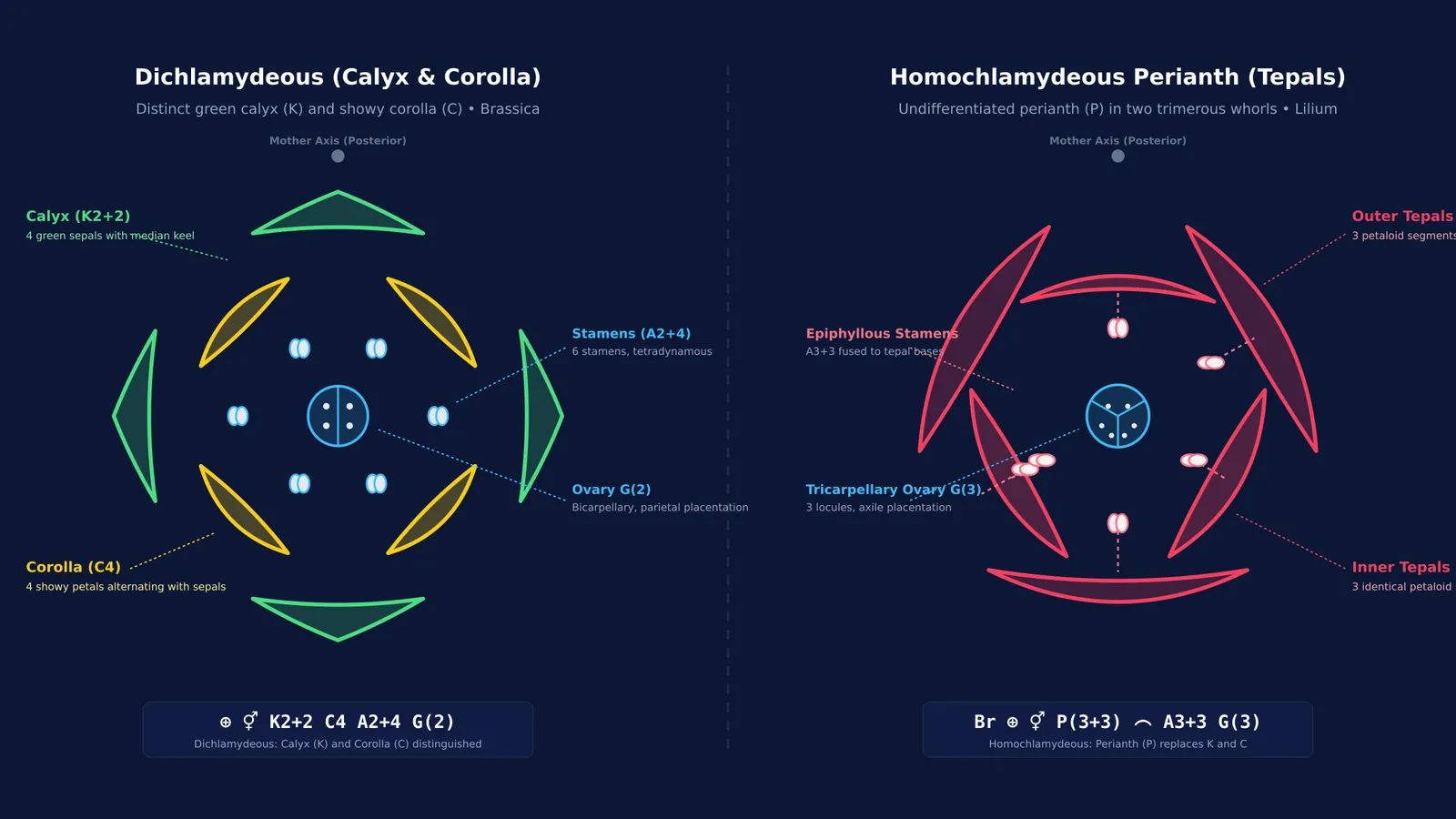
In classic eudicot flowers, the non-reproductive envelope divides into two distinct whorls. The outermost whorl is the calyx, formed of green sepals that shield the bud. Interior to the calyx sits the corolla, formed of petals that attract pollinators.
When a flower exhibits this clear separation, botanists classify it as dichlamydeous. According to structural definitions documented on Wikipedia's perianth classification, the term perianth refers collectively to both non-reproductive whorls together.
However, in many monocots, the outer and inner rings look identical. In these homochlamydeous flowers, you cannot point to a green protective cup distinct from an inner petal crown. Because neither ring is strictly a calyx or a corolla, botanists call the combined envelope a perianth.
When are floral parts called tepals instead of petals?
When a flower possesses an undifferentiated perianth, its individual segments are called tepals rather than sepals or petals. The Swiss botanist Augustin Pyramus de Candolle coined the term in his 1827 work *Organographie végétale* as an anagram of *pétale*, modeled directly after *sépale*, as noted on Wikipedia's botanical index.
Tepals fall into two functional categories:
Petaloid tepals: Brightly pigmented segments that attract pollinators while protecting developing organs, as seen in lilies (*Lilium*), tulips (*Tulipa*), and onions (*Allium*).
Sepaloid tepals: Small, greenish, or dry scarious segments that function primarily as physical shields, common in rushes (*Juncus*).
Why do lilies have two whorls of identical tepals?
In typical eudicots like *Arabidopsis*, floral architecture follows the classic ABC model. Class A genes act alone in whorl 1 to form green sepals, while Class A and Class B genes combine in whorl 2 to build showy petals.
Lilies and tulips operate under a modified homeotic programme. In a study published in *Plant Molecular Biology*, Kanno and colleagues (2003) showed that B-class homeotic genes are expressed in whorl 1 as well as whorl 2 in *Tulipa gesneriana*. Molecular research on *Lilium longiflorum* by Tzeng and Yang (2001) confirmed that lily MADS-box genes expand this petaloid fate to the outermost ring.
Because whorls 1 and 2 express both Class A and Class B genes, organs in both rings differentiate into petaloid tissue. The lily produces 6 petaloid tepals arranged in two trimerous whorls of 3.
How do you write floral formulas for perianth flowers?
In floral formulas, calyx is denoted by K and corolla by C. In flowers with an undifferentiated perianth, both symbols are replaced by P, following standard floral formula conventions.
In the lily family (Liliaceae):
Perianth notation: Six tepals sit in two whorls of three, written as P(3+3) if fused into a tube or P3+3 if free.
Epiphyllous stamens: Six filaments fuse directly onto tepal bases rather than the receptacle, written with an overhead arc: P(3+3) ⌢ A3+3.
Complete formula: A standard Liliaceae formula reads Br ⊕ ⚥ P(3+3) ⌢ A3+3 G(3), indicating fused tepals, epiphyllous stamens, and a superior tricarpellary ovary.
Mastering this notation is vital when reading floral formulas. Checking tepal margins under aestivation in floral whorls clarifies why valvate arrangements dominate monocots.
When revising plant families, confusing epiphyllous and epipetalous stamens is a common trap. The Fermi Concept Library covers every concept in biology, each with its own lesson and its place in the map, helping you visualize how organ identity alters floral structures.
How can you identify a perianth during flower dissections?
During laboratory dissections or practical exams, use this four-step checklist to classify floral envelopes based on botanical perianth classification:
Inspect the non-reproductive rings: If you find a green outer ring enclosing a colourful inner ring, record calyx (K) and corolla (C). If both rings look identical, record a perianth (P).
Count segments: Eudicots typically display 4 or 5 segments per ring, whereas monocots display trimerous rings (3 or 3+3).
Test for fusion: If segments separate cleanly, record free parts. If they fuse into a tube, place parentheses around the number, such as P(3+3).
Check stamen insertion and ovary: If filaments attach to tepals, mark epiphyllous stamens. Then cross-section the ovary to verify placentation types, contrasting the 3-locule axile ovary of a lily with the parietal ovary of mustard.
If you struggle to break down floral diagrams under timed conditions, the Fermi Problem Library offers worked problems with a step-by-step solver that explains the reasoning rather than printing an answer.


