On this page
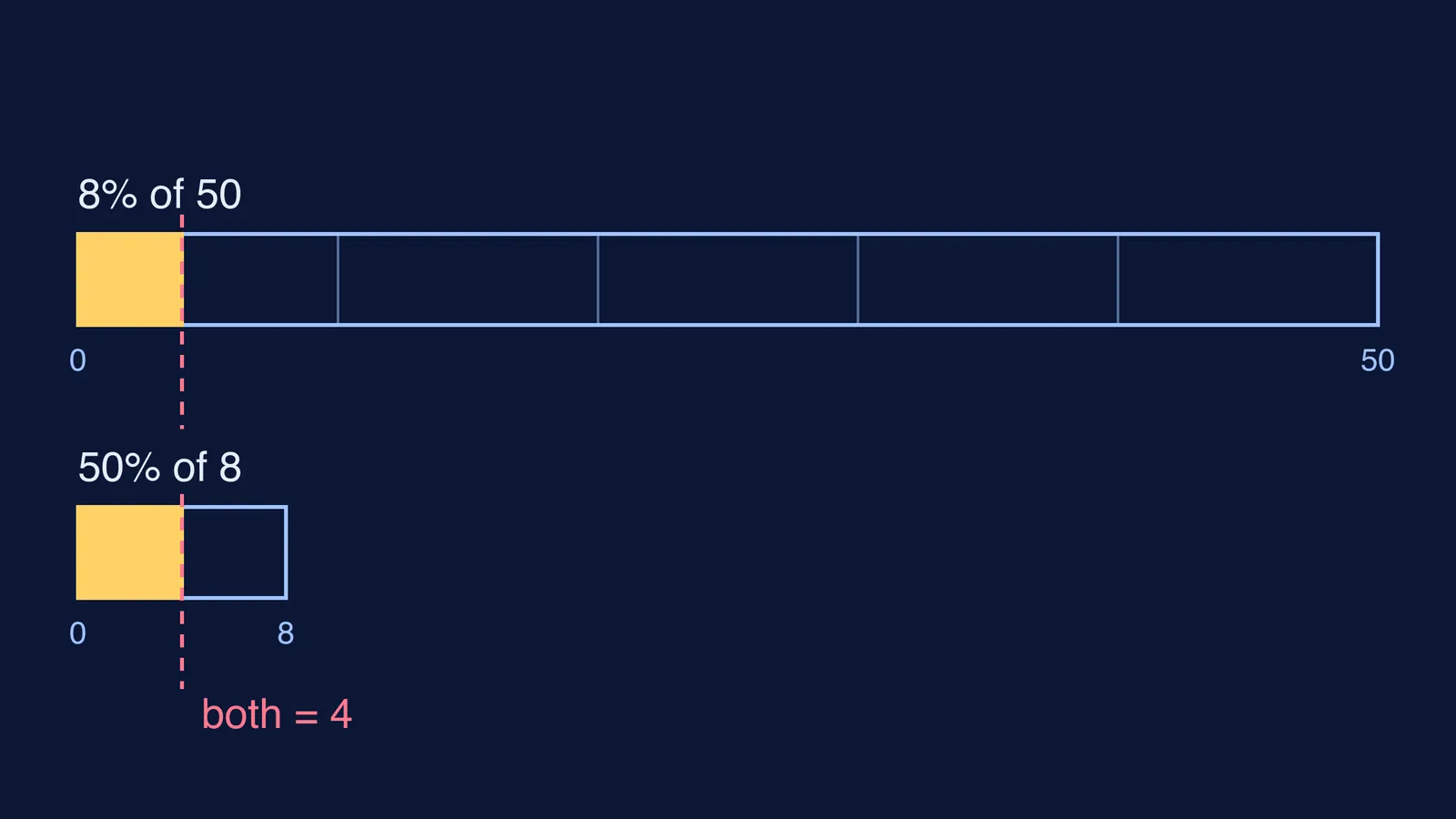
What is 8% of 50? There is a faster route than splitting 50 into hundredths: 8% of 50 is the same as 50% of 8, and half of 8 is 4. The swap works for every pair of numbers. Once you see why, awkward percentages like 16% of 25 or 4% of 75 become one-step mental maths.
Why is x% of y the same as y% of x?
A percentage is a number expressed as a fraction of 100, from the Latin *per centum*, “by a hundred” (Wikipedia: Percentage). So “8% of 50” means 8/100 × 50, which is 8 × 50 ÷ 100.
Now look at “50% of 8”. That is 50/100 × 8, which is 50 × 8 ÷ 100. Both lines contain the same product, 8 × 50 = 400, divided by the same 100. Either way the answer is 4.
This follows from the commutative property. An operation is commutative when changing the order of the operands does not change the result. Multiplication is commutative, so a × b = b × a (Wikipedia: Commutative property). The Percentage article gives its own example of the swap: 50% of 20 is 10, and 20% of 50 is 10 (Wikipedia: Percentage).
In general, x% of y = (x × y) ÷ 100 = y% of x.
When should you swap the numbers?
Swap when the other number makes a friendly percentage: 10%, 20%, 25%, 50%, 75%, 100% or a whole multiple of 100%. Those just mean divide by 10, divide by 5, divide by 4, halve, take three quarters, or multiply. A quick routine:
Look at both numbers and ask which one makes a friendly percentage.
If the number after “of” is friendlier, swap.
Do the easy version in your head.
Sanity-check the size: 8% of 50 should be a little under 10% of 50, which is 5.
Worked examples:
16% of 25 → 25% of 16 = 16 ÷ 4 = 4
4% of 75 → 75% of 4 = 3
18% of 50 → 50% of 18 = 9
36% of 20 → 20% of 36 = 36 ÷ 5 = 7.2
12% of 250 → 250% of 12 = 2.5 × 12 = 30
7% of 300 → 300% of 7 = 3 × 7 = 21
“250% of 12” is fine: percentages can go above 100 (Wikipedia: Percentage), and this one just means 2.5 times 12. If neither version is friendly, as with 13% of 47, swapping won’t help. Fall back on the 10% and 1% method in our guide to calculating percentages in your head.
Where does the swap help in exams and everyday life?
Percentages are often used to express a part of a total (Wikipedia: Percentage), and the swap helps whenever that total is a round number. An 18% tax on a ₹50 item is 50% of 18, so ₹9. If 24% of a class of 25 students wear glasses, that is 25% of 24, so 6 students. In chemistry, 4% of 75 g of solution is 75% of 4, so 3 g of solute.
In exams without a calculator, turning a long multiplication into a halving removes a step where you could slip. It sits well alongside other calculation shortcuts for JEE when there is no calculator.
When does the percent swap not work?
The swap only works for “x% of y”, which is a single multiplication. It fails as soon as the question adds a step:
Percentage increase: 10% more than 50 is 55, but 50% more than 10 is 15. You multiply and then add, so the order matters.
“What percent is x of y?”: 8 is 16% of 50, but 50 is 625% of 8. Division is not commutative (Wikipedia: Commutative property).
Successive changes: a 20% discount applied twice is not 40% off, as this bar picture of successive percentage change shows.
The test: if the question can be written as one multiplication divided by 100, you can swap. If it also needs a “+”, a “−” or a division by the other number, you can’t.
How can you practise until it is automatic?
Spend two minutes a day for a week. Write five “x% of y” questions where one number is 20, 25, 50 or a multiple of 100. Before you work each one out, say which way you would swap. Add one percentage-increase question to remember where the trick stops.
If a percentage word problem keeps going wrong, the mistake is usually in the setup, not the arithmetic. The Fermi Problem Library has worked problems with a step-by-step solver that explains the reasoning rather than printing an answer, so you can see where your setup went wrong. For the idea itself, every mathematics concept in the Fermi Concept Library has its own lesson.
Next time you see 8% of 50, think “half of 8” and move on.