On this page
A bullet hits a wooden plank at speed v and comes out the other side at v/2. How many more identical planks does it need to stop? The quick guess goes: "it lost half its speed, so the other half needs one more plank." It gives the right count here, but for the wrong reason, and it fails on most other versions of the question. In fact the bullet stops one-third of the way into the second plank. Here is why, plus a rule for any fraction of speed lost.
Why does each plank take away the same energy?
The problem assumes the wood pushes back on the bullet with a constant force F at every depth. This is a simplified model of real wood, but it is the one the question expects.
The work done by a constant force over a straight displacement is W = Fd cos θ, as OpenStax University Physics, section 7.1 defines it. The resistance points backwards, so θ = 180° and the work is −Fd: the wood takes energy away.
The work-energy theorem states that the net work done on a particle equals the change in its kinetic energy (OpenStax University Physics, section 7.3). Put the two together: each plank of thickness d removes Fd of kinetic energy, however fast the bullet is moving when it enters.
That is the key point. Planks remove equal amounts of energy, not equal amounts of speed. Kinetic energy is ½mv², so speed and energy do not fall in step.
How many more planks does the bullet need to stop?
Call the starting kinetic energy K = ½mv².
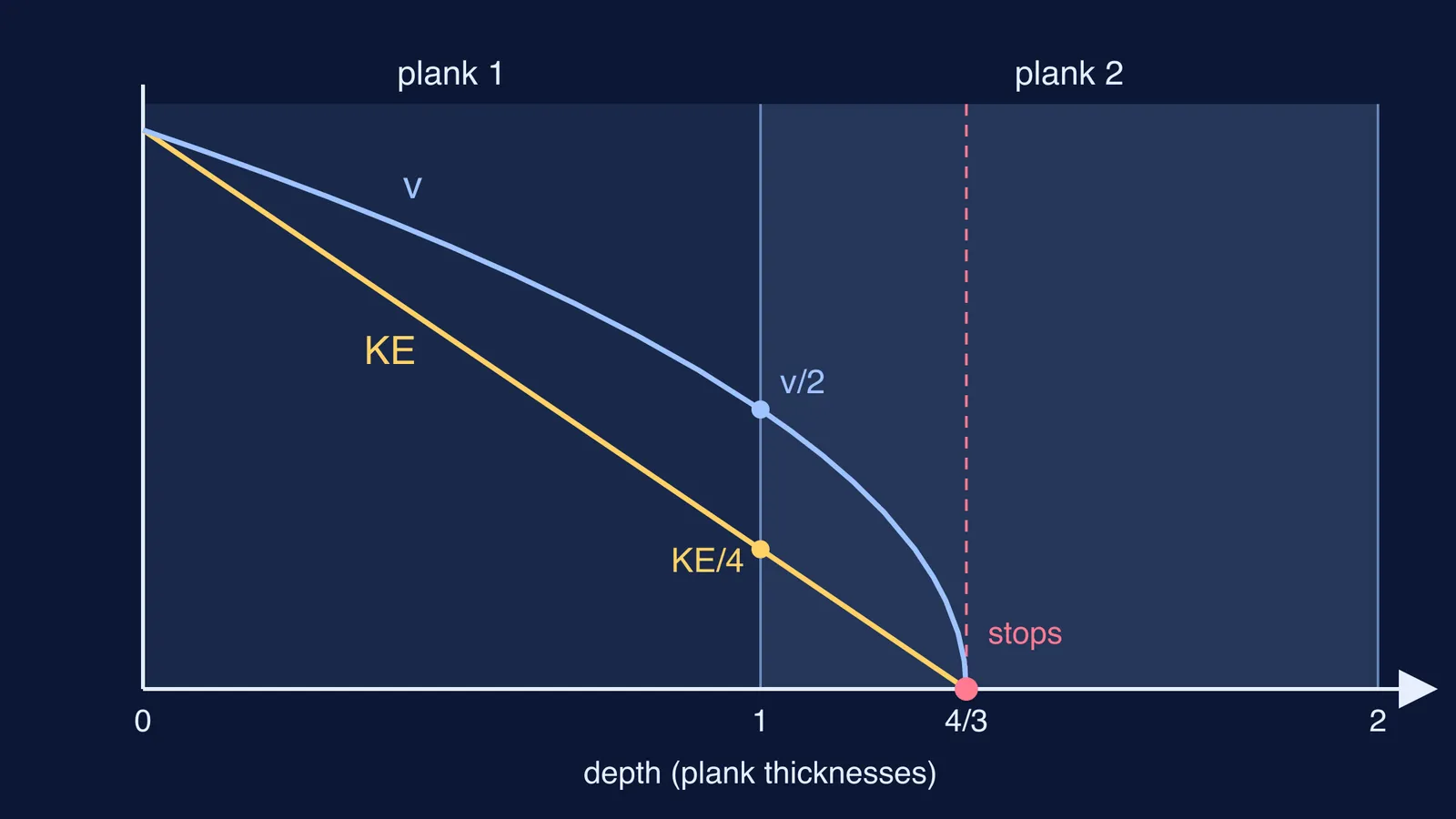
After the first plank the speed is v/2, so the kinetic energy is ½m(v/2)² = K/4.
So the first plank removed K − K/4 = 3K/4. That is Fd, the energy one full plank always removes.
The bullet has K/4 left. Energy removed is proportional to depth, so it stops at a depth x into the next plank where (3K/4)(x/d) = K/4. That gives x = d/3.
The bullet stops one-third of the way into the second plank, after a total depth of 4d/3.
So one more plank is enough, and the bullet uses only a third of it: two planks in total.
Kinematics gives the same result. For constant acceleration a, the motion equation is v² = v₀² + 2a(x − x₀) (OpenStax University Physics, section 3.4). Taking a as the size of the deceleration, from v to v/2 over d: v²/4 = v² − 2ad, so 2ad = 3v²/4. To stop from v: 0 = v² − 2aD, so D = v²/(2a) = 4d/3. Same answer, but the energy route is shorter.
What if the bullet loses 1/20 of its speed in one plank?
The same argument gives a general rule. Say one plank brings the speed from v down to fv, where f is a fraction less than 1. That plank removes the fraction 1 − f² of the starting kinetic energy, so the total depth needed to stop, in plank thicknesses, is n = 1/(1 − f²). Round n up to get the number of whole planks.
Speed halved (f = 1/2): n = 1/(3/4) = 4/3, so 2 planks in total, 1 more.
Loses 1/20 of its speed (f = 19/20): f² = 361/400, so n = 400/39, about 10.26, and you need 11 planks.
Loses 1/3 of its speed (f = 2/3): n = 1/(5/9) = 1.8, so 2 planks.
The 1/20 case shows why the quick guess fails. If speed dropped by the same amount in every plank, you would answer 20 planks. The real answer is 11, because the bullet loses little speed in the early planks and most of it near the end.
Where do students lose marks on this problem?
Assuming equal speed drops per plank. It only matches by coincidence in the half-speed version.
Rounding 10.26 down to 10. After ten planks the bullet is still moving.
Mixing up "how many more" with "how many in total".
Forgetting the assumption. If the resistance changes with speed or depth, this rule no longer applies.
The same energy bookkeeping runs through our guide on solving JEE problems with the work-energy theorem and our post on the temperature rise of a bullet stopping in a wall. Also see three work-energy mistakes that quietly cost marks.
If you get a plank or block problem wrong and can't see why, the Fermi Problem Library has worked problems with a step-by-step solver that explains the reasoning rather than printing an answer. If the gap is the idea itself, the Fermi Concept Library gives each concept its own lesson.
Try the 1/20 version yourself before reading the working above: square f and let the energy do the counting.