

On this page
Take a pendulum clock to the Moon and it runs slow. It isn't broken: a pendulum's rhythm is set by its length and gravity, and gravity there is weaker. Once you see that, every "pendulum on another planet" question becomes a one-line ratio.
What is the time period of a pendulum on a planet with different g?
For small swings, the period of a simple pendulum is T = 2π√(L/g), where L is the length and g is the acceleration due to gravity (OpenStax University Physics, section 15.4). The same OpenStax section says the period is independent of the bob's mass and, for angles below about 15°, nearly independent of how far you pull it back.
So if you keep L fixed and change planets, only g changes. That gives the rule worth memorising:
T(planet) / T(Earth) = √(g(Earth) / g(planet))
Weaker gravity means a longer period (slower swings). Stronger gravity means a shorter period (faster swings). Because of the square root, the period changes less than g does: a quarter of the gravity only doubles the period.
How much slower does a pendulum swing on the Moon?
NASA's Moon fact sheet lists surface gravity as 1.62 m/s² on the Moon and 9.80 m/s² on Earth, a ratio of 0.165. Plug those into the rule:
g(Earth) / g(Moon) = 9.80 / 1.62 = 6.05
√6.05 = 2.46
So T(Moon) = 2.46 × T(Earth)
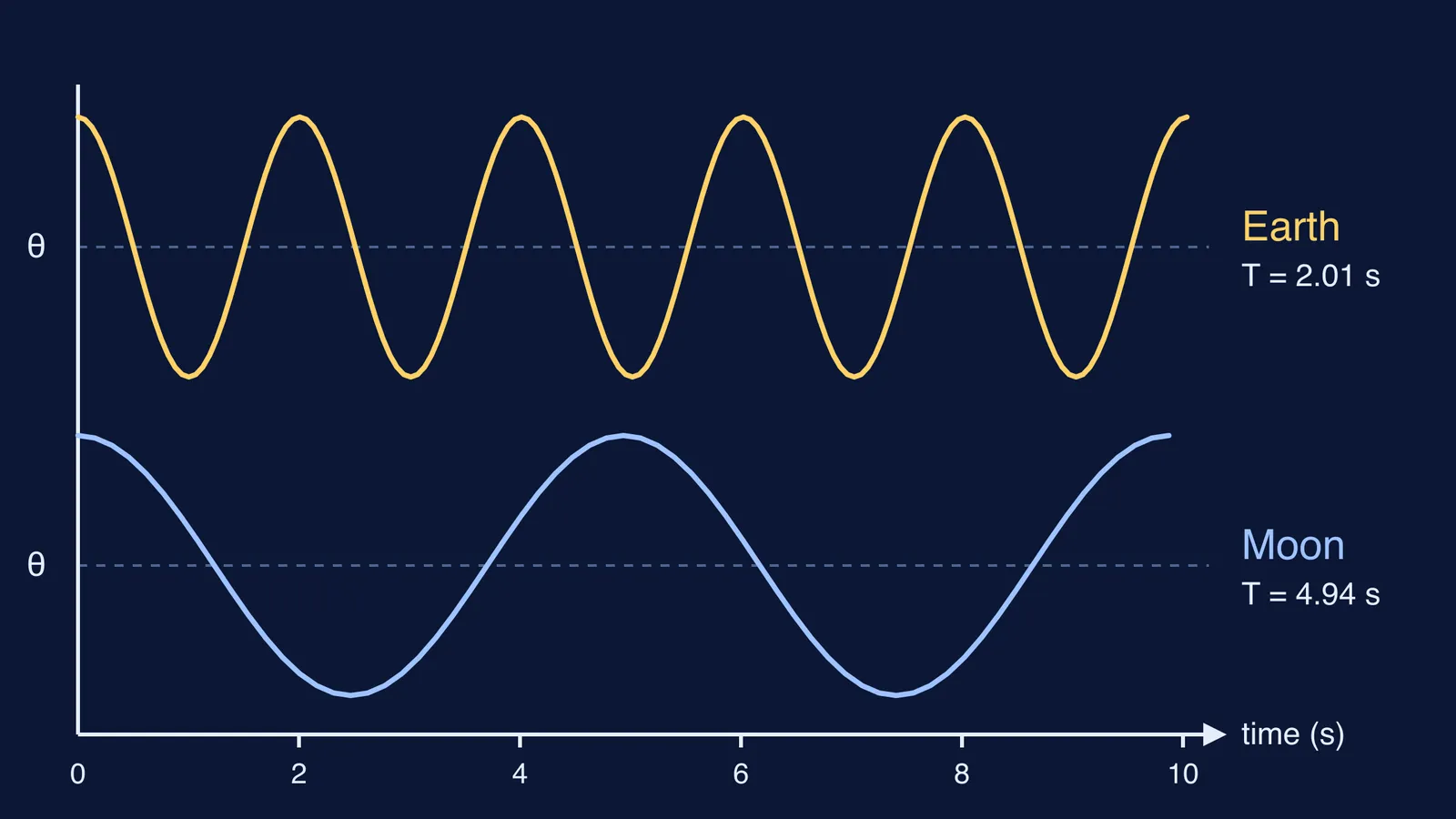
The same pendulum swings about 2.46 times slower on the Moon. If you use the textbook shortcut g(Moon) = g/6, you get √6, about 2.45.
Here is a worked example for a 1 m pendulum on four worlds, using T = 2π√(1/g) and NASA's figures. Mars is 3.73 m/s² from the Mars fact sheet. Jupiter is 25.92 m/s² from the Jupiter fact sheet, given at the 1-bar pressure level because Jupiter has no solid ground, so treat that one as a thought experiment.
Earth (g = 9.80 m/s²): T = 2.01 s
Moon (g = 1.62 m/s²): T = 4.94 s
Mars (g = 3.73 m/s²): T = 3.25 s
Jupiter (g = 25.92 m/s²): T = 1.23 s
Turn it around for the seconds pendulum (period 2 s). Its length is L = g/π², about 99.3 cm on Earth but only about 16.4 cm on the Moon with NASA's 1.62 m/s². To keep a Moon clock on time, you would shorten its pendulum to about a sixth of its Earth length. Our post on the seconds pendulum and how its period changes with length and g works through more of these.
Why does gravity change the period but mass does not?
Gravity pulls the bob back towards the middle, and the bob's mass resists being speeded up. A heavier bob feels a bigger pull but is equally harder to move, so mass cancels. Gravity does not cancel: weaker g means a gentler pull back to the centre at every point of the swing, so each oscillation takes longer.
This is also why g in the formula is really the effective g. In a lift accelerating upward, the bob behaves as if gravity were stronger; in free fall, it behaves as if g were zero and the pendulum stops oscillating. The same √(1/g) logic carries over.
How do you solve these questions fast in an exam?
JEE and board questions often hide g behind a planet's mass and radius. Use this four-step routine:
Write T ∝ √(L/g) and cross out everything that stays the same (usually L).
Find the ratio of g, not g itself. Since g = GM/R², a planet with twice Earth's mass and half its radius has 2 × 4 = 8 times Earth's g. Our post on gravity on a planet with double mass and half radius shows that step in detail.
Take the square root and flip it: T(new) = T(Earth) × √(g(Earth) / g(new)). With 8 times the g, the period is 1/√8, about 0.35 times as long.
Sanity check the direction: stronger gravity, faster swing.
The traps examiners like are predictable: changing the bob's mass (no effect), forgetting the square root, and using the planet's g when the pendulum is in an orbiting satellite, where effective g is zero.
If you want more practice of this kind, the Fermi Problem Library has worked problems with a step-by-step solver that explains the reasoning rather than printing an answer. And if the pendulum formula still feels memorised rather than understood, the Fermi Concept Library gives every physics concept its own lesson and its place in the map.
Next, try the pendulum period on the Moon as a predict, simulate and verify exercise.


