

On this page
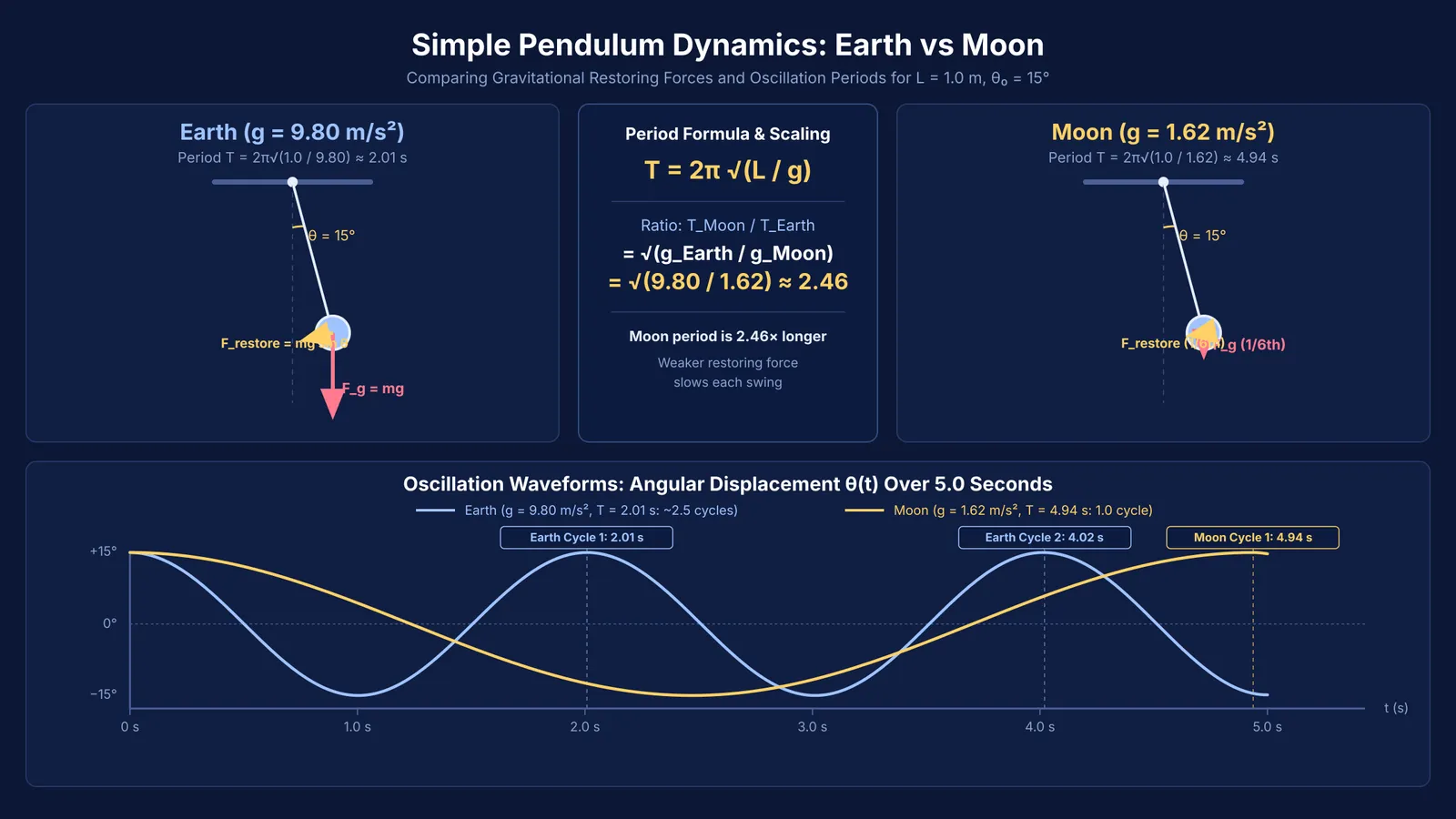
Imagine taking a 1-metre simple pendulum from your lab to the Moon. Before touching controls or calculating, ask yourself: will the pendulum tick faster, or will each swing take longer? Many students intuitively assume weak lunar gravity makes the bob float faster. But an oscillator requires a restoring force to pull the bob back toward equilibrium. On the Moon, gravitational acceleration is only 1.62 m/s² compared to Earth's 9.80 m/s², according to the NASA Moon Fact Sheet. Because lunar gravity exerts roughly one-sixth of Earth's downward pull, the restoring acceleration along the swing arc is far weaker, stretching each oscillation to nearly 2.5 times its Earth duration.
How do you calculate pendulum period on the Moon?
For small angular displacements, a simple pendulum behaves as a harmonic oscillator. As derived in OpenStax College Physics, when the displacement angle θ stays below 15°, the restoring force F = −mg sin θ simplifies to F ≈ −(mg/L) s, matching Hooke's law with stiffness k = mg/L. This yields the standard period equation:
T = 2π √(L/g)
Bob mass cancels out, while local gravity g appears under the square root in the denominator. For a 1.0 m string, Earth's period (g = 9.80 m/s²) is T = 2π √(1.0 / 9.80) ≈ 2.01 s. On the Moon, using g = 1.62 m/s² from the NASA Moon Fact Sheet yields T = 2π √(1.0 / 1.62) ≈ 4.94 s.
Taking the ratio eliminates string length and constants:
T_Moon / T_Earth = √(g_Earth / g_Moon) = √(9.80 / 1.62) ≈ √6.05 ≈ 2.46
The swing period stretches by a factor of 2.46. An Earth-calibrated pendulum clock on the Moon ticks roughly 24 times per minute instead of 60, advancing under 10 hours and losing more than 14 hours every standard 24-hour Earth day. You can explore related mechanics in our guides on how a seconds pendulum adjusts its length for local gravity and pendulums in an electric field where effective gravity shifts.
Why should you predict an outcome before running a simulation?
When using digital labs, dragging sliders passively builds little intuition. In the *American Journal of Physics*, researchers Crouch, Fagen, Callan, and Mazur showed that students who passively watched demonstrations scored 54% on predicting outcomes and 24% on explanations—barely exceeding students who saw no demonstration at all (49% and 22%).
When students committed to written predictions beforehand, scores rose to 69% on outcomes and 30% on explanations. A follow-up study by Miller, Lasry, Chu, and Mazur revealed that roughly 20% of students who made wrong predictions actually misremembered their subsequent observations to match their prior misconceptions. Committing to a prediction forces you to test your mental model against reality.
When an idea is easier to see than read, the Fermi Simulation Lab lets you adjust parameters like length and gravitational acceleration to inspect the physical response directly. If you want to practice setting up restoring force equations for varying gravities, the Fermi Problem Library provides worked problems with a step-by-step solver that explains the reasoning rather than printing an answer. For guided practice, Fermi's AI tutor works out what you already know and runs the simulation alongside you, checking your understanding as you explore.
How can you test lunar gravity in a simulation?
To test these relationships actively, set up an experiment using the NASA Moon Fact Sheet value of 1.62 m/s²:
Record your prediction: Note whether the pendulum will swing faster or slower when g drops from 9.80 m/s² to 1.62 m/s², and calculate the predicted period for L = 1.0 m.
Measure Earth baseline: Set L = 1.0 m and g = 9.80 m/s². Displace the bob by 10° and time 10 full oscillations. Dividing the elapsed time by 10 yields 2.01 s.
Switch to lunar gravity: Set g to 1.62 m/s² and release from 10°. Timing 10 cycles takes roughly 49.4 s, confirming a period of 4.94 s.
Verify mass independence: Change bob mass from 0.5 kg to 1.0 kg at 1.62 m/s². The period remains 4.94 s because gravitational mass cancels inertial mass.
Check against formula: Verify that your measured 4.94 s matches the formula T = 2π √(L/g) in OpenStax College Physics. You can also examine simple pendulum string tension at different points of the swing to see how reduced gravity lowers tension across the arc.
What are the most common misconceptions about pendulum period?
Exam problems frequently target three common conceptual errors regarding the pendulum equation derived in OpenStax College Physics:
Linear gravity scaling: Dividing gravity by 6 does not multiply period by 6. Because g sits inside a square root in the denominator, reducing gravity by six increases period by √6 ≈ 2.45 times (or 2.46 times for the Moon's 1.62 m/s² in the NASA Moon Fact Sheet).
Mass dependence in low gravity: Many assume heavier bobs fall faster on the Moon. However, mass cancels in Newton's second law (ma = −mg sin θ).
Large amplitude swings: The formula assumes sin θ ≈ θ. Displacements below 15° keep error under 1%, whereas 60° swings run measurably slower than the textbook formula predicts.


