

On this page
A pendulum bouncing off a wall looks like a new topic but is one you already know. You need two facts and one line of trigonometry.
What stays the same when a pendulum hits a wall?
For small swings, a simple pendulum has period T = 2π√(L/g), where L is its length and g is the acceleration due to gravity (HyperPhysics, Georgia State University). The same page gives its angular frequency as ω = √(g/L), and notes that for small swings the period does not depend on amplitude, an idea that goes back to Galileo's pendulum observations.
If you start the clock at the mean position, the angle follows θ = θ₀ sin(ωt), the standard displacement equation for simple harmonic motion (HyperPhysics). For other starting points, see how to find the SHM equation from initial position and velocity.
In a perfectly elastic collision (coefficient of restitution e = 1), the bob rebounds from a fixed wall with the same speed it arrived with (coefficient of restitution).
Put those together. After the bounce, the bob retraces its path exactly, like a film run backwards. The wall does not change the motion; it only cuts off the part of the swing beyond it. The period is just the time the bob spends on the allowed side.
What is the period if the wall is at the mean position?
Say the string hangs along a vertical wall when the bob is at rest. You pull the bob out to θ₀ and let go. It takes T/4 to swing down to the mean position, bounces, and takes another T/4 to climb back to θ₀. It never visits the other side.
So the period is T/2 = π√(L/g). Like the free pendulum, it does not depend on amplitude.
How do you find the period when the wall is at an angle?
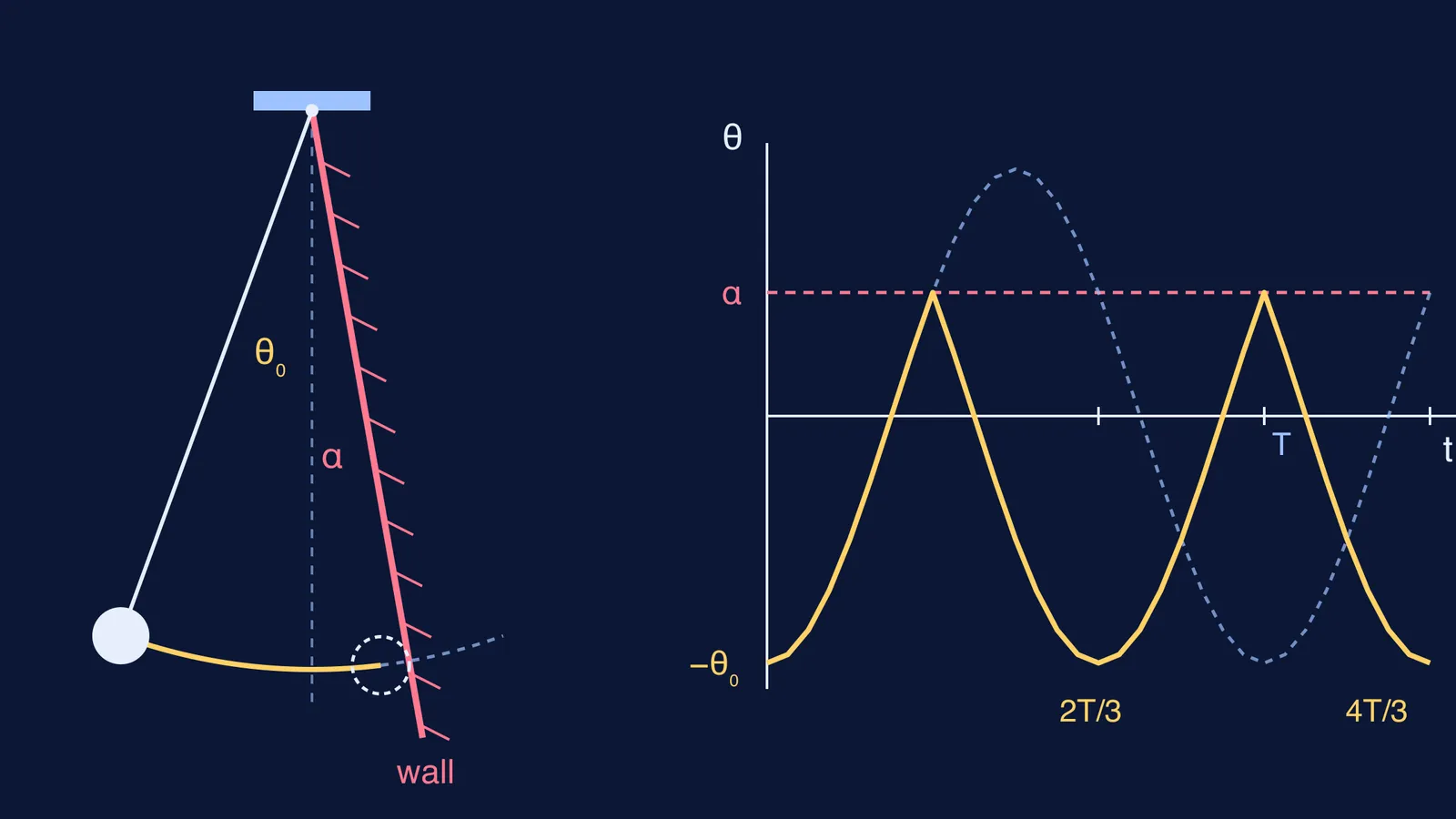
Now tilt the wall so it meets the string at angle α on the far side, with α smaller than θ₀, and release the bob from θ₀ on the near side. Split one cycle into four pieces:
From θ₀ on the near side down to the mean position: T/4.
From the mean position to the wall: solve α = θ₀ sin(ωt₁), so t₁ = (1/ω) arcsin(α/θ₀).
Bounce, and back to the mean position: t₁ again.
From the mean position back up to θ₀: T/4.
Add them: T′ = T/2 + 2t₁. Since 1/ω = T/(2π), this becomes
T′ = T/2 + (T/π) arcsin(α/θ₀)
Check both ends. With α = 0 you get T/2, the wall-at-the-mean case. With α = θ₀ you get T/2 + (T/π)(π/2) = T: the wall only touches the bob at its turning point, and nothing is cut off.
Worked example: amplitude 2°, wall at 1°
Here is a version from a practice site (Infinity Learn). A pendulum of length 1 m swings with amplitude 2° and hits, elastically, a wall inclined at 1° to the vertical. Take g = π² m/s².
Free period: T = 2π√(1/π²) = 2 s.
Near side, out and back: T/2 = 1 s.
Far side: 1° = 2° sin(ωt₁), so sin(ωt₁) = 1/2, ωt₁ = π/6 and t₁ = T/12 = 1/6 s.
Total: 1 + 2(1/6) = 4/3 s.
That is 2T/3, which the formula gives directly: T/2 + (T/π)(π/6). Problem 3.3.11 in Savchenko's problem book has the same set-up: the bob is released at twice the wall's angle (Savchenko 3.3.11). The same working applies.
How can you check your answer quickly?
These wall positions give clean answers from T′ = T/2 + (T/π) arcsin(α/θ₀):
α/θ₀ = 0 gives T′ = T/2
α/θ₀ = 1/2 gives T′ = 2T/3
α/θ₀ = 1/√2 gives T′ = 3T/4
α/θ₀ = √3/2 gives T′ = 5T/6
α/θ₀ = 1 gives T′ = T
Your answer must lie between T/2 and T. The bob always completes its near-side swing, and it can never take longer than a free pendulum.
Watch for these slips:
Treating angle as time. A wall at half the amplitude does not cut the far-side time in half (which would give 3T/4). The bob moves fastest near the mean position, so it covers the first half of the amplitude in one-third of a quarter period.
Dropping the factor 2. The bob goes to the wall and comes back.
Ignoring e. If e is less than 1, the bob rebounds slower than it arrived, so the amplitude shrinks after every bounce and the motion is no longer strictly periodic. With the wall at an angle, α/θ₀ then changes from one swing to the next, so the formula only gives the time for a single swing.
Large angles. Everything here relies on the small-angle form of the pendulum.
If you get stuck on the arcsin step, the Fermi Problem Library has worked problems with a step-by-step solver that explains the reasoning rather than printing an answer. If the SHM basics behind it feel shaky, the Fermi Concept Library gives each concept its own lesson.
Next, try a collision that changes the motion instead of just reversing it: what happens when a pendulum bob hits an identical bob at rest.


