

On this page
Why does x² make partial fractions so long?
If you want to break down the rational function x² / ((x² + 1)(x² + 4)), standard algebra rules dictate how you must handle the terms in the denominator. According to OpenStax Calculus, every irreducible quadratic factor—like (x² + 1) or (x² + 4)—requires a linear numerator of the form Ax + B. An irreducible quadratic is one that cannot be factored into real linear terms because it has no real roots.
Applying this rule to our specific fraction means writing the decomposition as: x² / ((x² + 1)(x² + 4)) = (Ax + B) / (x² + 1) + (Cx + D) / (x² + 4)
To clear the denominators, you multiply the entire equation by (x² + 1)(x² + 4). This leaves you with four unknown constants to find: A, B, C, and D. You have to multiply everything out, group the x³, x², x, and constant terms on the right side, and match their coefficients with the left side to solve a system of four simultaneous linear equations. It certainly works, but it takes considerable time and invites frustrating arithmetic errors, especially under exam pressure. If you are prone to making a mistake when solving large systems of equations, the Fermi Problem Library has worked problems with a step-by-step solver that explains the reasoning rather than printing an answer, helping you trace exactly where your algebra went wrong.
How do you treat x² as t?
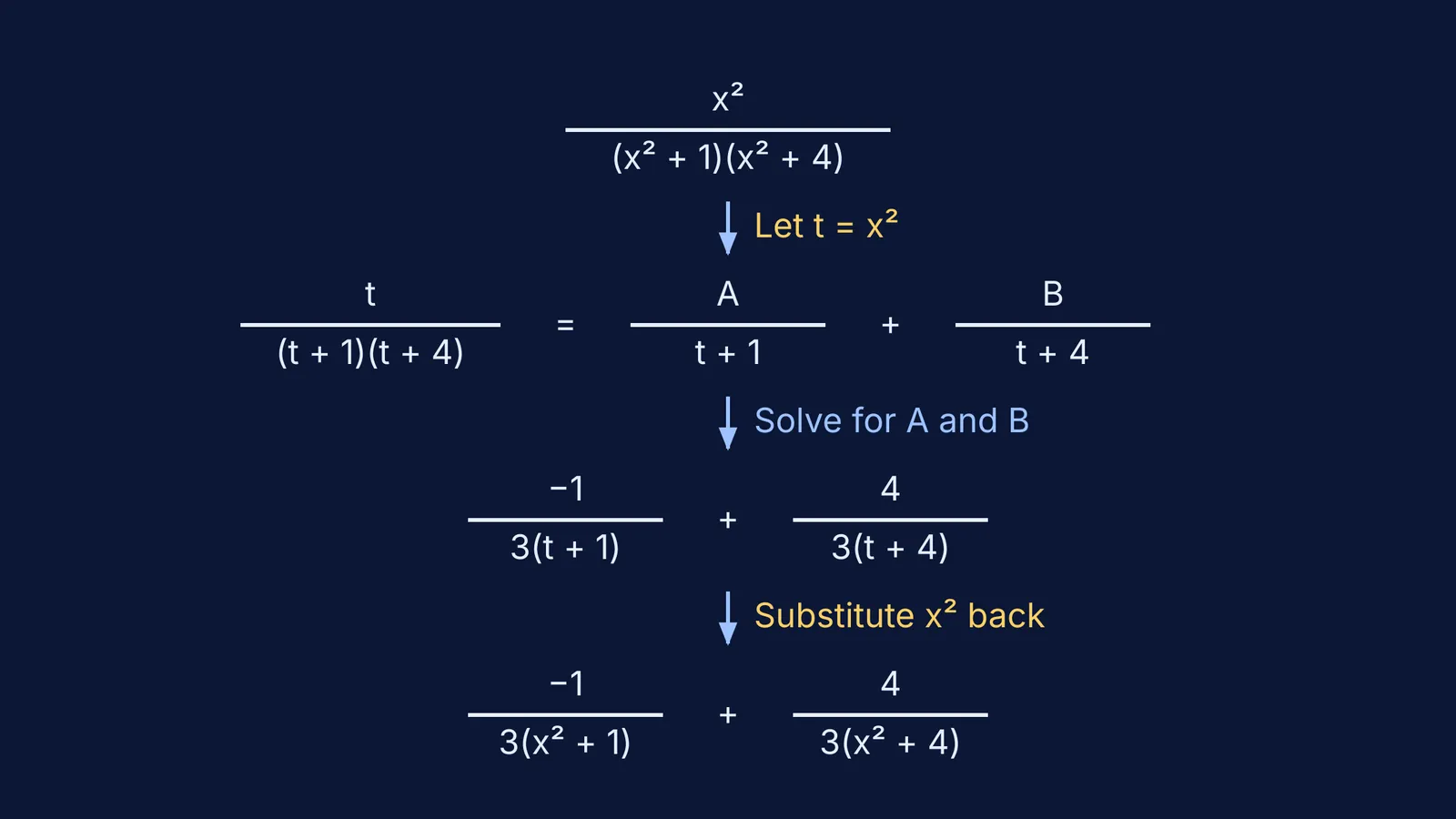
Look closely at the original function x² / ((x² + 1)(x² + 4)). Notice that there are no x³, x, or other odd powers of x anywhere in the expression. Every single x is squared. When this specific pattern happens, you can bypass the four-variable system and use a pure algebra shortcut.
Step 1: Temporarily replace every instance of x² with a new variable t. By doing this, the fraction becomes: t / ((t + 1)(t + 4))
Step 2: Decompose this new, simpler fraction. Because t is a linear variable (raised only to the power of 1), you now only need single constants in the numerators of your partial fractions: t / ((t + 1)(t + 4)) = A / (t + 1) + B / (t + 4)
This powerful substitution takes a complex four-variable system down to a basic two-variable system, cutting your calculation time in half.
How do you find the constants A and B?
You can use the Heaviside cover-up method, which is much faster than comparing coefficients and solving equations. First, multiply both sides by the common denominator (t + 1)(t + 4) to get a flat equation: t = A(t + 4) + B(t + 1)
Now, choose values for t that make the terms in the brackets zero.
Put t = −1 to eliminate B: −1 = A(−1 + 4) −1 = 3A A = −1/3
Put t = −4 to eliminate A: −4 = B(−4 + 1) −4 = −3B B = 4/3
So, the decomposition in terms of our temporary variable t is: (−1/3) / (t + 1) + (4/3) / (t + 4)
When do you substitute x² back in?
The substitution t = x² was only a temporary scaffold to make the algebra easier. It is not an integration substitution, so there is no differential dt = 2x dx to worry about. Once you have your decomposed fraction, you must immediately put x² back in place of t before doing any calculus.
The final decomposed fraction is: −1 / 3(x² + 1) + 4 / 3(x² + 4)
If this was an integration problem, you can now integrate the two separate terms directly. Both terms are of the form 1 / (x² + a²), which integrate to the standard arctan (or tan inverse) function: (1/a) arctan(x/a). This trick of swapping variables to simplify polynomials works across mathematics, such as when Solving Biquadratic Equations by Setting t = x².
Can you use this method if the numerator has an x?
No. This purely algebraic shortcut only works when every x in the expression is squared (or raised to an even power that can be written as a power of x²).
If your original fraction was instead x / ((x² + 1)(x² + 4)), substituting t = x² algebraically would leave a square root (√t) in the numerator, which completely ruins the rational format needed for partial fractions. However, for integration, having a single x in the numerator is exactly what you want for a true calculus substitution. You would let u = x² and therefore du = 2x dx, which absorbs the x in the numerator and elegantly solves the integral without needing partial fractions. For a deep dive into combining these methods on complex integrals, see How to Solve Integrals Using Substitution and Partial Fractions.
Knowing which substitution tool to pull from your kit saves time. If you want to review when to use pure algebraic substitution versus integration substitution, the Fermi Concept Library contains every concept in physics, chemistry, biology, mathematics and computing, each with its own lesson and its place in the map.


