

On this page
When you face an equation with a fourth power and a squared term but no odd powers, you do not need to guess roots or try long division. You can simply swap out the x² for a new variable to turn the problem into an ordinary quadratic equation.
A polynomial equation where the leading exponent is exactly double the middle exponent is considered quadratic in form and can be solved by substitution (OpenStax College Algebra/02%3A_Equations_and_Inequalities/2.06%3A_Other_Types_of_Equations)). By replacing x² with a temporary variable like t, a fourth-degree (biquadratic) equation drops down to degree two, which can be solved with factoring or the quadratic formula.
How do you solve x^4 minus 5x^2 plus 4 equals 0?
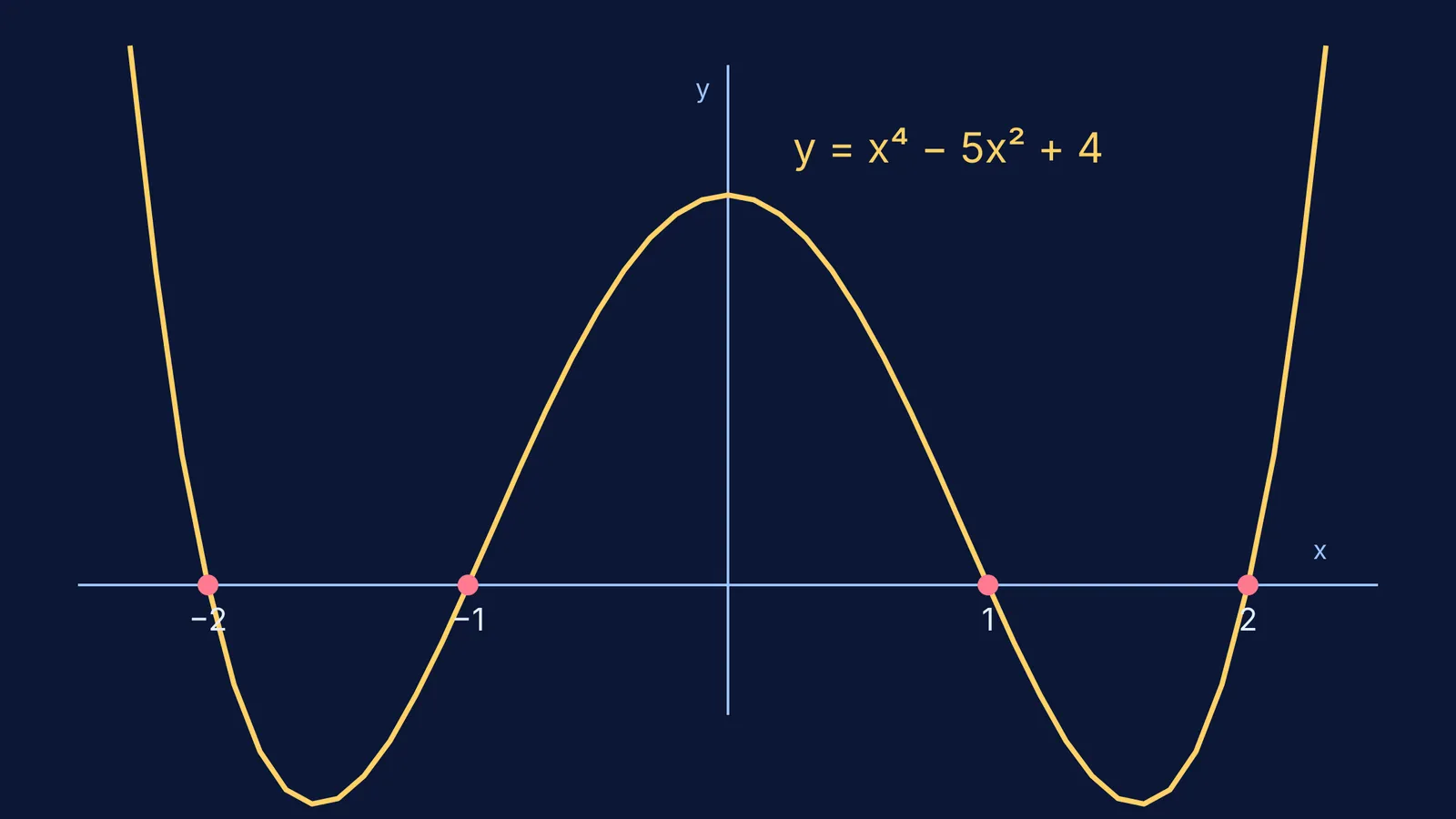
This classic biquadratic equation asks for the roots of x⁴ − 5x² + 4 = 0. Notice the pattern of the powers: 4, 2 and a constant.
Step 1: Make the substitution. Let t = x². This means t² = (x²)² = x⁴. Now rewrite the original equation in terms of t: t² − 5t + 4 = 0
Step 2: Solve the quadratic in t. This is a simple quadratic equation that factors easily. You need two numbers that multiply to 4 and add to −5: (t − 1)(t − 4) = 0 So, t = 1 or t = 4.
Step 3: Back-substitute to find x. Remember that t was just a stand-in for x². You must set x² equal to the values you found: For t = 1: x² = 1 x = ±1
For t = 4: x² = 4 x = ±2
The solution set is {−2, −1, 1, 2}. If a student gets stuck here, Fermi's AI tutor can guide them through the back-substitution step, drawing out the logic of why each positive value of t yields two values for x. You can also verify these visually by counting the roots by curve intersections.
What happens if the substitution gives a negative value for t?
Because you are solving for x in the real number system, x² cannot be negative. If your quadratic in t gives you a negative root, you must reject it for real solutions.
Consider the equation x⁴ + 5x² − 36 = 0. Substituting t = x² gives: t² + 5t − 36 = 0 (t + 9)(t − 4) = 0 This yields t = −9 or t = 4.
When you substitute back: x² = 4 gives x = ±2. x² = −9 has no real solutions (x = ±3i in complex numbers). So, the only real roots are x = 2 and x = −2. If you want to confirm these algebraically, you can test when a quadratic is positive for all x to see if its roots stay in the real plane. If you are learning these boundary cases, practicing in the Fermi Problem Library will show you step-by-step why the negative t branch halts in real algebra.
How do you solve equations with repeated quadratic blocks?
The substitution trick is not just for x⁴. Any repeated block can be swapped out. Here, the block (x² + x) appears squared and then to the first power in the equation (x² + x)² − 8(x² + x) + 12 = 0.
Let t = x² + x. The equation becomes: t² − 8t + 12 = 0 (t − 2)(t − 6) = 0 So, t = 2 or t = 6.
Now set up two separate quadratic equations for x:
x² + x = 2 → x² + x − 2 = 0 → (x + 2)(x − 1) = 0 → x = −2 or x = 1.
x² + x = 6 → x² + x − 6 = 0 → (x + 3)(x − 2) = 0 → x = −3 or x = 2.
The complete solution set is {−3, −2, 1, 2}. Before solving, you could also use the case-split method as a logical tool to ensure you have mapped out all possibilities.
How do you solve equations of the form (x+1)(x+2)(x+3)(x+4) = k?
This looks like a massive expansion problem that would create an unmanageable x⁴ polynomial, but you can force a substitution to appear by pairing the linear factors intelligently. The goal is to multiply two pairs so that they produce the exact same x² + bx terms.
Take the equation (x+1)(x+2)(x+3)(x+4) = 24. Check the constants inside each bracket: 1 + 4 = 5, and 2 + 3 = 5. Group the first with the fourth, and the second with the third: [(x+1)(x+4)] × [(x+2)(x+3)] = 24
Expand the pairs: (x² + 5x + 4) × (x² + 5x + 6) = 24
Now the repeated block is obvious. Let t = x² + 5x. (t + 4)(t + 6) = 24 t² + 10t + 24 = 24 t² + 10t = 0 t(t + 10) = 0
This gives t = 0 or t = −10. Substitute back into x² + 5x:
x² + 5x = 0 → x(x + 5) = 0 → x = 0 or x = −5.
x² + 5x = −10 → x² + 5x + 10 = 0. The discriminant (5² − 4×1×10 = −15) is negative, so this yields no real roots.
The only real solutions are x = 0 and x = −5. When encountering complex expressions, identifying hidden structures is often faster than brute-force multiplying.
How do you spot a substitution problem?
When an equation looks too big to factor directly, run through this check:
Does it have three terms, with the highest power double the middle one?
Is there a common expression trapped inside brackets?
Can you pair linear factors so their constant sums match?
If any of these are true, introduce t, solve the simpler quadratic, and work your way back to x. By looking for the structure first, you turn a tedious calculation into an elegant puzzle. To review these algebraic structures conceptually, explore the Fermi Concept Library map.


