On this page
Many capacitor questions in board exams and JEE Main test one distinction: what capacitance depends on versus what it merely relates. Here is the formula, a worked example you can check on a calculator, and a two-question habit for numericals.
What does the capacitance of a parallel plate capacitor depend on?
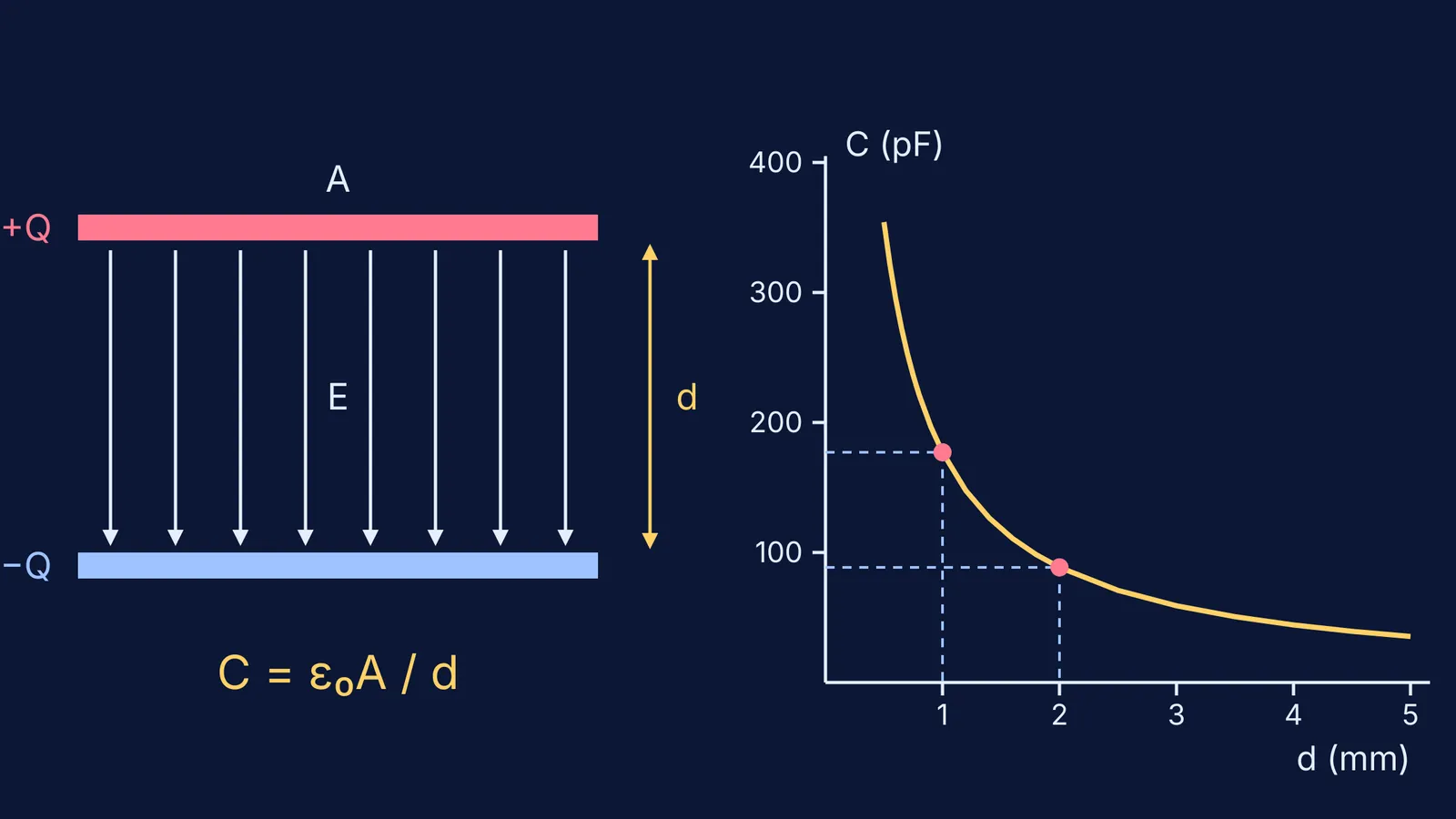
A parallel plate capacitor is two large flat conducting plates, each of area A, separated by a small distance d, as defined in Section 2.12 of the NCERT Class 12 Physics chapter on electrostatic potential and capacitance. With vacuum between the plates, NCERT derives C = ε₀A/d and notes that this depends only on the geometry of the system.
The permittivity of free space, ε₀, is 8.854 187 8188 × 10⁻¹² F m⁻¹ in the NIST CODATA 2022 recommended values. That is a constant, so you can change only three things:
Plate area A. C is proportional to A. Bigger plates hold more charge at the same voltage.
Gap d. C is inversely proportional to d. Bring the plates closer and C goes up.
The material in the gap. Fill the gap completely with a dielectric of dielectric constant K and C becomes Kε₀A/d. NCERT defines K as the factor, always greater than 1, by which capacitance increases from its vacuum value (Section 2.13, same chapter).
The formula assumes d is much smaller than the plate size (d² much less than A). Near the edges the field lines bend outward, which NCERT calls fringing, and the formula ignores this. If K is new to you, see our explainer on what the dielectric constant means.
Why don't charge and voltage change capacitance?
C = Q/V looks as if C depends on Q and V. It does not. NCERT's argument in Section 2.11 of the same chapter runs like this. Double the charge and the field between the plates doubles everywhere, so the potential difference doubles too. Q and V rise and fall together, and their ratio stays fixed. In NCERT's words, C is independent of Q or V.
Think of a jug: pour in more water (Q) and the level (V) rises, but the jug's cross-section (C) does not change. For the longer version, read why capacitance does not depend on charge and voltage.
A worked example: one capacitor, five changes
Take plates 10 cm by 20 cm (A = 0.02 m²) with a 1 mm gap, treated as vacuum like NCERT's own example. Using the NIST value of ε₀, C = (8.854 × 10⁻¹² × 0.02) / 0.001 = 1.77 × 10⁻¹⁰ F, about 177 pF. Now change one thing at a time:
Double the area to 0.04 m². C doubles to about 354 pF.
Halve the gap to 0.5 mm. C again doubles to about 354 pF.
Fill the 1 mm gap with a dielectric of K = 4. C becomes 4 × 177 = about 708 pF.
Connect a 12 V battery. Q = CV = 177 pF × 12 V, about 2.12 nC. C is still 177 pF.
Swap to a 24 V battery. Q doubles to about 4.25 nC. C is still 177 pF.
The first three changes moved C. The last two moved Q and left C alone. A partly filled gap needs a different calculation; see capacitance with a dielectric slab of thickness t.
What changes when the battery stays connected or is removed?
Once C changes, you need to know whether Q or V is held fixed. Charge the example capacitor to 12 V, then pull the plates from 1 mm to 2 mm, so C halves to about 88.5 pF.
Battery still connected: V is fixed at 12 V. Q = CV halves to about 1.06 nC. The field E = V/d falls from 12,000 V/m to 6,000 V/m.
Battery removed first: Q is fixed at 2.12 nC. V = Q/C doubles to about 24 V. The field stays at 12,000 V/m, because between the plates E = Q/(ε₀A), as NCERT shows in Section 2.12 of the chapter, and neither Q nor A changed.
C is 88.5 pF in both cases; only what the circuit let move differs.
How to practise this so it sticks
Write C = Kε₀A/d at the top of every capacitor problem and circle what changed.
Write "V fixed" or "Q fixed" next to it before you calculate anything.
Check the direction: closer plates or a dielectric should always raise C.
If you keep holding the wrong quantity fixed, try a few problems in the Fermi Problem Library, where the step-by-step solver explains the reasoning rather than printing an answer. For the ideas underneath, such as permittivity, the Fermi Concept Library gives each concept its own lesson.
Next time you see a capacitor question, ask the two questions first, then reach for the formula.