On this page
If an exam question gives you an alkene, Hg(OAc)2 and water, then NaBH4, the answer is the Markovnikov alcohol with the carbon skeleton unchanged. That unchanged skeleton is the detail these questions test.
What does oxymercuration-demercuration do to an alkene?
It adds H and OH across the double bond, with OH on the more substituted carbon. Herbert C. Brown and Philip Geoghegan described it in 1967 as a convenient, mild procedure for the Markovnikov hydration of the carbon-carbon double bond (Journal of the American Chemical Society, volume 89, pages 1522-1524).
The reaction runs in two steps:
Oxymercuration: mercury(II) acetate, Hg(OAc)2, in water (often mixed with THF) adds HgOAc to one carbon and OH to the other.
Demercuration: sodium borohydride, NaBH4, replaces the C-HgOAc bond with C-H.
The OpenStax textbook gives a typical result: 1-methylcyclopentene gives 1-methylcyclopentanol in 92 percent yield. It also notes why you would want this route at all: direct acid-catalysed hydration needs strongly acidic conditions and, for ethylene, about 250 °C.
Why is there no carbocation rearrangement?
Because the intermediate is not a free carbocation. The electrophile +Hg(OAc) attacks the double bond and forms a mercurinium ion, a three-membered ring that looks like a bromonium ion. In Wade's Organic Chemistry, the key line is: "No free carbocation is formed, so there is no opportunity for rearrangements or polymerization."
So where does Markovnikov come from? The same chapter explains that the mercurinium ion carries partial positive charge on both carbons, but more on the more substituted carbon. Water attacks that carbon, and mercury stays on the less substituted end. The chemistry LibreTexts course says the same thing: the OH goes to the most substituted carbon, and because no carbocation is involved, rearrangements are not observed/10:_Alkenes_and_Alkynes/10.06:_Two_Other_Hydration_Reactions_of_Alkenes).
If you need a refresher on how hydride and methyl shifts happen in the first place, read our explainer on carbocation rearrangements and 1,2-shifts.
Worked example: one alkene, two answers
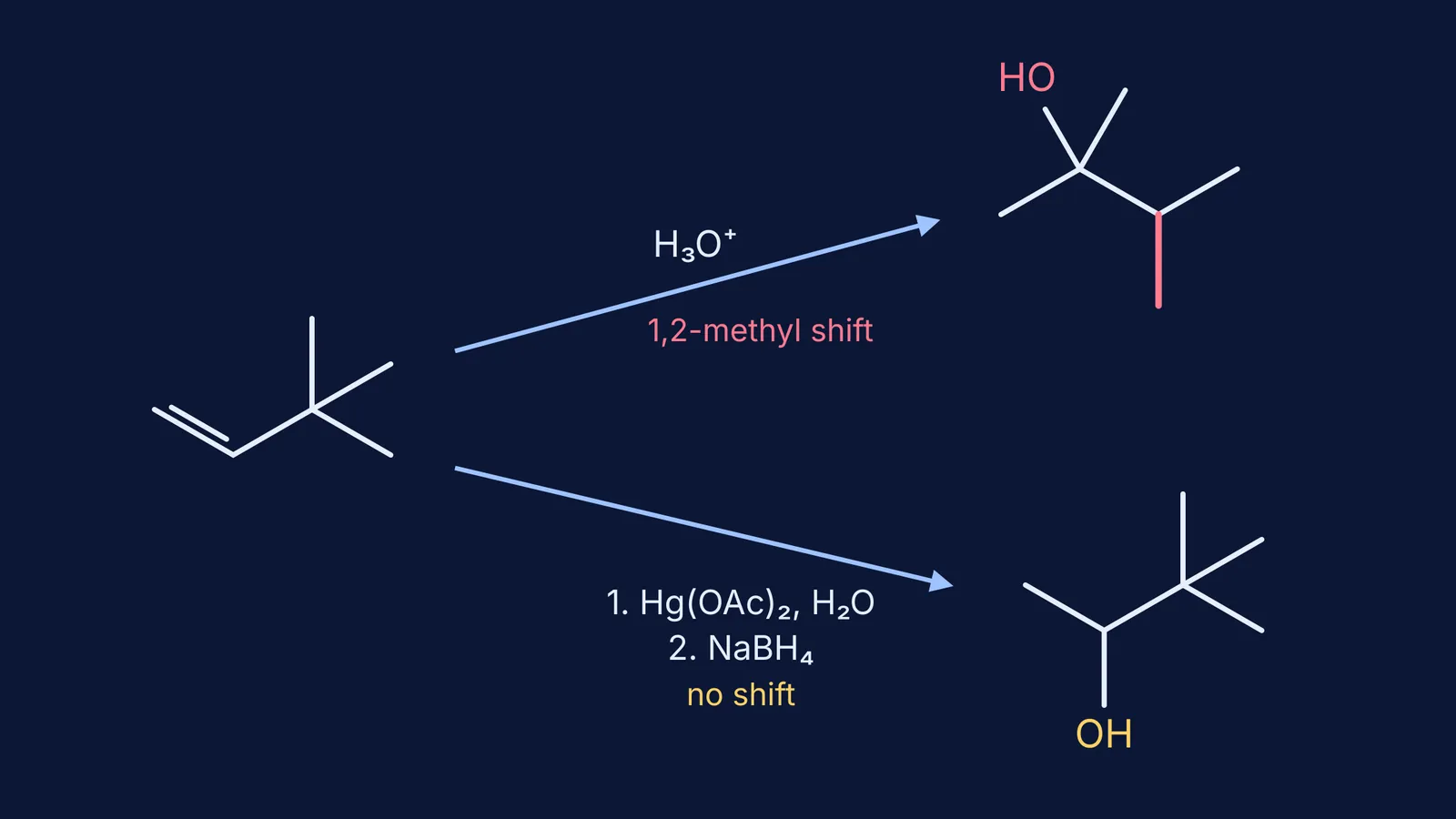
Take 3,3-dimethylbut-1-ene, CH2=CH-C(CH3)3. The worked example in Wade, chapter 8 compares the two routes.
Route A: 50% H2SO4 (acid-catalysed hydration)
H+ adds to CH2, giving a secondary carbocation next to the tert-butyl carbon.
A methyl group shifts across, giving a more stable tertiary carbocation.
Water attacks the new cation. Major product: 2,3-dimethylbutan-2-ol, which has a different skeleton from the starting alkene.
Route B: Hg(OAc)2, H2O, then NaBH4
+Hg(OAc) bridges C1 and C2 as a mercurinium ion.
Water attacks C2, the more substituted carbon, and HgOAc stays on C1.
NaBH4 replaces HgOAc with H. Product: 3,3-dimethylbutan-2-ol, reported at 94% overall yield.
The only difference is whether a free carbocation ever existed. Our post on acid-catalysed hydration of alkenes covers route A in more detail.
Which hydration method should you pick?
Use this decision list when a question asks you to make an alcohol from an alkene:
You want OH on the more substituted carbon and a shift is possible: oxymercuration-demercuration.
You want OH on the more substituted carbon and no shift is possible: acid hydration and oxymercuration give the same product.
You want OH on the less substituted carbon: hydroboration-oxidation. See our guide to hydroboration-oxidation and anti-Markovnikov alcohols.
The solvent is an alcohol (ROH) instead of water: alkoxymercuration. The alcohol attacks the mercurinium ion and you get a Markovnikov ether, as described by Master Organic Chemistry.
What do exam questions test about this reaction?
Run through this checklist before you write your final answer:
Regiochemistry: OH on the more substituted alkene carbon, H on the other.
Skeleton: the same carbons are joined in the same way as in the starting alkene.
Stereochemistry: the oxymercuration step is an anti addition, but Master Organic Chemistry notes that the NaBH4 step goes through a free radical, so that stereochemistry is lost and the overall reaction is not stereoselective.
Reagents: water gives an alcohol and ROH gives an ether. NaBH4 is only there to remove mercury.
Mercury compounds are toxic. That is why labs prefer other reagents when they can. The WHO lists mercury as one of the top ten chemicals of major public health concern.
If you get the product right but can't explain why it doesn't rearrange, the Fermi Concept Library gives each concept in chemistry its own lesson and shows its place in the map. To practise, the Fermi Problem Library has worked problems with a step-by-step solver that explains the reasoning rather than printing an answer.
Next step: write out route A and route B for 3-methylbut-1-ene from memory, then check each product against the checklist above.