

On this page
Redox reactions are notoriously tricky because the language feels completely backwards.
When you hear "reduction", it is natural to think something is being lost or getting smaller. However, in chemistry, reduction means gaining electrons. To make things worse, the substance that undergoes reduction is called the oxidising agent, and the substance that undergoes oxidation is the reducing agent.
In a 2019 study of first-year high school students, 40.11% were found to hold deep misconceptions about identifying these agents, making it the most confused area of redox chemistry. Students frequently assume that if a substance is oxidised, it must be the oxidising agent.
Historically, oxidation was defined simply as adding oxygen to a substance. When magnesium burns in air to form magnesium oxide, it gains oxygen. Reduction was defined as the removal of oxygen, such as refining iron ore into pure iron. In these classic examples, the terminology makes physical sense.
However, as chemistry advanced, scientists realised these reactions were fundamentally about the transfer of electrons. This shift from oxygen transfer to electron transfer is where the confusion usually starts. The language remained the same, but the mechanism shifted to tracking invisible, negatively charged particles.
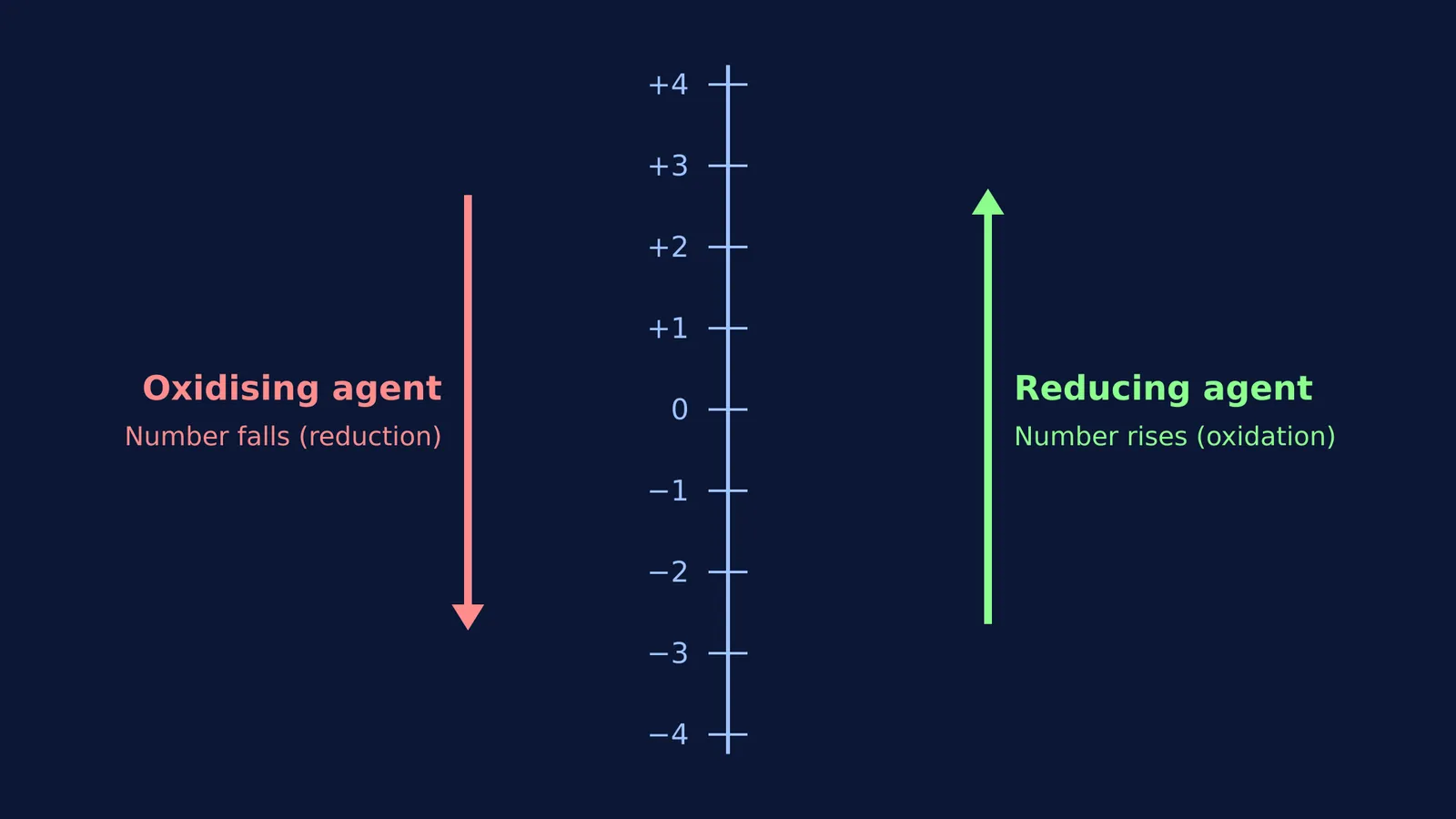
Because electrons are negative, gaining them (reduction) causes a mathematical decrease in the oxidation number. Conversely, losing negative electrons (oxidation) causes a mathematical increase. The most reliable way to avoid the linguistic trap is to ignore the names at first and just track the oxidation numbers.
How to identify the oxidising agent?
An oxidising agent (or oxidant) forces another substance to oxidise. By taking electrons away from that other substance, the oxidising agent gains those electrons itself.
Because electrons carry a negative charge, gaining them pushes the atom's oxidation number down.
To find the oxidising agent:
Assign an oxidation number to every atom on the reactant side.
Assign an oxidation number to every atom on the product side.
Look for the atom whose number falls (becomes more negative or less positive).
The entire reactant molecule containing that atom is your oxidising agent.
If you ever forget the standard assignment rules, the Fermi Concept Library breaks down every concept in chemistry with its own lesson and its place in the map.
How to identify the reducing agent?
A reducing agent (or reductant) forces another substance to reduce by giving away its own electrons.
When an atom loses negatively charged electrons, its oxidation number becomes more positive.
To find the reducing agent:
Compare the reactant and product oxidation numbers.
Look for the atom whose number rises (becomes more positive or less negative).
The entire reactant molecule containing that atom is your reducing agent.
If you find yourself relying on rote memorisation and still getting the agents backwards, Fermi's AI tutor can work out what you already know and build a plan for the session, teaching you the underlying electron transfers until it clicks.
A step-by-step worked example
Let us look at a classic reaction: the extraction of zinc from zinc oxide using carbon.
ZnO + C → Zn + CO
First, assign the oxidation numbers to the reactants:
In ZnO, oxygen is almost always −2. Therefore, zinc must be +2 to balance it out.
C is a pure, uncombined element, so its oxidation number is 0.
Next, assign the oxidation numbers to the products:
Zn is now a pure element, so its oxidation number is 0.
In CO, oxygen is −2. Therefore, carbon must be +2.
Now, track the changes:
Zinc goes from +2 to 0. Its oxidation number falls. It has been reduced, which makes ZnO the oxidising agent.
Carbon goes from 0 to +2. Its oxidation number rises. It has been oxidised, which makes C the reducing agent.
Let us look at another common reaction involving iron:
Fe₂O₃ + 3CO → 2Fe + 3CO₂
Following the same steps:
In Fe₂O₃, oxygen is −2, so iron must be +3 to give a neutral molecule.
In CO, oxygen is −2, making carbon +2.
On the product side, Fe is a free element (0).
In CO₂, oxygen is −2, making carbon +4.
Tracking the changes:
Iron goes from +3 to 0. Its number falls, meaning it is reduced. The entire reactant, Fe₂O₃, is the oxidising agent.
Carbon goes from +2 to +4. Its number rises, meaning it is oxidised. The reactant CO is the reducing agent.
When you face equations with tricky structures where standard rules fail, such as CrO₅ or Fe₃O₄, you will need to find oxidation numbers from structure first. When you are stuck on a complicated equation, the Fermi Problem Library has worked problems with a step-by-step solver that explains the reasoning rather than printing an answer.
The agent checklist
When solving exam questions, keep this checklist handy to verify your logic:
Did the oxidation number rise? The substance was oxidised, making it the reducing agent.
Did the oxidation number fall? The substance was reduced, making it the oxidising agent.
Did it gain oxygen atoms? It was oxidised (reducing agent).
Did it lose oxygen atoms? It was reduced (oxidising agent).
Did it gain hydrogen atoms? It was reduced (oxidising agent).
Did it lose hydrogen atoms? It was oxidised (reducing agent).
Once you master these rules, predicting everyday reactions like corrosion and rancidity or industrial processes such as the electrolytic refining of copper becomes a simple matter of tracking the numbers.


