

On this page
Orthogonal trajectories are a standard application of first-order differential equations, and the method is the same every time: get the slope of the family, turn it through a right angle, and solve again. Below are the steps, three worked families, and a check you can run on any answer.
What are orthogonal trajectories?
An orthogonal trajectory is a curve that cuts every curve of a given family at a right angle (Wikipedia: Orthogonal trajectory).
A right angle between curves means the tangents at the meeting point are perpendicular, so the slopes are linked by y₂′ = −1/y₁′, as the LibreTexts notes on orthogonal trajectories put it. If that −1 rule feels shaky, start with our post on why the product of slopes of perpendicular lines is −1.
How do you find orthogonal trajectories of a family of curves?
Differentiate the family equation once with respect to x.
Eliminate the arbitrary constant, so you have dy/dx = f(x, y) with no constant left.
Replace dy/dx with −dx/dy. This is the same as writing dy/dx = −1/f(x, y).
Solve the new differential equation, usually by separating variables or as a homogeneous equation.
Check: take one curve from each family, find a point where they meet, and confirm the slopes multiply to −1.
Step 2 is where answers usually go wrong. Each point (x, y) sits on one curve of the family, so the slope there must be written in x and y alone. If the constant survives the swap, the answer is wrong.
Why do circles give lines through the origin?
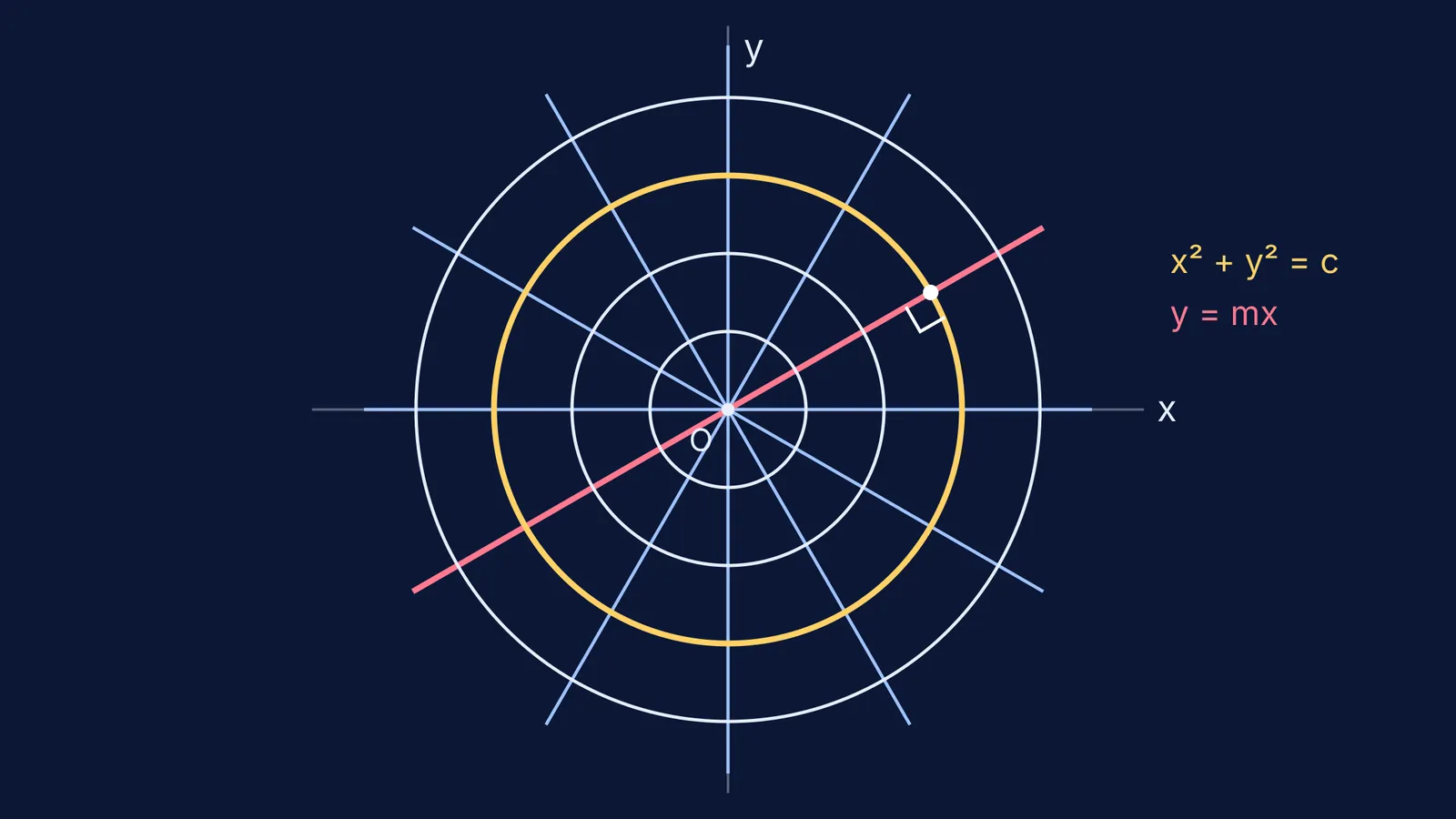
Take the concentric circles x² + y² = c.
Differentiate: 2x + 2y(dy/dx) = 0, so dy/dx = −x/y. The constant vanished on differentiation, so step 2 is already done.
Swap: −dx/dy = −x/y, which is dx/dy = x/y.
Separate: dy/y = dx/x.
Integrate: ln|y| = ln|x| + ln|m|, so y = mx.
Writing the constant as ln|m| keeps the answer tidy; our explainer on why we write the constant of integration as ln C covers that habit.
The orthogonal trajectories of concentric circles are the lines through the origin, which matches the example in the Wikipedia article. It makes geometric sense too: a radius always meets its circle at a right angle.
Now run it backwards as a check. For y = mx, dy/dx = m, and eliminating m gives dy/dx = y/x. Swap: −dx/dy = y/x, so x dx + y dy = 0, which integrates to x² + y² = c. You get the circles back, so the method works in both directions.
Worked example: parabolas y = ax²
This family needs step 2. Differentiate: dy/dx = 2ax. From the original equation, a = y/x², so dy/dx = 2y/x.
Swap: −dx/dy = 2y/x, so 2y dy = −x dx. Integrate: y² = −x²/2 + C, or x² + 2y² = k after renaming the constant. The orthogonal trajectories of the parabolas y = ax² are ellipses, the same answer the LibreTexts worked example reaches.
Check at the point (1, 1). The parabola y = x² has slope 2 there. The ellipse x² + 2y² = 3 passes through (1, 1) with slope −x/(2y) = −1/2. The product is −1, so the curves cross at a right angle.
A JEE-style family: circles touching the y-axis at the origin
Family: x² + y² = 2ax. Differentiate: 2x + 2y(dy/dx) = 2a. Eliminate a using 2a = (x² + y²)/x, which gives 2y(dy/dx) = (y² − x²)/x, so dy/dx = (y² − x²)/(2xy).
Swap: −dx/dy = (y² − x²)/(2xy), so dy/dx = 2xy/(x² − y²). This is homogeneous, and the substitution y = vx separates it.
In an exam, testing a candidate is often faster than solving from scratch. Try the circles x² + y² = 2by, which touch the x-axis at the origin. Differentiate: 2x + 2y(dy/dx) = 2b(dy/dx). Substitute 2b = (x² + y²)/y and simplify: dy/dx = 2xy/(x² − y²), exactly the swapped equation. Our guide on how to verify that a function solves a differential equation shows this move in more detail.
If you set up the equation but cannot see where your working went off track, the Fermi Problem Library has worked problems with a step-by-step solver that explains the reasoning rather than printing an answer.
Which mistakes cost marks?
Swapping before eliminating the constant.
Replacing dy/dx with −dy/dx. Flipping the sign reflects the tangent in the x-axis; it does not turn it through a right angle.
Replacing dy/dx with dx/dy and forgetting the minus sign. That reflects each tangent in the line y = x instead; for the circles x² + y² = c it gives the hyperbolas xy = k, not lines.
Skipping the check. Testing one point is quick and catches all three.
If the pieces underneath feel loose, such as implicit differentiation or separable equations, the Fermi Concept Library gives each concept its own lesson and its place in the map.


