On this page
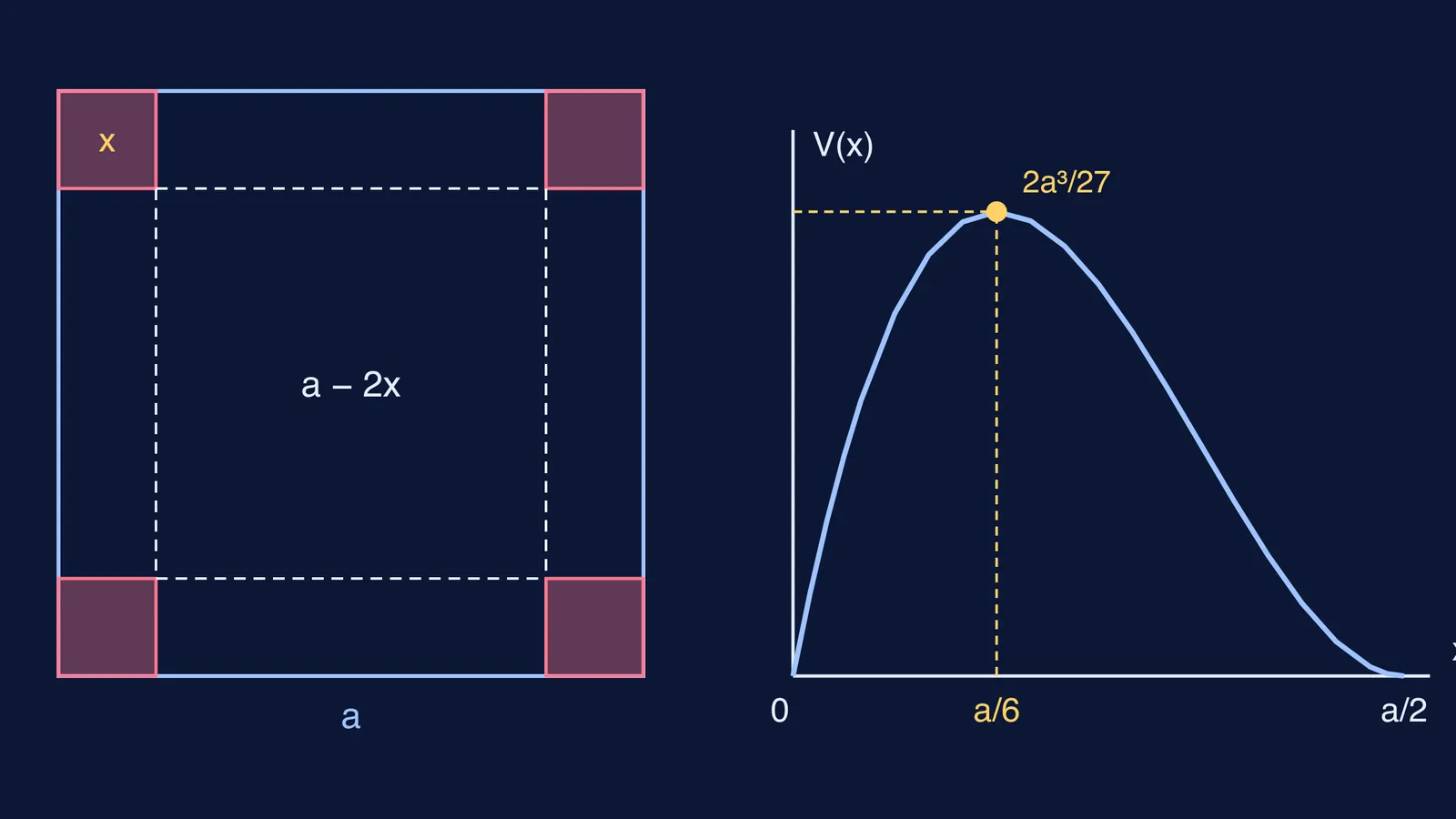
Take a square sheet of side a, cut a square of side x from each corner and fold up the flaps. The open box has its largest volume when x = a/6. This is one of the standard optimisation problems in Class 12 calculus. The NCERT chapter Application of Derivatives asks it with an 18 cm square of tin (Exercise 6.3, Question 17, worked solution on Teachoo).
Below is the general method in four steps, the NCERT numbers worked through, and a checklist of the slips that cost marks.
How do you write the volume V(x) of the open box?
Picture the flat sheet before you fold it. Each side of the sheet loses a length x at both ends, so the base of the box is a square of side a − 2x. The flaps fold up to make walls of height x.
Volume is base area times height:
V(x) = x(a − 2x)²
Everything after this line depends on it, so check it against a quick sketch. The most common slip is writing a − x for the base.
What values of x are allowed?
The domain is 0 < x < a/2. At x = 0 you cut nothing and there are no walls. At x = a/2 the base shrinks to a point. Both ends give zero volume, so the maximum has to lie strictly between them.
Write the domain down before you differentiate. Later it lets you reject a root with a reason instead of a guess.
Why is the best cut x = a/6?
Differentiate with the product rule:
V′(x) = (a − 2x)² − 4x(a − 2x) = (a − 2x)(a − 6x)
Setting V′(x) = 0 gives x = a/2 or x = a/6. The root x = a/2 lies outside the domain (it is the flat, zero-volume case), so the only critical point is x = a/6.
At that cut, the base side is a − a/3 = 2a/3 and the height is a/6. The volume is:
V(a/6) = (a/6)(2a/3)² = 2a³/27
How does the second derivative confirm a maximum?
Differentiate V′(x) = (a − 2x)(a − 6x) once more:
V″(x) = −2(a − 6x) − 6(a − 2x) = 24x − 8a
At x = a/6, V″ = 4a − 8a = −4a. Since a > 0, V″(a/6) is negative. The graph bends downward there, so x = a/6 is a local maximum.
That proves a local maximum. To show it is the largest volume of all, note that x = a/6 is the only critical point in the domain and V is zero at both ends. So it is also the maximum over the whole interval.
Worked example: the NCERT 18 cm tin sheet
NCERT's version uses a = 18 cm, and the step-by-step Teachoo solution follows the same route:
Set up: V(x) = x(18 − 2x)², with domain 0 < x < 9.
Differentiate: V′(x) = (18 − 2x)(18 − 6x) = 12(9 − x)(3 − x), so x = 3 or x = 9.
Reject x = 9, since the base would be 0 cm.
Check: V″(x) = 24x − 144, so V″(3) = −72, which is negative, so this is a maximum.
Answer: cut 3 cm squares. The box measures 12 cm by 12 cm by 3 cm, with volume 432 cm³.
The general formula agrees: 18/6 = 3, and 2(18)³/27 = 432. A quick check with nearby values also helps. A 2 cm cut gives 2 × 14² = 392 cm³, and a 4 cm cut gives 4 × 10² = 400 cm³. Both are smaller.
The next question in the same exercise starts from a 45 cm by 24 cm rectangle. There the answer is a 5 cm cut, the rejected root is 18 cm and V″(5) = −156 (worked solution for Question 18). The a/6 shortcut works only for squares, so for a rectangle set up V(x) = x(l − 2x)(b − 2x) from scratch.
What mistakes cost marks on this problem?
Run through this list before you move to the next question:
Base written as a − x instead of a − 2x.
No domain stated, so no reason given for rejecting x = a/2.
Stopping at V′(x) = 0 without the second derivative test or a sign check.
Answering with the volume when the question asks for the side of the cut, or the other way round. Read the last line of the question again.
Missing units: cm for x, cm³ for the volume.
If your setup is right but you lose track in the algebra, the Fermi Problem Library has worked problems with a step-by-step solver that explains the reasoning rather than printing an answer. If the second derivative test still feels shaky, the Fermi Concept Library gives every mathematics concept its own lesson.
Try it yourself with a 30 cm square sheet. You should get a 5 cm cut and a volume of 2000 cm³.