

On this page
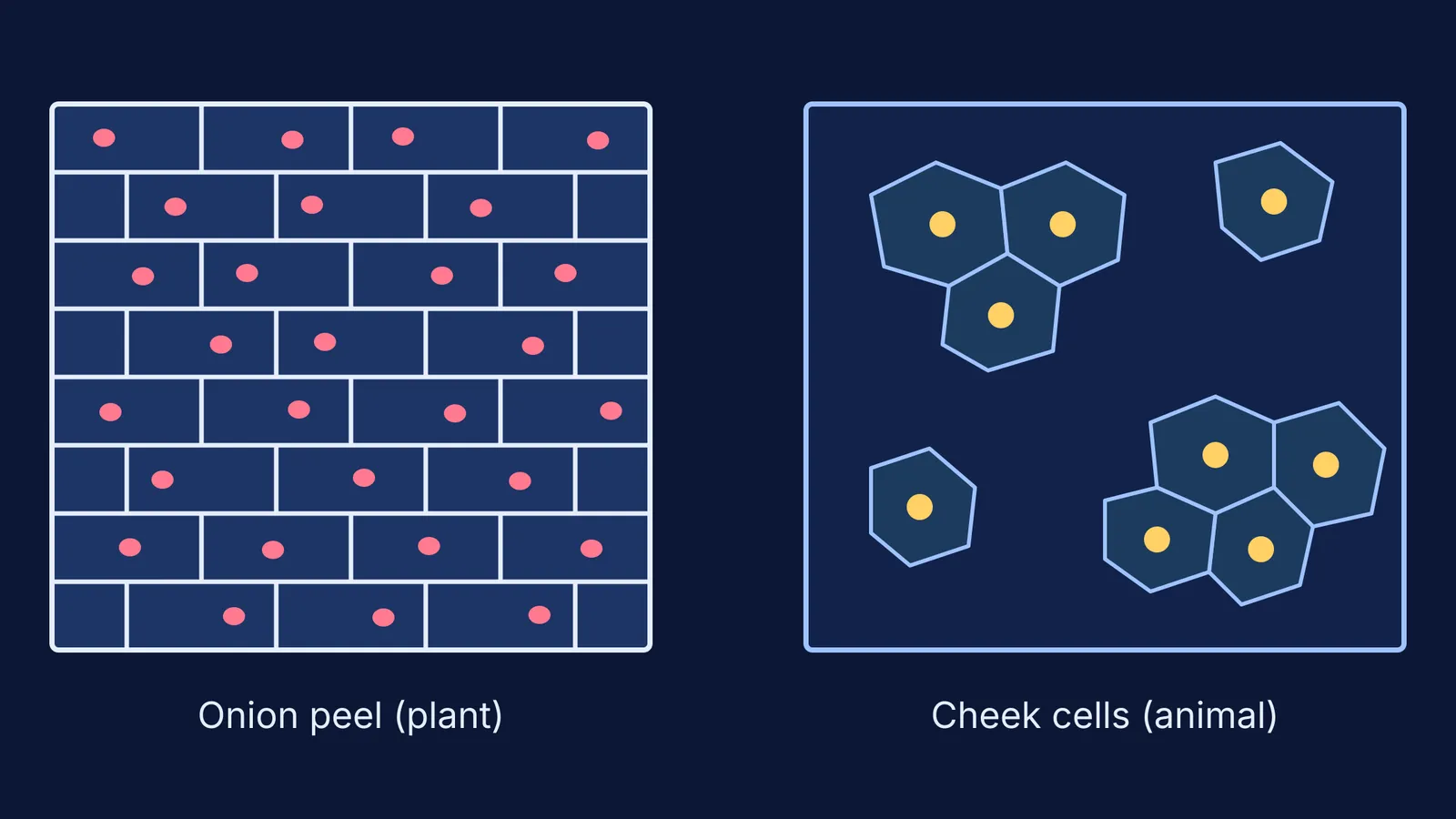
These two slides show the plant and animal difference you have been memorising: one has a cell wall and the other does not. The steps follow the NCERT Class 9 Science laboratory manual (Experiments 18 and 19), followed by a drawing checklist and fixes for slides that go wrong.
What do you need to prepare onion peel and cheek cell slides?
The NCERT lab manual lists these materials for the two experiments:
an onion bulb, glass slides and cover slips
two watch glasses, a needle, a brush, forceps and a razor blade
methylene blue (or safranin) solution, glycerine, water and blotting paper
a clean toothpick or spatula for the cheek cells
a compound microscope
Iodine also works for onion peel: the Biology I Laboratory Manual from Lumen Learning mounts onion epidermis in iodine solution. Use the stain your lab gives you and name it in your record.
How do you prepare an onion peel slide?
These steps come from Experiment 18 of the NCERT lab manual.
Take one fleshy scale leaf of the onion and snap it in two.
With forceps, pull the thin, see-through peel off its inner surface. This is the epidermal peel.
Put the peel in a watch glass of water and cut it into small rectangles.
In a second watch glass, mix 1 or 2 drops of methylene blue or safranin into a little water. Leave the peels in it for about 3 minutes.
Dip the peel in water to wash off the extra stain.
Put a drop of glycerine in the middle of a clean slide and lift the peel onto it with a brush.
Lower a cover slip slowly onto it, resting one edge on a needle, so no air bubbles get in.
Soak up the extra glycerine at the edges with blotting paper.
Look at the slide under low power first, then under high power.
How do you prepare a cheek cell slide?
Experiment 19 in the NCERT manual uses scraped cells instead of a peel.
Rinse your mouth with fresh water.
Scrape the inside of your cheek gently with a clean toothpick or spatula. Never press hard.
Put the scraping into a drop of water on a clean slide.
Spread it into a thin, even layer with a needle.
Add a drop of methylene blue. After about 3 minutes, put a drop of glycerine over it.
Place a clean cover slip on top and blot the extra glycerine from the edges.
Look at it under low power, then high power.
Use each toothpick once and throw it away. New to microscopes? Read how to focus a compound microscope without cracking the slide before your practical.
What should your plant and animal cell drawings show?
Draw what you see, not the textbook figure, then check it against the NCERT manual.
The onion peel cells are rectangular, packed tightly with no gaps between them, and each one has a clear cell wall, a prominent nucleus and a vacuole. Cheek cells are small, polygonal (many-sided) and packed close together in a continuous layer, and they have no cell wall.
Use this checklist for each drawing:
Onion peel: draw several cells, joined like bricks in a wall with no gaps between them. Label the cell wall, cell membrane, cytoplasm and nucleus, the labels the NCERT figure uses.
Cheek cells: draw a few flat, uneven, many-sided cells with thin outlines and a dark central nucleus. Label the cell membrane, cytoplasm and nucleus. Do not draw a cell wall.
Use a sharp pencil, unbroken outlines and straight label lines that never cross.
Under each drawing, note the stain and the power (low or high).
If drawing worries you, try a simple method for biology diagrams.
Why is my slide not showing cells clearly?
These fixes build on the precautions in the NCERT manual.
Everything is dark blue or red: the peel is overstained. Rinse it again in the watch glass of water before mounting.
Round shapes with thick black rims: these are air bubbles, not cells. Remount, lowering the cover slip slowly against a needle.
Blurry, layered patches: the peel is folded or too thick. Cut a smaller piece and spread it flat with the brush.
Cheek slide looks empty: you have too little material, or it is not spread out. Scrape gently again and spread it into a thin, even layer.
The cover slip slides around: there is too much glycerine. Blot the edges.
You cannot find anything at high power: go back to low power, find a stained patch, centre it, then switch.
If you are not sure why plant cells need a wall, the Fermi Concept Library covers every concept in biology, each with its own lesson, so you can read the idea behind the slide. For the rest of the practical, see how to identify slides and specimens in biology spotting.


