

On this page
When you substitute x = 0 into (1 − cos x)/x², cosine evaluates to cos(0) = 1, giving (1 − 1)/0² = 0/0. While competitive exam aspirants often race to differentiate using when L'Hôpital's rule can be used, relying entirely on differentiation conceals the underlying geometry.
Understanding why this limit equals 1/2 through algebraic identities equips you to solve more complex variants—such as (cos x − cos 2x)/x²—without repeated differentiation. As outlined in the CBSE Senior Secondary Curriculum under Unit-IV Calculus, mastering algebraic transformations is the intended foundation before students advance to higher-order derivatives.
Why does the limit of (1 − cos x)/x² give a 0/0 indeterminate form?
Direct evaluation fails because the numerator and denominator vanish simultaneously at x = 0:
Numerator: 1 − cos(0) = 1 − 1 = 0
Denominator: 0² = 0
In calculus, a 0/0 quotient indicates that the rate at which the numerator approaches zero balances against the rate of the denominator. The standard benchmark is:
lim (θ → 0) (sin θ / θ) = 1
Derived in the NCERT Class 11 Mathematics textbook using the squeeze theorem, this result requires θ to be in radians (see why we use radians in calculus). Because 1 − cos x contains no sine function initially, we transform the cosine term into a sine term using trigonometry.
How do you prove the limit of (1 − cos x)/x² using 2 sin²(x/2)?
The direct algebraic path replaces 1 − cos x with its half-angle counterpart. Recall the cosine double-angle identity:
cos(2θ) = 1 − 2 sin²(θ)
Setting 2θ = x gives θ = x/2:
1 − cos x = 2 sin²(x/2)
Substituting this into the limit gives:
lim (x → 0) (1 − cos x) / x² = lim (x → 0) [2 sin²(x/2)] / x²
To apply the standard sine limit, the denominator must match the squared argument (x/2)² = x²/4. We rewrite the denominator accordingly:
[2 sin²(x/2)] / x² = 2 · [sin(x/2)]² / [4 · (x/2)²] = (1/2) · [sin(x/2) / (x/2)]²
As x approaches 0, the angle x/2 also approaches 0:
lim (x → 0) [(1/2) · (sin(x/2) / (x/2))²] = (1/2) · (1)² = 1/2
How does chord length in a unit circle explain the result geometrically?
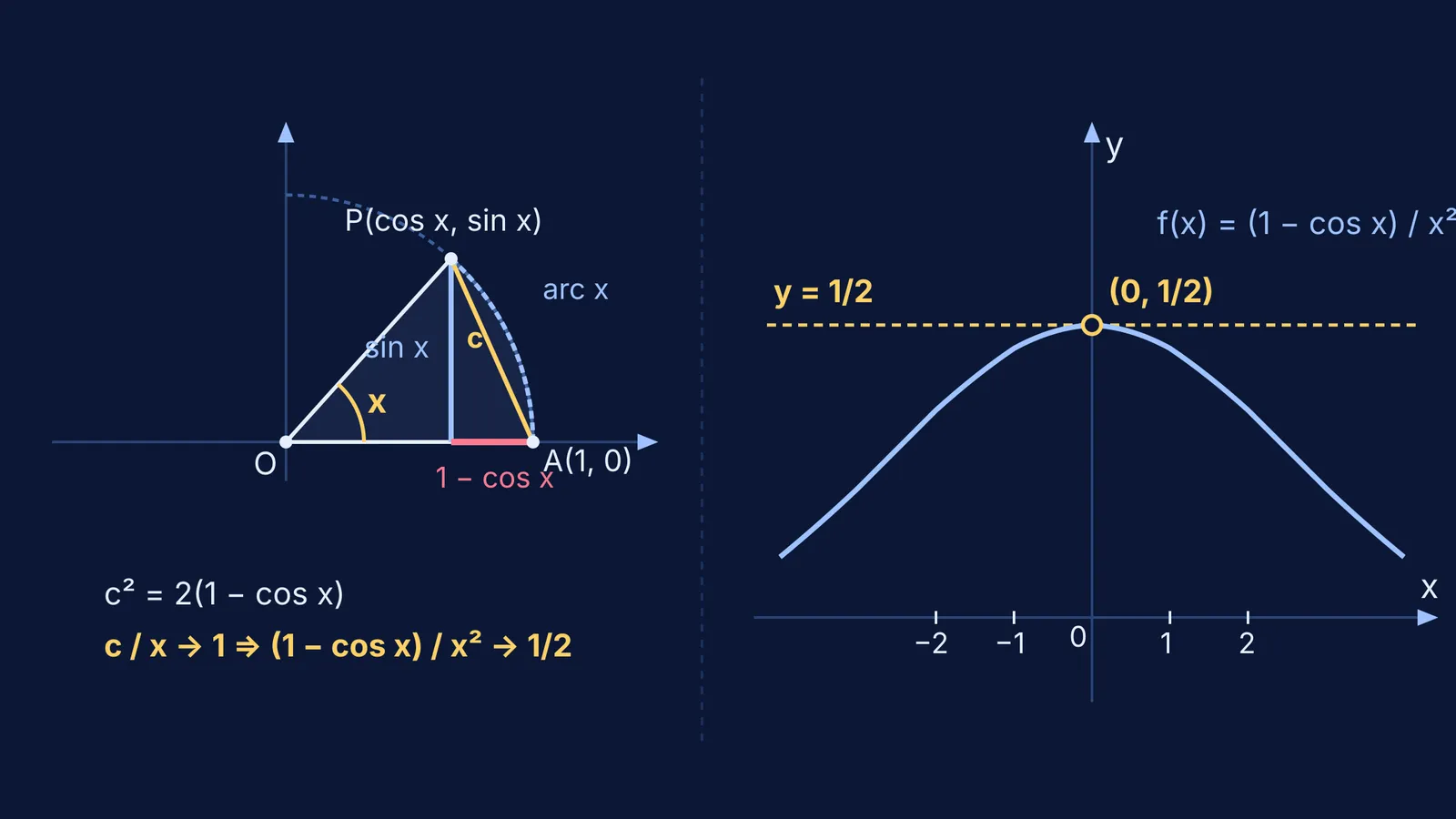
Beyond algebra, circle geometry explains why the factor of 1/2 appears. In the *Proofs Without Words* series edited by Roger B. Nelsen (DOI: 10.1090/clrm/001), a visual proof by Guanshen Ren evaluates the limit using the relationship between the chord and arc of a unit circle.
Consider a unit circle centered at the origin. Let point A be (1, 0) and point P be (cos x, sin x) at an angle of x radians. The chord length c between A and P satisfies:
c² = (1 − cos x)² + (sin x)² = 1 − 2 cos x + cos² x + sin² x = 2(1 − cos x)
Meanwhile, the circular arc length connecting A and P is exactly x. As the angle x shrinks toward 0, chord length c and arc length x converge, so their ratio c / x approaches 1:
lim (x → 0) (c² / x²) = 1² = 1
Substituting c² = 2(1 − cos x) gives 2(1 − cos x) / x² → 1, which simplifies directly to:
lim (x → 0) (1 − cos x) / x² = 1/2
Research on mathematical cognition by David Tall and Shlomo Vinner (DOI: 10.1007/BF00305619) emphasizes that a student's concept image—their intuitive mental pictures and associations—must develop alongside formal definitions to prevent cognitive conflict when evaluating limits.
To see how fundamental limits connect with derivatives across the curriculum, explore the Fermi Concept Library, which covers every concept in physics, chemistry, biology, mathematics and computing, each with its own lesson and its place in the map.
How do you solve the cos x − cos 2x variation?
A common question in JEE Main asks for the limit of (cos x − cos 2x)/x² as x approaches 0. You can resolve this variation using two methods.
Method 1: Adding and subtracting 1
Split the numerator into two expressions matching the 1 − cos θ template:
cos x − cos 2x = (1 − cos 2x) − (1 − cos x)
Dividing both terms by x²:
(cos x − cos 2x) / x² = [(1 − cos 2x) / x²] − [(1 − cos x) / x²]
For (1 − cos 2x)/x², scale the denominator by 2² = 4: 4 · [1 − cos(2x)] / (2x)² → 4 · (1/2) = 2.
For (1 − cos x)/x², the standard value is 1/2.
Subtracting the limits gives 2 − 1/2 = 3/2.
Method 2: The cosine difference-to-product formula
Using the identity cos C − cos D = 2 sin((C + D)/2) sin((D − C)/2):
cos x − cos 2x = 2 sin(3x/2) sin(x/2)
Dividing by x² and grouping factors:
[2 sin(3x/2) sin(x/2)] / x² = 2 · (3/2) · [sin(3x/2) / (3x/2)] · (1/2) · [sin(x/2) / (x/2)]
Taking the limit yields 2 · (3/2) · (1/2) · 1 · 1 = 3/2. Compare this with limits using series expansions.
What is the general shortcut for cos(ax) − cos(bx) over x²?
Generalizing Method 1 provides a shortcut for any cosine difference divided by x²:
lim (x → 0) [cos(ax) − cos(bx)] / x² = (b² − a²) / 2
Derivation:
[cos(ax) − cos(bx)] / x² = b² · [(1 − cos(bx)) / (bx)²] − a² · [(1 − cos(ax)) / (ax)²]
Taking the limit as x approaches 0 gives b² · (1/2) − a² · (1/2) = (b² − a²) / 2.
For cos x − cos 2x: a = 1, b = 2 gives (2² − 1²)/2 = 3/2.
For cos 3x − cos 5x: a = 3, b = 5 gives (5² − 3²)/2 = (25 − 9)/2 = 8.
For 1 − cos(kx): setting a = 0, b = k gives (k² − 0)/2 = k²/2.
If you want to practice identifying when to transform trigonometric forms versus applying expansion methods, the Fermi Problem Library has worked problems with a step-by-step solver that explains the reasoning rather than printing an answer.


