

On this page
Ask how intelligent an octopus is and someone will say it has "nine brains". The phrase is a shortcut, but the anatomy behind it is real, and it explains a lot about how an octopus solves problems.
How many neurons does an octopus have, and where are they?
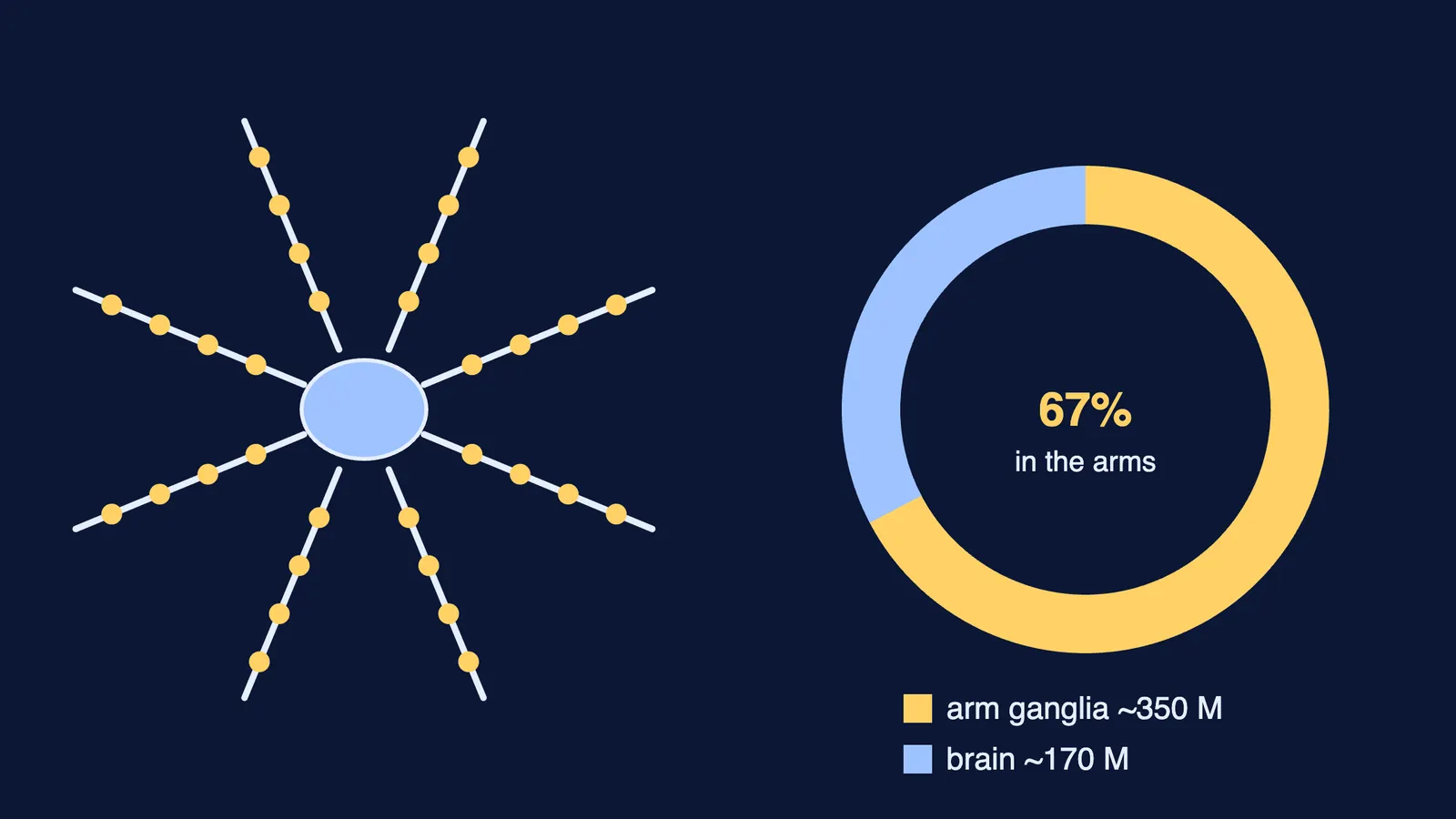
The octopus nervous system has more than 500 million neurons, according to a 2022 review by Sivitilli, Smith and Gire in Frontiers in Robotics and AI. About 350 million of them are in ganglia along the arms, which act as local control centres for the suckers and nearby muscle; the brain and optic lobes hold about 170 million (same review).
The link between arms and brain is narrow. The same review, drawing on J. Z. Young's counts from the 1960s, estimates that about 18 million sensory neurons in the suckers feed only about 140 thousand fibres entering the brain, with about 32 thousand fibres going the other way. So much of what the suckers sense is processed in the arm before it reaches the brain.
Can an octopus arm move without the brain?
Partly, yes. In a 2001 study in Science, Sumbre and colleagues at the Hebrew University of Jerusalem showed that arms whose connection with the brain had been cut could still be made to extend, mechanically or electrically, with movements almost identical to normal reaching. The basic programme for reaching, they concluded, is built into the arm's own circuits.
Hochner, one of those authors, later argued in Current Biology that octopus intelligence is "embodied": it emerges from brain, body and surroundings together.
What problems can an octopus solve?
Learning by watching. Fiorito and Scotto trained octopuses to pick one of two objects that differed only in colour. In their 1992 Science paper, untrained octopuses that had watched the trained ones then chose the same object, and learned faster than the trained animals had through conditioning. It showed that observational learning can happen in invertebrates.
Carrying a tool for later. Finn, Tregenza and Norman described veined octopuses that stack coconut shell halves, make their arms rigid and walk on them with the shells tucked underneath. The Cell Press release reports that on four occasions octopuses carried the shells up to 20 metres, and that the only benefit is using them later as a shelter. Collecting and carrying shells for later, rather than hiding under whatever is nearby, is why the team counted it as tool use.
How does an octopus change colour?
Its skin is covered in chromatophores. A 2001 review by Messenger explains that each one is an elastic sac of pigment with radial muscles attached, each muscle with its own nerves. When the muscles contract the sac stretches open and the colour shows; when they relax, the elastic sac pulls back. They are controlled by nerves from the brain, not by hormones.
The skin may also sense light on its own. Ramirez and Oakley (2015) found that pieces of skin cut from the California two-spot octopus expanded their chromatophores when lit, fastest under blue light, with peak sensitivity estimated at 480 nm, close to that of the light-sensing opsin in octopus eyes.
Why does an octopus have three hearts?
It has two branchial (gill) hearts and one systemic heart. Hu and colleagues (2017) trace the route in the common octopus: blood reaches each branchial heart, is pumped through that gill, and then enters the systemic heart, which sends it round the body. The oxygen carrier is haemocyanin, a large protein dissolved freely in the blood in which a pair of copper atoms binds oxygen, unlike our iron-based haemoglobin packed in red blood cells.
How do you judge how intelligent an animal is?
Instead of asking "which animal is smarter?", use these five questions:
Count and place: how many neurons, and where? (Octopus: about two-thirds in the arms, from the Sivitilli review.)
Connect: how much traffic runs between the centre and the edges? (Octopus: a narrow link.)
Check the evidence: a controlled lab test (Fiorito and Scotto) or field observation (the coconut shells)?
Find the mechanism: which organ does the job? (Colour change: muscles and nerves in the skin.)
Ask "intelligent at what?": reaching, learning from others, hiding, planning ahead.
Worked example. Question: "Is the octopus nervous system centralised?" A strong answer: "Partly. It has a central brain, but most of its neurons are in ganglia along the arms, and arms cut off from the brain can still perform reaching movements, so control is shared between brain and arms."
For contrast, a Hydra has no brain at all, only a nerve net, and our own system is split into the central and peripheral nervous systems.
If ganglia, nerve nets and the CNS and PNS start to blur together, the Fermi Concept Library gives each biology concept its own lesson and shows where it sits in the map. And if you are not sure where to start on a chapter, Fermi's AI tutor can work out what you already know and build a plan for the session.


