On this page
Nylon 6,6 and nylon 6 are both polyamides: long chains held together by amide (–CO–NH–) links. The difference is in how they are made. One is built from two monomers, the other from one ring. Once you can see that, the names, the repeat units and the usual MCQ traps all make sense.
What are the monomers of nylon 6,6 and nylon 6?
Nylon 6,6 is made from hexamethylenediamine, H2N–(CH2)6–NH2, and adipic acid, HOOC–(CH2)4–COOH. Each monomer has six carbon atoms, which is where the two sixes in the name come from (Wikipedia, Nylon 66; LibreTexts, Polyamides/Amides/Reactivity_of_Amides/Polyamides)).
Nylon 6 is made from a single monomer, caprolactam (C6H11NO): a seven-membered ring with six carbons and one nitrogen that already contains an amide link (Wikipedia, Caprolactam; LibreTexts, Polyamides/Amides/Reactivity_of_Amides/Polyamides)). One monomer with six carbons gives one 6 in the name.
How is nylon 6,6 prepared?
Nylon 6,6 is a condensation polymer. When the monomers join, an amine group and an acid group combine and lose one molecule of water each time (LibreTexts, Polyamides/Amides/Reactivity_of_Amides/Polyamides)).
In industry, equal amounts of the two monomers are first mixed in water to form an ammonium carboxylate salt, often called nylon salt, which is then heated to drive the polycondensation (Wikipedia, Nylon 66). Textbook answers usually state the conditions as heating at 553 K under pressure (Vedantu, Class 12 answer).
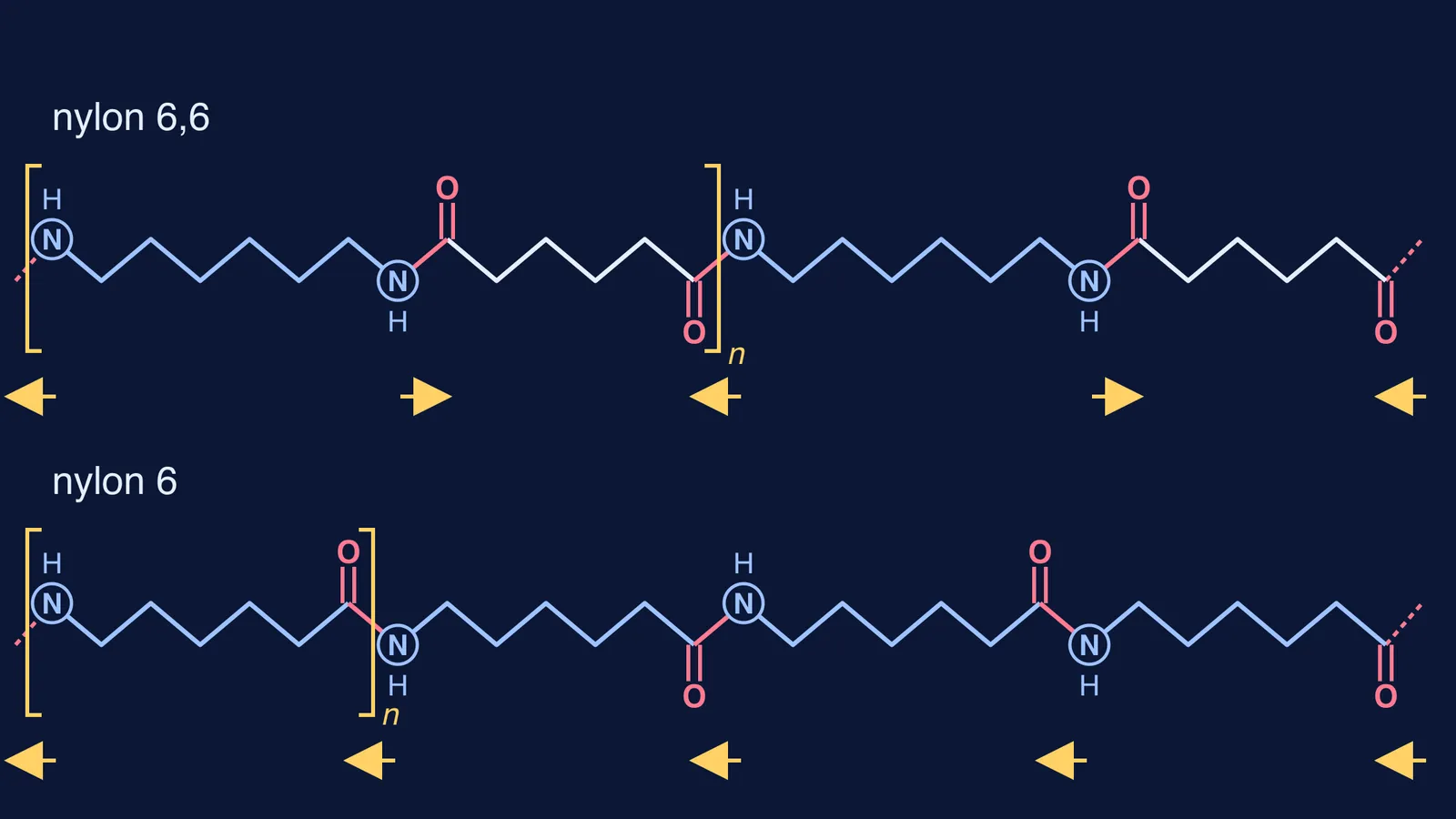
The repeat unit is –[NH–(CH2)6–NH–CO–(CH2)4–CO]–, with formula C12H22N2O2 (Wikipedia, Nylon 66). Wallace Carothers of DuPont developed it, and his US patent was issued on 20 September 1938 (same source).
How is nylon 6 prepared from caprolactam?
Nylon 6 is made by ring-opening polymerization. Caprolactam is heated at about 533 K in a nitrogen atmosphere for about 4 to 5 hours, the ring breaks, and the opened units link into a chain (Wikipedia, Nylon 6). Exam questions describe it as heating caprolactam at high temperature in the presence of water, and JEE Main asked exactly this on 30 January 2023 (Shift 1), with nylon 6 as the answer (Cracku, JEE Main 2023 question).
The repeat unit is –[NH–(CH2)5–CO]–. Paul Schlack at IG Farben made it in 1938, aiming to reproduce the properties of nylon 6,6 without violating its patent (Wikipedia, Nylon 6).
How do the repeat units of nylon 6,6 and nylon 6 compare?
This atom count shows why one reaction loses water and the other does not.
Add up the two nylon 6,6 monomers. Hexamethylenediamine is C6H16N2 and adipic acid is C6H10O4, so together they make C12H26N2O4.
Compare with the repeat unit, C12H22N2O2. The difference is H4O2, which is two molecules of water per repeat unit. So it is a condensation polymer.
Now nylon 6. Caprolactam is C6H11NO, and the repeat unit –NH–(CH2)5–CO– is also C6H11NO. Nothing is lost. The ring has simply opened and joined up.
Molar mass of each repeat unit, using C = 12, H = 1, N = 14, O = 16: nylon 6,6 gives 226 g/mol and nylon 6 gives 113 g/mol. Exactly half, because C12H22N2O2 is exactly twice C6H11NO: the nylon 6,6 unit has two amide groups and twelve carbons, the nylon 6 unit one amide group and six carbons.
The chains also differ in direction. In nylon 6,6 the amide bond points the opposite way at each link, while in nylon 6 every amide bond points the same way (Wikipedia, Nylon 6). The diagram at the top of this post shows this with arrows. Their melting points are about 264 °C for nylon 6,6 (Wikipedia, Nylon 66) and about 215 °C for nylon 6 (Wikipedia, Nylon 6).
Which mistakes cost marks on nylon questions?
Run through this checklist before an exam:
Nylon 6,6 has two monomers, a diamine and a diacid. Nylon 6 has one, caprolactam.
The 6,6 counts carbons in each monomer, not the number of repeat units.
Write –(CH2)6– on the amine side and –(CH2)4– on the acid side. The acid's six carbons include the two C=O carbons.
Nylon 6 has –(CH2)5– between NH and CO, not six CH2 groups.
Draw brackets through the bonds at each end and write n outside them.
If a question asks what is lost, the answer for nylon 6,6 is water. For nylon 6, nothing is lost overall.
If you want more practice, the Fermi Problem Library has worked problems with a step-by-step solver that explains the reasoning rather than printing an answer. If the amide link or condensation itself still feels shaky, the Fermi Concept Library gives every chemistry concept its own lesson.