On this page
Exam questions often give you a formula for Sₙ, the sum of the first n terms, and ask for the nth term. The method takes one line. The trap is the first term.
What is the formula for the nth term from the sum of n terms?
The nth term of an AP is the sum of the first n terms minus the sum of the first (n − 1) terms, aₙ = Sₙ − Sₙ₋₁, as stated in the Remark in section 5.4 of the NCERT Class 10 Mathematics chapter on arithmetic progressions.
The reason: Sₙ = a₁ + a₂ + … + aₙ, and Sₙ₋₁ is the same list without the last term. Subtract, and only aₙ is left. Nothing here needs an AP, so for n ≥ 2 the rule works for any sequence.
But for n = 1 the subtraction needs S₀, the sum of no terms, which is 0. Your formula for Sₙ may not give 0 at n = 0. That is where the trouble starts.
How do you use aₙ = Sₙ − Sₙ₋₁ in a worked example?
Take Exercise 5.3, Question 11 of the NCERT Class 10 AP chapter: the sum of the first n terms of an AP is 4n − n². Find the first, second, third, 10th and nth terms.
First term: a₁ = S₁ = 4 − 1 = 3.
Sum of the first two terms: S₂ = 8 − 4 = 4, so a₂ = S₂ − S₁ = 1.
General term: aₙ = (4n − n²) − [4(n − 1) − (n − 1)²] = 4n − n² − 4n + 4 + n² − 2n + 1 = 5 − 2n.
Check against step 1: 5 − 2(1) = 3. It matches a₁.
So a₃ = −1, a₁₀ = −15, and aₙ = 5 − 2n.
Step 4 is the habit to build. Here it passes, because 4n − n² gives 0 at n = 0.
Why must you check a₁ separately?
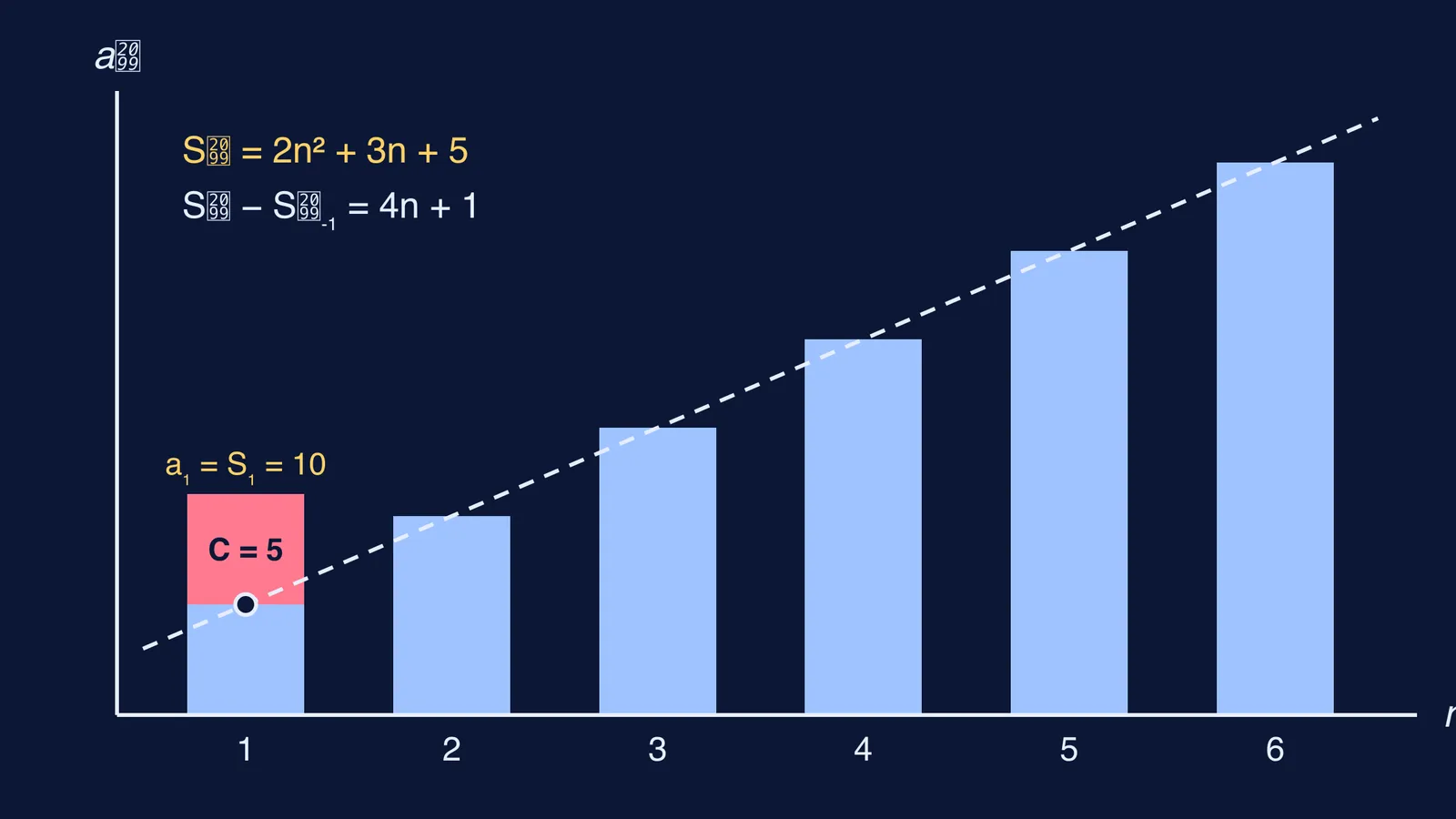
Now try Sₙ = 2n² + 3n + 5.
Subtract: Sₙ − Sₙ₋₁ = 2(2n − 1) + 3 = 4n + 1.
Put n = 1 into that: you get 5.
But a₁ = S₁ = 2 + 3 + 5 = 10.
They disagree by exactly 5, the constant term. List the sums to check: S₁ = 10, S₂ = 19, S₃ = 32, so the terms are 10, 9, 13, 17, 21, … The gap is 4 from the second term on; the first term breaks the pattern.
So the answer has two parts: a₁ = 10, and aₙ = 4n + 1 for n ≥ 2. The sequence is an AP only from the second term. Writing just "aₙ = 4n + 1" is incomplete, because it gives the wrong first term.
Why? At n = 1 the subtraction formula gives S₁ minus your expression at n = 0, while the true first term is S₁ − 0.
How do you know if a sum formula describes an AP?
NCERT derives the AP sum as Sₙ = (n/2)[2a + (n − 1)d] in the Class 10 AP chapter. Multiply it out and you get Sₙ = (d/2)n² + (a − d/2)n. That is a quadratic in n with no constant term.
That gives you a quick test. If Sₙ = An² + Bn with no constant, the sequence is an AP with common difference d = 2A and first term a = A + B. For 4n − n², A = −1 and B = 4, so d = −2 and a = 3, matching the worked example. If a constant C is present, the terms form an AP only from the second term.
The zero test works beyond quadratics. The NCERT Class 11 chapter on sequences and series gives the GP sum as Sₙ = a(rⁿ − 1)/(r − 1) for r ≠ 1. Sₙ = 3ⁿ − 1 gives 0 at n = 0, and its terms 2, 6, 18, … form a GP. Sₙ = 3ⁿ gives 1 at n = 0, and its terms are 3, 6, 18, …, a GP only from the second term.
A four-step checklist for exam questions
Write a₁ = S₁ first, before any algebra.
Find Sₙ − Sₙ₋₁ and simplify fully.
Put n = 1 into your answer from step 2 and compare it with step 1. Or put n = 0 into Sₙ and see if it gives 0.
If they match, give one formula. If not, give a₁ on its own and the formula "for n ≥ 2".
For more practice, the Fermi Problem Library has worked problems with a step-by-step solver that explains the reasoning rather than printing an answer. If sequences themselves feel shaky, the Fermi Concept Library gives each mathematics concept its own lesson.
Next time you see "the sum of n terms is…", write a₁ = S₁ before anything else.