

On this page
Your child's worksheet says “circle the nouns and write their kind”. Here are the four kinds, a sorting test and a quiz. This matches the syllabus: NCERT's Learning Outcomes at the Elementary Stage says a Class IV learner “uses nouns, verbs, adjectives, and prepositions in speech and writing”, and a Class V learner “identifies kinds of nouns”.
What is a noun?
The British Council's LearnEnglish grammar reference defines it simply: “Nouns are words that give a name to people, places or things, though they can also refer to ideas and other abstract objects.” What changes from one noun to the next is the kind of thing it names.
What are the four types of nouns for Class 4?
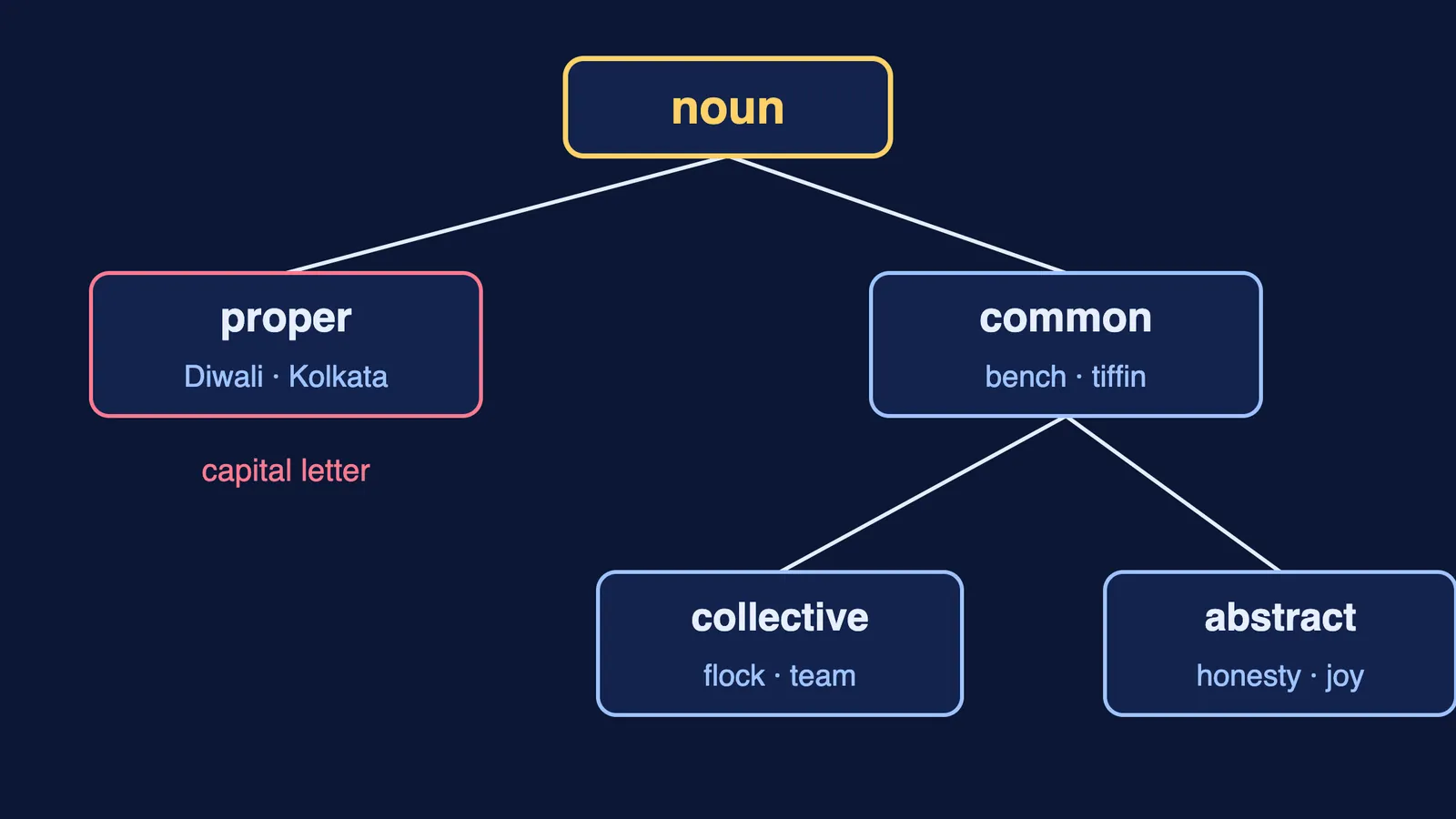
Common nouns
A common noun names any member of a group, not one particular thing; Wikipedia's entry on proper nouns describes it as a noun that “refers to a class of entities”. School examples: bench, tiffin, teacher, auto-rickshaw, playground.
Proper nouns
A proper noun is the name of one particular person, place or organisation, and the British Council's page on proper nouns says “We spell proper nouns with a capital letter”. The same page says festivals take capitals too. Examples: Priya, Kolkata, the Ganga, Diwali, Kendriya Vidyalaya.
Collective nouns
A collective noun is “a word referring to a collection of things taken as a whole”, according to Wikipedia's entry on collective nouns. Examples: a class of students, a team of players, a flock of pigeons, a bunch of bananas, a herd of cows.
Is it “the team is” or “the team are”? The British Council's page on group nouns says these nouns can be used “either as singular nouns or as plural nouns”. In exams, follow the form your child's textbook uses.
Abstract nouns
Abstract nouns name ideas, feelings and qualities. Wikipedia's article on nouns says concrete nouns name things that can be observed by at least one of the senses, while abstract nouns refer to “ideas or concepts”. Many are made by adding -ness, -ity or -ion, as happiness comes from happy. School examples: honesty, friendship, kindness, fear before a test, freedom on Independence Day.
Science has abstract nouns too: Wikipedia's list includes solubility and duration. When one puzzles an older child, the Fermi Concept Library has a lesson for every concept in physics, chemistry, biology, mathematics and computing.
How do you tell which kind of noun it is?
Ask these four questions in order and stop at the first yes.
Is it the name of one particular person, place, day, festival or organisation? Proper noun, with a capital letter.
Is it one word for a whole group of people, animals or things? Collective noun.
Is it something you cannot see, hear, touch, smell or taste? Abstract noun.
None of these? Common noun.
Worked example: “On Republic Day, our class carried the flag past Lajpat Nagar with great pride.”
Republic Day: a particular day, so proper (question 1).
Lajpat Nagar: a particular place, so proper (question 1).
class: one word for a group of students, so collective (question 2).
pride: a feeling you cannot touch, so abstract (question 3).
flag: an ordinary thing, so common (question 4).
Quick quiz: what kind of noun is it?
Name the kind of each word in quotation marks.
“herd”: A herd of goats stopped our school bus.
“Mumbai”: My cousin lives in Mumbai.
“courage”: Meera showed courage on stage.
“tiffin”: I forgot my tiffin at home.
“Holi”: We played with colours on Holi.
“bunch”: Ma gave me a bunch of keys.
“friendship”: Their friendship began in nursery.
“blackboard”: The blackboard was full of sums.
“team”: Our team won the kho-kho match.
“Wednesday”: We have PT on Wednesday.
Answers: 1 collective, 2 proper, 3 abstract, 4 common, 5 proper, 6 collective, 7 abstract, 8 common, 9 collective, 10 proper.
After each answer, ask which question settled it.
How can you practise nouns at home without a worksheet?
Signboard hunt: on the way to school, read signs aloud and sort them. Shop and road names are proper; bus, signal and gate are common.
Feelings at dinner: everyone names one abstract noun from their day, such as worry or joy.
Fix the capitals: write three sentences with the capitals missing and let your child correct the proper nouns.
Quizzes help most when your child hears why an answer is right, as we explain in why younger children should practise MCQs with feedback. If you are unsure how closely to sit beside your child for grammar homework, see a four-week plan for a Class 5 child doing homework alone. And if your child knows the grammar but goes quiet when speaking, try a family English hour for a child shy to speak in class.
Copy the four sorting questions inside the front cover of the English notebook and use them on the next worksheet.


