

On this page
When you write the equation of a straight line as Ax + By + C = 0, the numbers A, B and C tell you its slope and intercepts. But in coordinate geometry, it is often more useful to know exactly how far the line is from the origin, and in what direction.
Why use the normal form? When checking whether lines are parallel or coincident (as you would using the ratio test for parallel and coincident lines), the general form is enough. But if you need to calculate the distance between parallel lines, or find a line's exact distance from the origin, the normal form gives you the answer instantly.
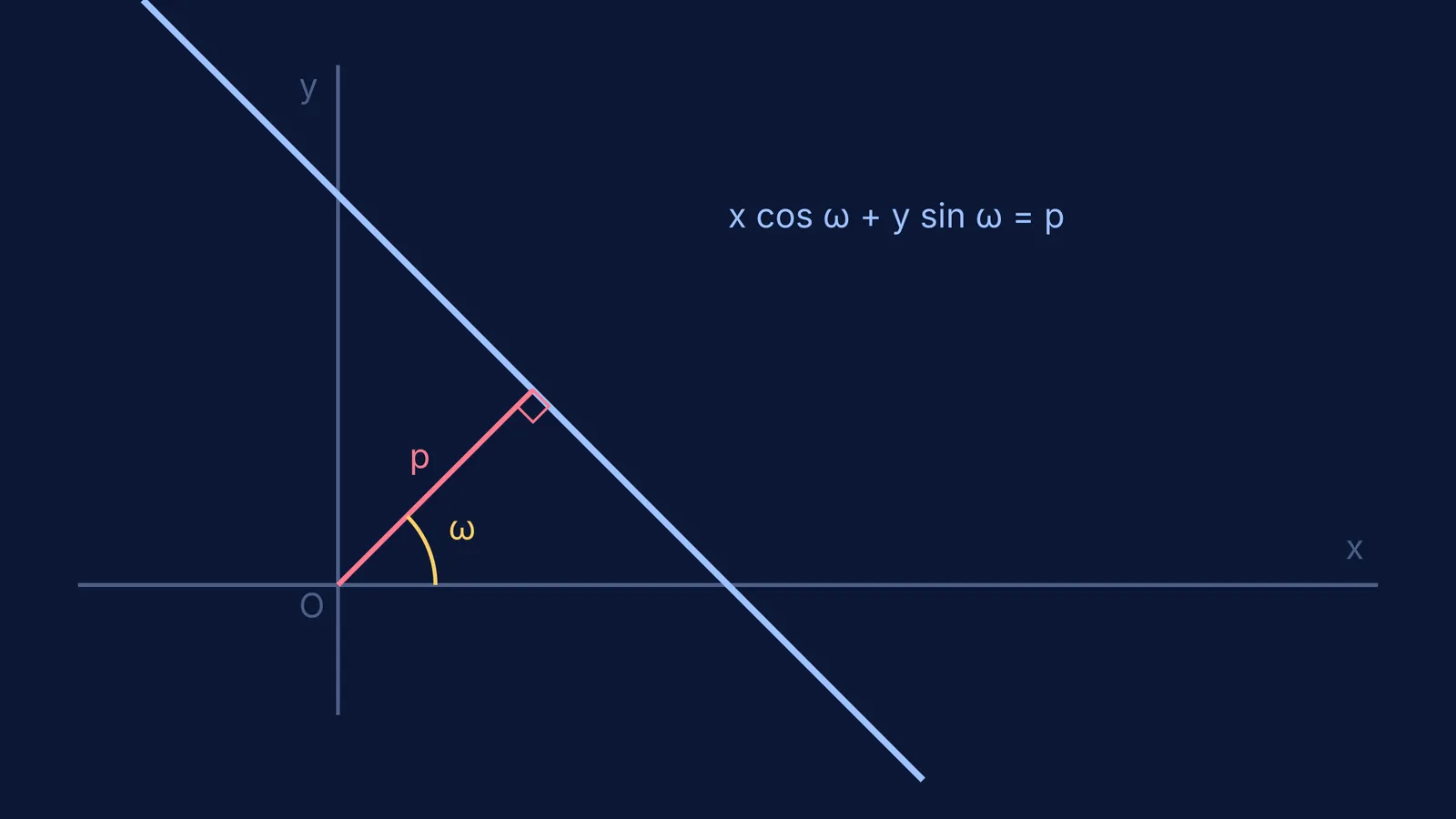
The normal form) (also called the Hesse normal form) defines the line using a single perpendicular dropped from the origin.
What is the normal form of a line?
The normal form of a straight line is written as: x cos ω + y sin ω = p
This equation uses two specific numbers to pin down the line:
p (the perpendicular distance): The shortest straight-line distance from the origin (0, 0) to the line. Because it is a physical distance, p must always be positive or zero (p ≥ 0).
ω (omega): The angle that this perpendicular makes with the positive x-axis, measured anti-clockwise.
Every point (x, y) that satisfies this equation lies on your line.
How do you convert a general equation into normal form?
You can turn any general linear equation into the normal form in three steps. Let us convert the general equation Ax + By + C = 0.
Move the constant to the right side. Rearrange your equation so the variables are on the left and the constant is on the right: Ax + By = -C.
Make the right side positive. The right side will become your distance p, so it cannot be negative. If -C is negative, multiply the entire equation by -1.
Divide by the magnitude. Divide every term by the square root of the sum of the squares of the coefficients: √(A² + B²).
The resulting equation is in normal form. The coefficient of x is your cos ω, the coefficient of y is your sin ω, and the constant on the right is p.
How do you find the quadrant of the angle ω?
The most common mistake students make is calculating the reference angle for ω but placing it in the wrong quadrant.
Once you have your normal form, look at the signs of cos ω and sin ω. They tell you exactly which quadrant the normal line points into (if either value is zero, the angle is on an axis: 0°, 90°, 180° or 270°):
Quadrant I: Both cos ω and sin ω are positive (0° < ω < 90°).
Quadrant II: cos ω is negative, sin ω is positive (90° < ω < 180°). Find your angle by subtracting the reference angle from 180°.
Quadrant III: Both cos ω and sin ω are negative (180° < ω < 270°). Add the reference angle to 180°.
Quadrant IV: cos ω is positive, sin ω is negative (270° < ω < 360°). Subtract the reference angle from 360°.
If you find yourself making sign errors during coordinate geometry conversions, the Fermi Problem Library has worked problems with a step-by-step solver that explains the reasoning rather than printing an answer. It catches quadrant mistakes before they cascade into the rest of your working.
How do you convert a line to normal form in practice?
Let us reduce the equation √3x - y - 8 = 0 into normal form and find p and ω.
Step 1: Isolate the constant √3x - y = 8
Step 2: Check the sign The right side (8) is already positive, so we do not need to multiply by -1.
Step 3: Divide by the magnitude Calculate √((√3)² + (-1)²) = √(3 + 1) = √4 = 2. Divide the whole equation by 2: (√3 / 2)x - (1 / 2)y = 4
Now we can read off our values:
cos ω = √3 / 2
sin ω = -1 / 2
p = 4
Because cosine is positive and sine is negative, ω lies in Quadrant IV. The reference angle where cosine is √3 / 2 is 30°. In Quadrant IV, ω = 360° - 30° = 330°.
The final normal form is x cos 330° + y sin 330° = 4.
You can use these same principles when working with planes in 3D geometry or when finding the equation of angle bisectors of two lines, where the perpendicular distance from the origin plays a central role.


