On this page
A neutron hits a hydrogen atom at rest in its ground state. What is the smallest kinetic energy the neutron must have to excite the atom? Most students write 10.2 eV, the n = 2 gap listed by NIST. The correct answer is about 20.4 eV, because not all kinetic energy can be absorbed.
Why isn't 10.2 eV enough to excite hydrogen?
The first excited level of hydrogen, n = 2, lies 10.2 eV above the ground state: the NIST Atomic Spectra Database lists the 2s level at 10.19881 eV. So the atom must absorb at least that much energy.
But the neutron cannot hand over all its kinetic energy. Suppose it did: the neutron would stop, the atom would stay put, and the total momentum would drop to zero. That breaks momentum conservation. After the collision something must still be moving, and moving things carry kinetic energy that cannot go into the atom.
How does the centre of mass frame give the answer?
Split the kinetic energy into two parts: the energy of the centre of mass moving as a whole, and the energy of motion relative to the centre of mass. The first part can never change in a collision, because total momentum is fixed. Only the second part can be turned into internal energy.
Let the neutron have mass m and speed u, and the atom mass M, at rest. The neutron's kinetic energy is K = ½mu².
Total momentum is mu, so the centre of mass moves at V = mu/(m + M).
Energy locked in centre-of-mass motion: ½(m + M)V² = K × m/(m + M).
Energy available for excitation: K − K × m/(m + M) = K × M/(m + M).
Excitation needs K × M/(m + M) ≥ ΔE, so K(min) = ΔE × (1 + m/M).
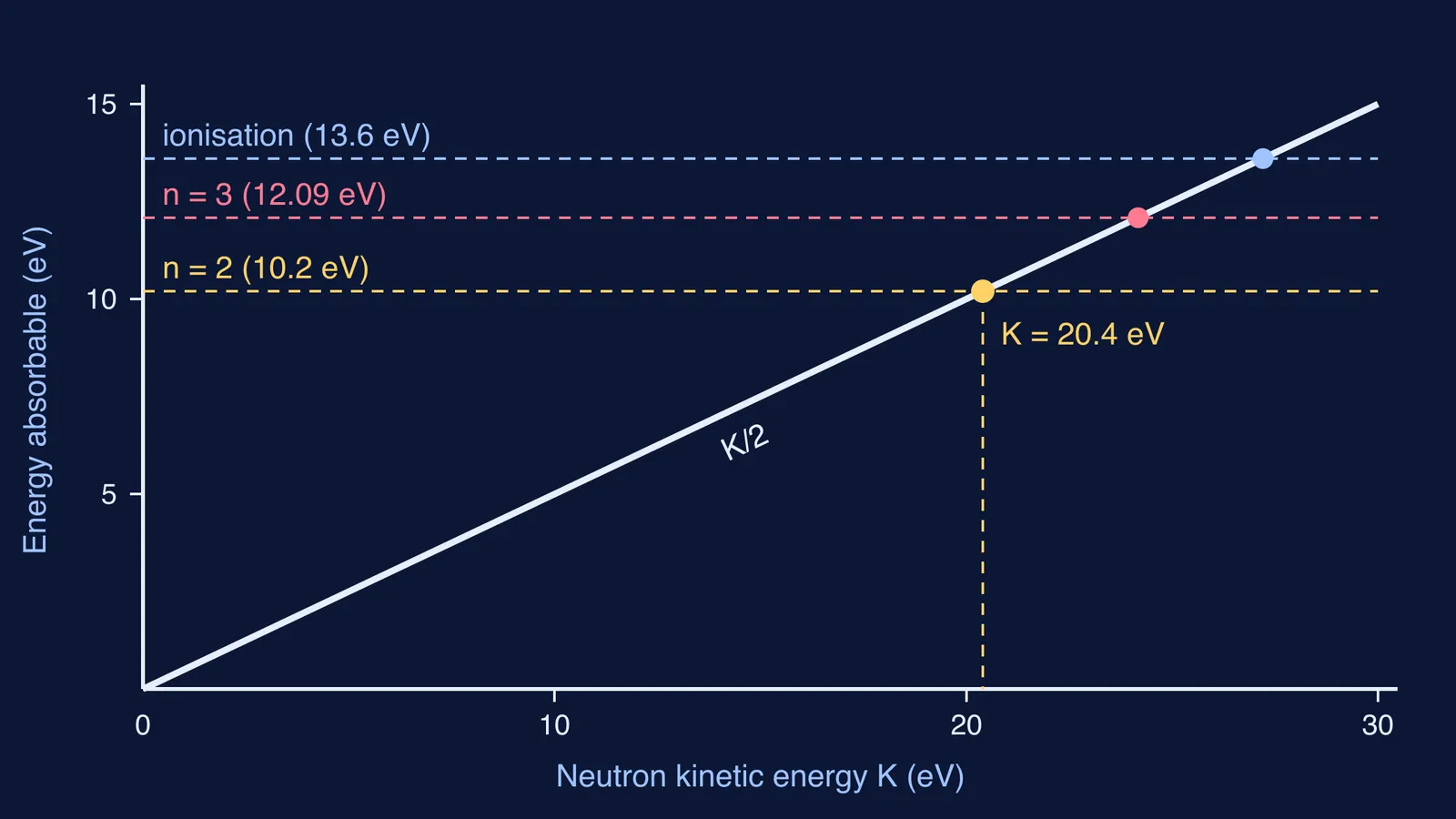
For equal masses, m/M = 1. With the n = 2 gap from the NIST Atomic Spectra Database, K(min) = 2ΔE = 2 × 10.2 eV = 20.4 eV. At exactly this threshold the collision is perfectly inelastic: neutron and atom move off together at u/2, with zero relative motion left over.
If the centre-of-mass frame still feels slippery, the Fermi Concept Library covers every concept in physics, each with its own lesson and its place in the map.
How close are a neutron and a hydrogen atom to equal masses?
The 2022 CODATA neutron-to-proton mass ratio is 1.00137841946, according to NIST. The proton-to-electron mass ratio is 1836.152673426, also from NIST. A hydrogen atom is a proton plus an electron, so the neutron is heavier than the whole atom by less than a tenth of a percent: m/M is about 1.00083.
Putting that into the formula gives K(min) = 10.19881 eV × 2.00083, which is about 20.41 eV. The textbook answer of 20.4 eV holds to three significant figures, so treating the masses as equal is safe in JEE Main and JEE Advanced.
What happens if the neutron has 25 eV?
Level energies here come from the NIST Atomic Spectra Database. With equal masses, the energy available is 25/2 = 12.5 eV.
The n = 3 level sits at 12.0875 eV. Since 12.5 eV is more than that, n = 2 and n = 3 can both be reached. Reaching n = 3 needs at least 2 × 12.0875, about 24.2 eV.
The same database lists the ionisation limit at 13.598 eV. Ionising the atom would need about 2 × 13.6 = 27.2 eV, so 25 eV cannot ionise it.
Whatever is not absorbed stays as kinetic energy. If the atom goes to n = 3, the leftover 12.5 − 12.09 = 0.41 eV of centre-of-mass-frame energy remains as relative motion.
For an electron hitting hydrogen, m/M is about 1/1837 from the NIST proton-electron mass ratio, so K(min) is barely above 10.2 eV. A light projectile can give nearly everything; an equal-mass one only half; a heavy one even less. A projectile four times heavier than the target would need 5ΔE.
A checklist for collision-excitation questions
Is the target free to move? If yes, momentum conservation applies and some energy is locked.
Write down the projectile mass m and target mass M.
Use K(min) = ΔE × (1 + m/M). Equal masses give 2ΔE.
Read the level energies from the question, not from memory.
Check the answer against the limits: tiny projectile gives about ΔE, equal masses give 2ΔE.
Common mistakes to watch for:
Setting K equal to ΔE and forgetting momentum.
Using the elastic-collision result that equal masses swap velocities. That result assumes no energy is absorbed.
Halving the wrong quantity, for example halving ΔE instead of doubling it.
To practise this pattern on more problems, the Fermi Problem Library has worked problems with a step-by-step solver that explains the reasoning rather than printing an answer.
Next time a collision question mentions excitation, start by asking how much energy the centre of mass is keeping for itself.