

On this page
When studying the phylum Annelida, the common earthworm is usually introduced first. Yet it represents a specialised terrestrial branch of the phylum. To understand the ancestral aquatic body plan of segmented worms, biologists examine *Nereis*—the marine clam worm (or ragworm).
While an earthworm burrows through soil using hydrostatic peristalsis, *Nereis* is an active marine predator equipped with sensory tentacles, eyes, and lateral paddle-like appendages called parapodia. In our guide to placing animal phyla, Annelida is defined by true metameric segmentation, a coelomic cavity, and a closed circulatory system. In *Nereis*, this segmented plan enables agile seabed crawling and open-water swimming.
What are parapodia and how do they function?
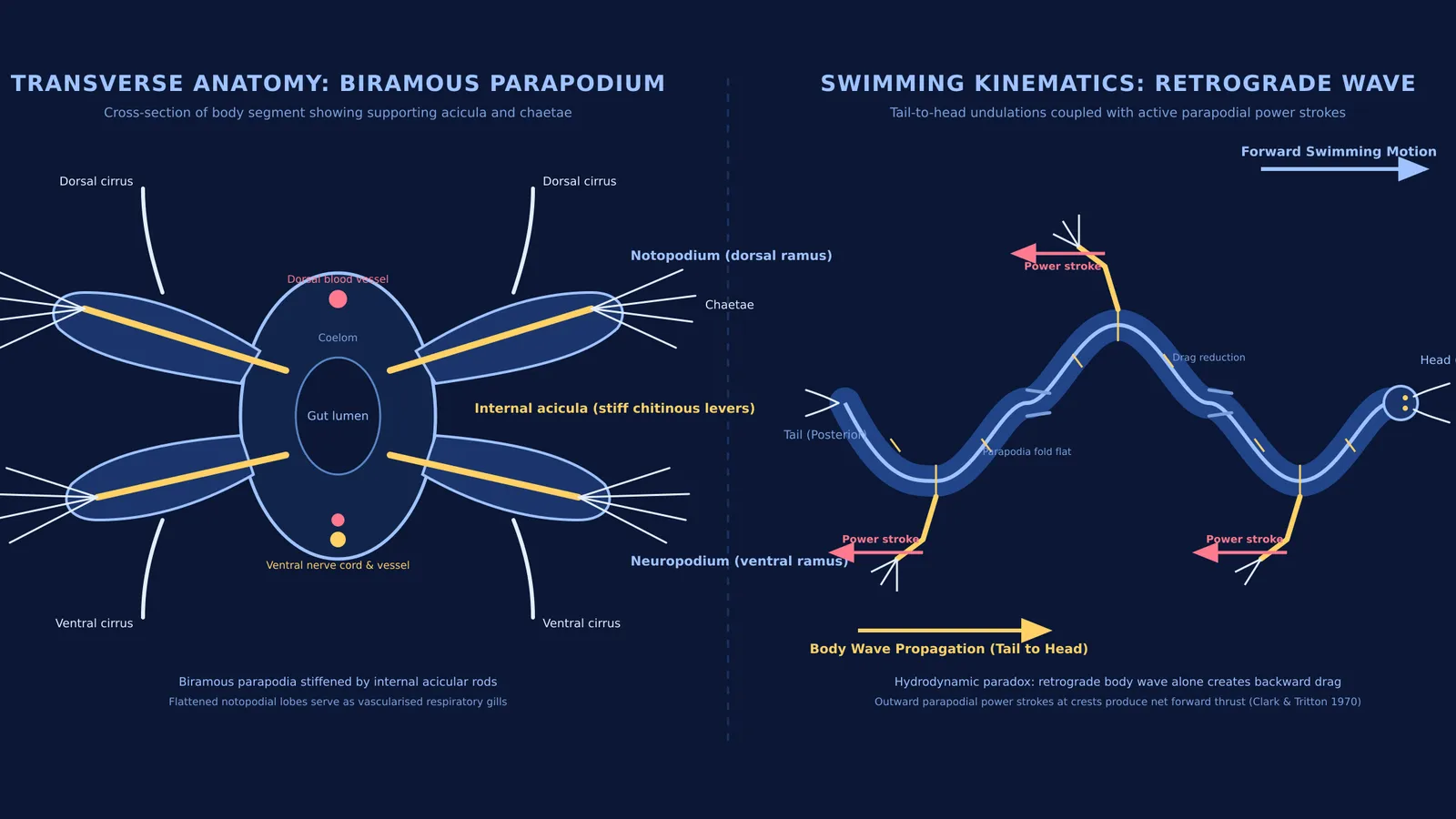
Every typical body segment of *Nereis* bears a pair of unjointed, fleshy lateral outgrowths known as parapodia (from the Greek for "beside feet"). Each parapodium is biramous, dividing into two distinct lobes:
Notopodium: The dorsal (upper) branch, consisting of flattened leaf-like ligules and a sensory dorsal cirrus.
Neuropodium: The ventral (lower) branch, which bears a ventral cirrus and contacts the substrate during crawling.
Because parapodia lack jointed exoskeletons, each ramus is reinforced by a stout internal chitinous rod called an aciculum (plural: acicula). These acicula act as an internal skeletal lever system, anchoring the protractor and retractor muscles that control the stroke. In the NCERT Class 11 Biology curriculum, *Nereis* exemplifies aquatic annelids that use parapodia for swimming locomotion. Movable chitinous bristles called chaetae (setae) project alongside each aciculum to provide traction and propulsion.
Beyond locomotion, parapodia serve a vital respiratory role. Because marine dissolved oxygen fluctuates, the flattened, thin-walled lobes of the notopodium are packed with capillary networks. Gas exchange occurs directly across this thin cuticular surface into the blood, allowing parapodia to function as vascularised gills.
How does Nereis coordinate swimming and crawling locomotion?
*Nereis* coordinates two distinct locomotory modes:
Slow crawling: The worm creeps over sediment using its parapodia as miniature stepping levers. In a 1939 kinematic study in the Journal of Experimental Biology, Sir James Gray showed that longitudinal body-wall muscles remain largely inactive during slow creeping. Instead, intrinsic acicular muscles thrust each parapodium forward, plant the chaetae for traction, and lever the body forward in repeating metachronal waves. Muscular analysis in the Journal of Zoology demonstrated how ventral oblique muscles insert at the parapodial base to drive this stepping stroke.
Fast crawling and swimming: When pursuing prey or escaping predators, *Nereis* recruits longitudinal body muscles to produce rapid lateral undulations.
Swimming in *Nereis* does not follow the kinematics of eels or fish. In fish, muscular waves travel from head to tail. In *Nereis*, the undulatory body wave travels from tail to head (posterior to anterior).
As demonstrated by Clark and Tritton in the Journal of Zoology, a forward-moving body wave alone would create backward drag. The parapodial stroke resolves this paradox: at each convex crest, parapodia swing outward into undisturbed water to deliver a backward power stroke, while in concave troughs, they fold flat against the flank to minimise drag. This converts tail-to-head undulations into forward propulsion.
When students struggle to visualise how wave propagation, muscle tension, and hydrodynamic drag interact in non-rigid organisms, the Fermi Concept Library offers lessons covering every concept in physics and biology, each with its place in the map.
How does Nereis differ from the common earthworm?
Standard textbook questions based on the NCERT Biology syllabus regularly contrast *Nereis* with the earthworm (*Pheretima posthuma*). Their divergent habitats account for five key structural distinctions:
Locomotory apparatus: *Nereis* possesses paired, biramous parapodia supported by acicula and chaetae. The earthworm lacks parapodia entirely, relying on simple S-shaped setae embedded in epidermal pits within the body wall.
Locomotion mechanics: *Nereis* relies on lateral undulation and parapodial paddling. Earthworms rely on retrograde peristalsis, contracting circular and longitudinal muscles against fluid-filled coelomic compartments; compare our breakdown of animal locomotion and muscle systems.
Sensory head: *Nereis* shows distinct cephalisation, possessing a prostomium and peristomium with four eyes, tentacles, and palps. Earthworms lack eyes, tentacles, and palps.
Reproductive biology: *Nereis* is dioecious (separate sexes), forming temporary gonads during the breeding season. Earthworms are monoecious (hermaphrodites) with permanent male and female reproductive systems.
Clitellum and development: Earthworms possess a glandular clitellum (spanning segments 14 to 16 in *Pheretima*) that secretes an egg cocoon for direct development. *Nereis* lacks a clitellum; fertilisation is external in seawater, and development is indirect via a free-swimming ciliated trochophore larva.
Excretion also mirrors their ecology: while marine annelids wash away ammonia directly, terrestrial earthworms conserve water by excreting urea, as detailed in our guide to ammonotelic and ureotelic excretion.
What is the five-point diagnostic framework for annelid exam questions?
When solving multi-statement or assertion-reason questions on Annelida, apply this five-point diagnostic framework:
Check for lateral appendages: Fleshy lobes supported by internal acicula indicate *Nereis* (a polychaete). If lateral lobes are absent, identify whether setae or suckers are present.
Identify the sexual condition: An annelid with separate sexes is *Nereis*. An individual possessing both testes and ovaries is an earthworm (*Pheretima*) or a leech (*Hirudinaria*).
Scan for a clitellum: A glandular girdle identifies an oligochaete or leech. *Nereis* never develops a clitellum at any life stage.
Identify the wave vector: A tail-to-head lateral undulatory wave indicates polychaete swimming. A head-to-tail peristaltic wave of alternating thinning and thickening indicates earthworm burrowing.
Trace the developmental stage: Indirect development with a free-swimming trochophore larva confirms *Nereis*. Direct development without a larval stage identifies the earthworm.
When tackling complex assertion-reason questions on comparative invertebrate anatomy, the Fermi Problem Library provides worked problems with a step-by-step solver that explains the reasoning rather than printing an answer.


