

On this page
The first chapter of your Class 10 history book covers 1789 to 1871, and the easiest marks to lose are dates and names you mix up. Every date below is from the NCERT textbook India and the Contemporary World II, Chapter 1, The Rise of Nationalism in Europe.
What does the rise of nationalism in Europe mean?
NCERT defines a nation-state as one in which the majority of its citizens, and not only its rulers, came to develop a sense of common identity and shared history or descent (NCERT, Chapter 1). In the mid-eighteenth century Europe had no nation-states as we know them; Germany, Italy and Switzerland were split into kingdoms, duchies and cantons.
What are the key dates from 1789 to 1871?
Each line is from the NCERT chapter.
1789: The French Revolution, the first clear expression of nationalism; sovereignty passes from the monarchy to the citizens.
1797: Napoleon invades Italy and the Napoleonic wars begin.
1804: The Civil Code, or Napoleonic Code, ends privileges based on birth and establishes equality before the law.
1814–1815: Napoleon falls. The Treaty of Vienna, drawn up at a Congress hosted by Duke Metternich, restores the Bourbons and undoes most of the changes of the Napoleonic wars.
1821: The Greek struggle for independence begins.
1830: The July Revolution in France installs a constitutional monarchy under Louis Philippe; Belgium breaks away from the United Kingdom of the Netherlands.
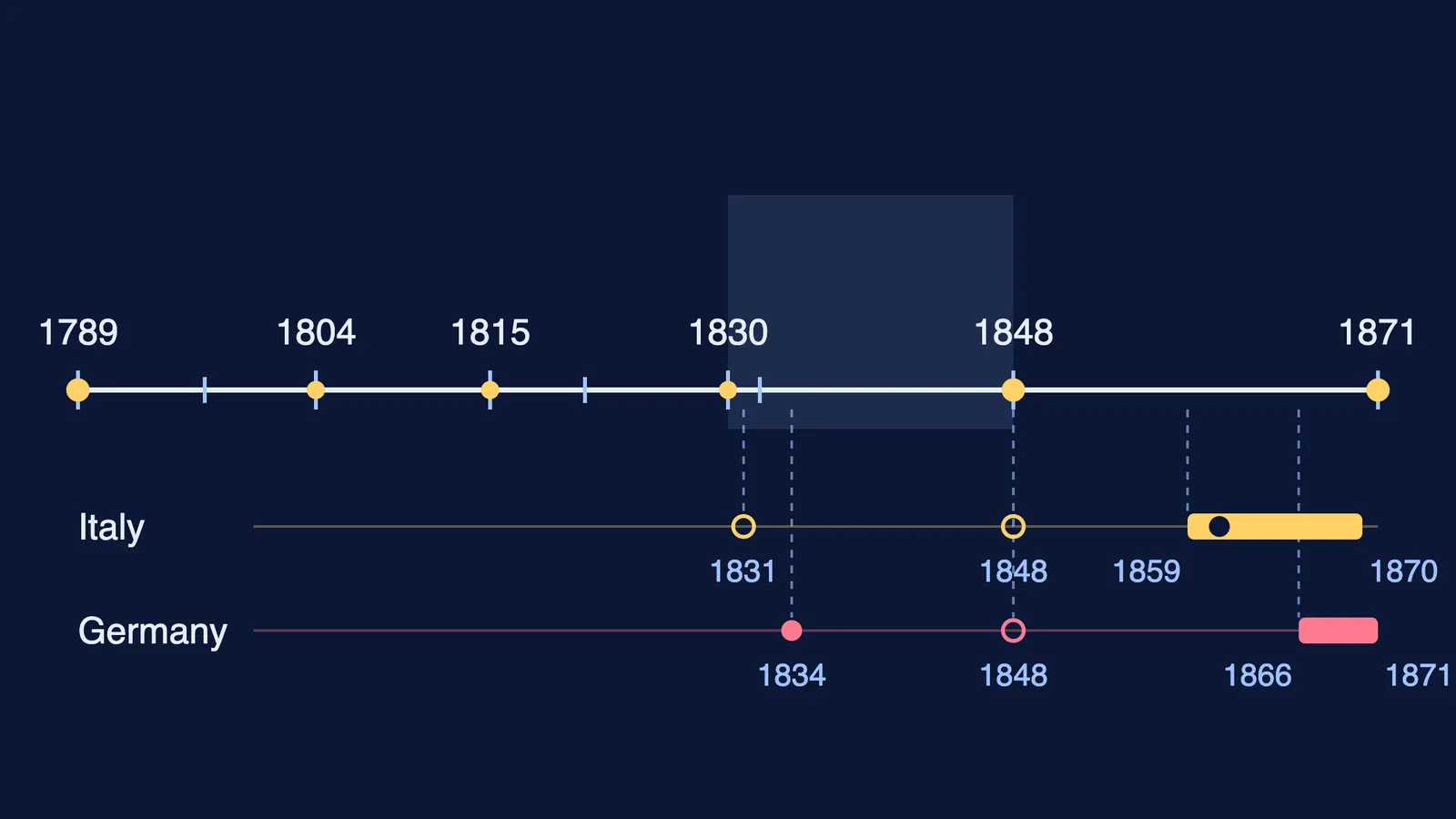
1831: Giuseppe Mazzini, aged 26, is exiled for attempting a revolution in Liguria.
1832: The Treaty of Constantinople recognises Greece as an independent nation.
1834: Prussia leads the formation of the Zollverein, a customs union joined by most German states.
1848: Revolutions across Europe, and the Frankfurt parliament meets.
1859–1870: Unification of Italy.
1866–1871: Unification of Germany.
How was Italy unified?
In the middle of the nineteenth century Italy was divided into seven states, and only one, Sardinia-Piedmont, was ruled by an Italian princely house (NCERT). The Austrian Habsburgs held the north, the Pope ruled the centre and the Bourbon kings of Spain dominated the south.
Three people did three different jobs:
Mazzini, the idea: he founded the secret society Young Italy and wanted a unitary Italian republic, but the uprisings of 1831 and 1848 failed.
Cavour, the diplomacy: Sardinia-Piedmont's chief minister, who favoured neither revolution nor democracy, built the alliance with France that defeated Austria in 1859.
Garibaldi, the volunteers: in 1860 he led the Expedition of the Thousand into the Kingdom of the Two Sicilies, and his Red Shirts grew to about 30,000.
In 1861 Victor Emmanuel II was proclaimed king of united Italy. Rome came last: the Papal States joined only in 1870, when France withdrew its troops during its war with Prussia.
How was Germany unified?
Napoleon had left a confederation of 39 states, each with its own currency and weights and measures, and a merchant travelling from Hamburg to Nuremberg in 1833 would have had to pass 11 customs barriers, paying a duty of about 5 per cent at each (NCERT). The 1834 Zollverein cut the number of currencies from over thirty to two.
On 18 May 1848, 831 elected representatives took their seats in the Frankfurt parliament. They offered the crown to Friedrich Wilhelm IV, King of Prussia, who rejected it, and troops later forced the assembly to disband.
After that, Prussia led. Its chief minister, Otto von Bismarck, worked through the Prussian army and bureaucracy. Three wars over seven years, with Austria, Denmark and France, ended in Prussian victory. On 18 January 1871, William I of Prussia was proclaimed German Emperor in the Hall of Mirrors at Versailles.
How should you revise this chapter in a week?
Take one block a day, in this order:
Day 1: Write the twelve dates above from memory, then check them line by line, as in our guide to checking history dates against NCERT.
Day 2: France and Napoleon. What the Napoleonic Code changed, and why conquered people turned hostile.
Day 3: 1815 to 1834. Vienna, conservatism, Mazzini, Greece, the Zollverein.
Day 4: Both versions of 1848. Make a cause-and-effect chart for the chapter.
Day 5: Italy. One line each for Mazzini, Cavour, Garibaldi and Victor Emmanuel II.
Day 6: Germany. The Frankfurt failure, Bismarck, three wars, 1871.
Day 7: Redraw the timeline on a blank page and write one long answer comparing the two unifications.
If maths or science is eating your revision time, Fermi's AI tutor can work out what you already know and build a plan for the session. For the full board timetable, see our week-by-week plan for the last 45 days before Class 10 boards.


