

On this page
Walking through a meadow or a wet lawn, you might spot mushrooms growing in a near-perfect circle. These formations, known as fairy rings, have inspired centuries of folklore, often being attributed to dancing fairies or witches. But the real biology of how fungi grow in the soil is just as remarkable. The mushrooms you see above ground are just the fruiting bodies of a much larger hidden organism.
Why do mushrooms grow in circles?
Fungi grow by extending microscopic, thread-like filaments called hyphae. These filaments branch out and fuse together to form a vast, web-like network known as a mycelium. When a fungal spore lands in a uniform environment—like an open lawn with even moisture and nutrients—the mycelium spreads outward in all directions simultaneously.
Because the growth rate is roughly equal across the entire front, this advancing edge naturally forms a circle. A typical lawn fairy ring can grow to over 10 metres in diameter, though some undisturbed ancient rings near Belfort, France, have grown to 600 metres in diameter over seven centuries. At the outer edge of this network, where the fungus is actively gathering resources and accumulating energy, it sends up mushrooms. These fruiting bodies release spores to colonise new areas, appearing exactly where the underground network is most active.
But this raises a question: why doesn't the fungus simply grow as a solid, filled-in disc?
Why is the centre of a fairy ring hollow?
For a long time, scientists debated whether the center of the ring was dead, dormant, or simply out of nutrients. If the fungus started from a single point in the middle, you might expect the entire enclosed area to be packed with living mycelium.
In a study published in August 2026 in *Royal Society Open Science*, a research team used soil metagenomic analysis to map the DNA of the fairy ring fungus *Marasmius oreades* (10.1098/rsos.260575). Instead of trying to grow the fungus in a lab, they extracted genetic material directly from soil samples taken across the diameter of natural rings.
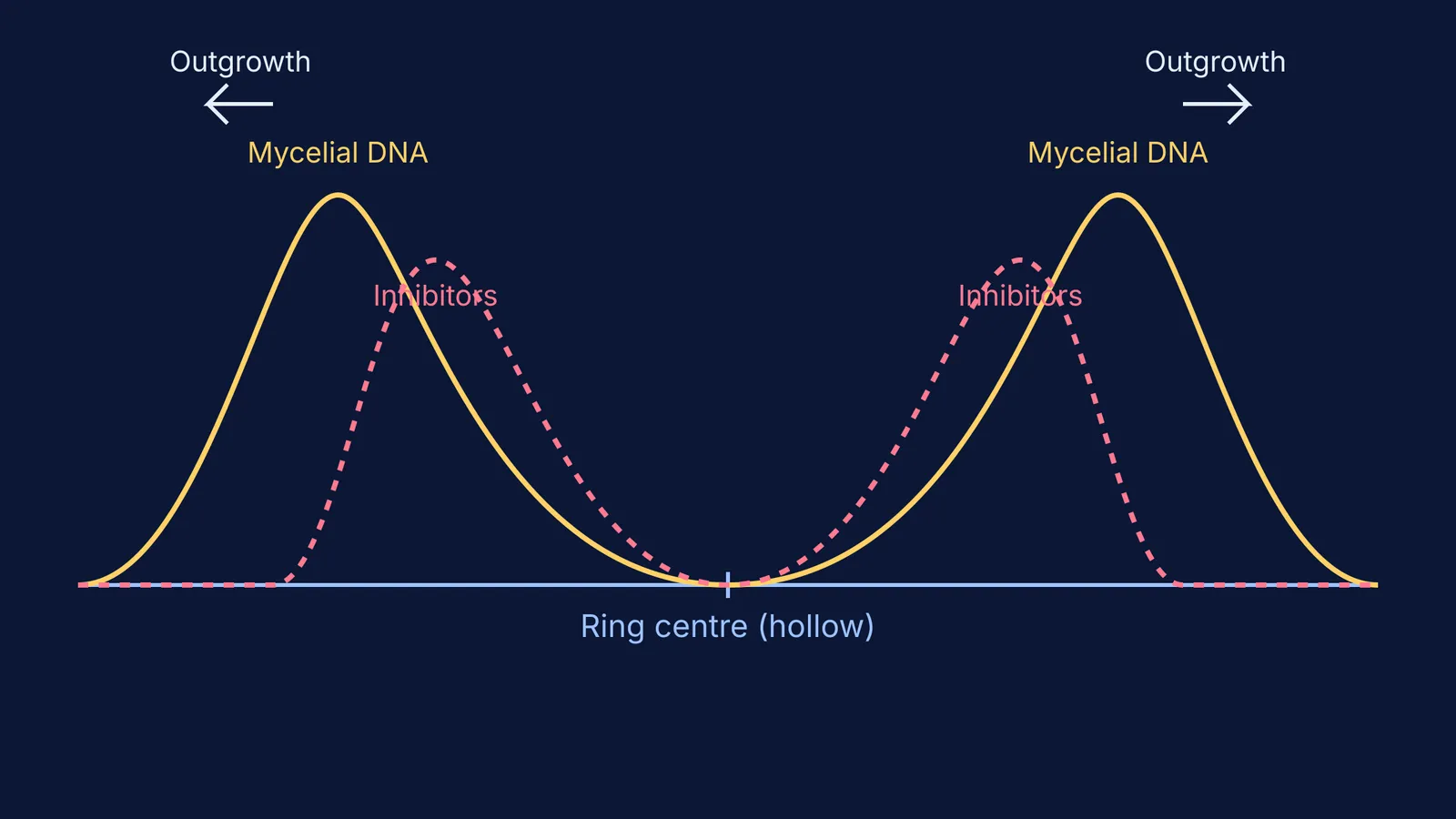
They confirmed that the mycelium exists as a genuinely hollow ring. The DNA of the fungus is highly concentrated at the outer growth front but virtually absent in the center. The fungus has completely vacated the area where it first started growing.
The transient-escape hypothesis
The same 2026 study found that the ring's growth is best explained by the "transient-escape hypothesis". As the fungus consumes organic matter, it creates inhibitory conditions immediately behind its growing edge. This might be a sudden drop in available nutrients or a build-up of toxic metabolic byproducts left behind by the fungus itself.
To survive, the mycelium must flee its own wake, constantly advancing into fresh soil. The older hyphae in the center die off, leaving only the expanding outer ring alive. However, this depletion is temporary. By transplanting the fungus back into the center of older rings, researchers proved it could grow there again once the soil had recovered and the inhibitory factors had dissipated.
There are two main types of fairy rings: "free" rings and "tethered" rings. The free rings, like those of *Marasmius oreades*, feed on dead organic matter in the soil and can expand indefinitely until they hit an obstacle. Tethered rings, on the other hand, are formed by mycorrhizal fungi that live in a symbiotic relationship with a host tree. These rings cannot grow beyond the reach of the tree's root system, demonstrating how fungi adapt their growth patterns to their specific ecological niche.
Visualising how hidden structures grow over time is a common hurdle in Class 11 biology. For topics that are hard to picture from a textbook, the Fermi Concept Library contains every concept in physics, chemistry, biology, mathematics and computing, each with its own lesson and its place in the map.
How to revise Kingdom Fungi for NEET
When studying basidiomycetes and fungal growth for exams, you are often tested on the structures you cannot see. Here is a three-point checklist for tackling assertion-reason questions on fungal growth:
Growth is radial. In a uniform medium, mycelial expansion is symmetric. A solid disc implies constant resources everywhere, which is rarely true in nature. If an assertion claims mycelium grows linearly like a plant root, remember the radial nature of fungal hyphae.
Fruiting bodies mark the active edge. Mushrooms appear where the mycelium is most active and accumulating nutrients, not at the oldest point of origin. The reproductive phase requires immense energy, which is only available at the expanding frontier.
Resource depletion drives movement. A hollow center is a classic sign of localized nutrient exhaustion or inhibitor buildup, forcing the organism outward. This is a fundamental ecological concept of how immobile organisms exploit their environment.
Understanding the differences between plant and fungal biology goes beyond memorising definitions. By picturing the mycelium actively hunting through the soil, escaping its own waste and chasing fresh nutrients, these exam facts become a logical sequence of events rather than a list of terms to rote learn.


