

On this page
Some kinematics questions do not tell you how acceleration changes with time. They tell you how it changes with position: a = −kx², or a = −k/x². The constant-acceleration equations do not apply. The fix is one line of calculus, and the usual slips are in the limits or a sign.
Why can't you integrate a(x) with respect to time?
Acceleration is dv/dt, so the obvious move is v = ∫ a dt. That works when a is written in terms of t, which is how the OpenStax University Physics section on finding velocity from acceleration sets it up. If a is written in terms of x, you would need x(t) first, and that is exactly what you do not know yet.
The chain rule gets you out: a = dv/dt = (dv/dx)(dx/dt) = v dv/dx. A specialist maths guide to rectilinear motion puts the rule simply: use a = v dv/dx, or its twin a = d/dx(½v²), when the acceleration or velocity is a function of displacement.
The recipe has three steps:
Write v dv = a(x) dx, so each side holds one variable.
Integrate both sides with limits: v from v₀ to v, and x from x₀ to x. The limits do the job of the constant C.
Solve for v², then take the square root with the sign that matches the direction of motion.
If the separating step feels new, our guide to solving variable separable differential equations covers it, and integrating acceleration as a function of position walks through simpler a(x) cases.
How do you solve a = −kx²?
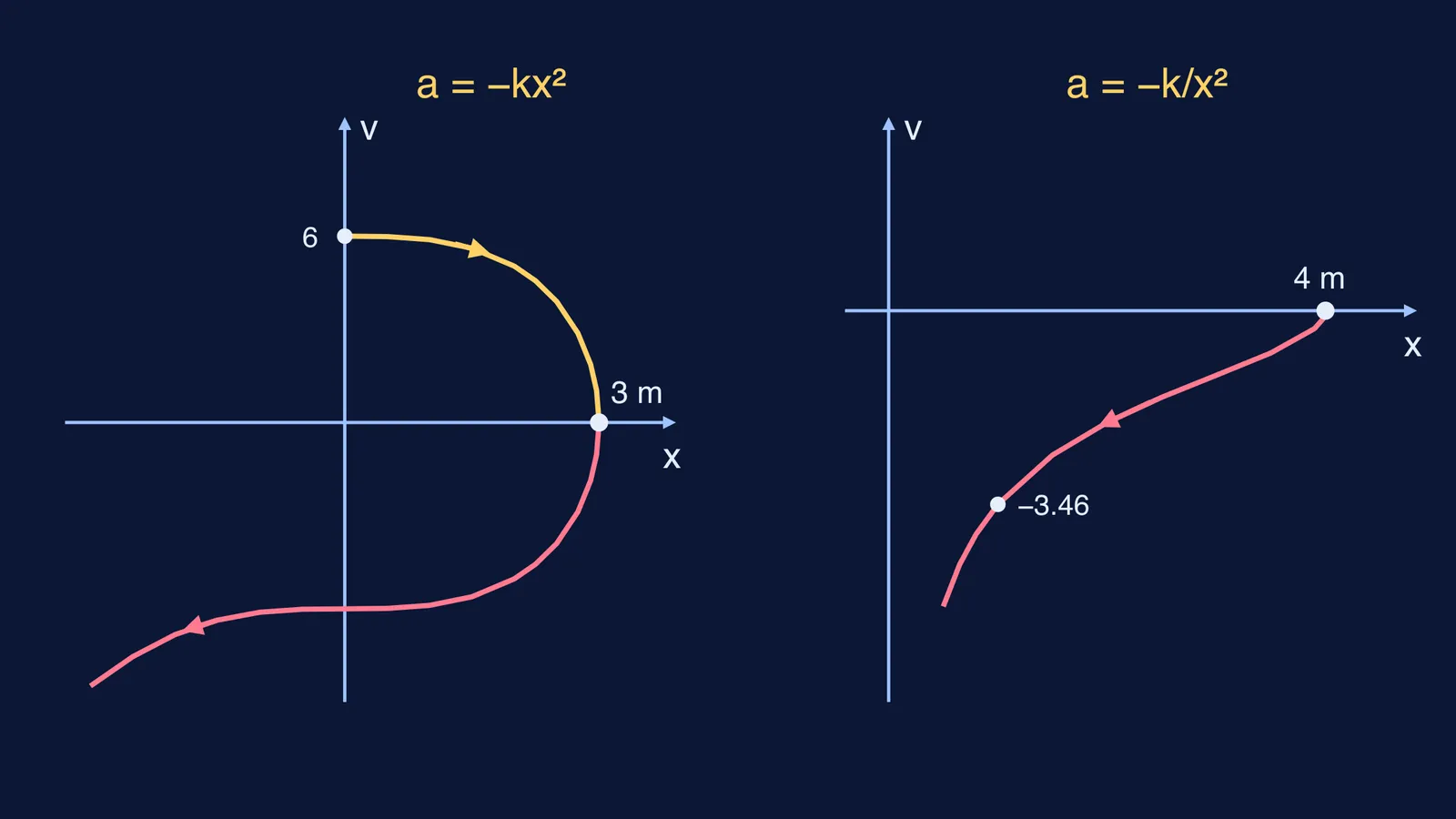
Worked example: a particle is at x = 0 moving along +x at 6 m/s. Its acceleration is a = −2x² in SI units, so k = 2 m⁻¹ s⁻². Find its speed at x = 1.5 m and where it stops.
Separate: v dv = −2x² dx.
Integrate with limits: ∫ v dv from 6 to v equals −2 ∫ x² dx from 0 to x.
So ½(v² − 36) = −(2/3)x³, which gives v² = 36 − (4/3)x³.
At x = 1.5 m: x³ = 3.375, so v² = 36 − 4.5 = 31.5 and v ≈ 5.61 m/s.
It stops when v = 0: x³ = 27, so x = 3 m.
At x = 3 m the acceleration is −18 m/s², so the particle turns back and passes x = 0 at 6 m/s heading towards −x. For negative x, a still points towards −x, so it keeps speeding up and never returns. That is why a = −kx² is not simple harmonic motion: SHM needs a = −ω²x, as our post on checking for SHM from the acceleration equation explains.
What changes when a = −k/x²?
This is the inverse-square pull of gravity, with x measured from the centre. The OpenStax section on gravitational potential energy writes the energy between two masses as U = −GMm/r, which gives an acceleration of −GM/r².
Worked example: a particle is released from rest at x₀ = 4 m, with a = −8/x² in SI units (k = 8 m³ s⁻²).
Separate: v dv = −8 dx/x².
Integrate: ∫ v dv from 0 to v equals −8 ∫ dx/x² from 4 to x.
So ½v² = 8(1/x − 1/4), which gives v² = 16(1/x − 1/4).
At x = 1 m: v² = 16 × 0.75 = 12, so the speed is about 3.46 m/s, towards the origin.
The formula says the speed grows without limit as x approaches 0. Real objects have size, so the model stops applying when they touch.
The same algebra gives escape speed. Start at radius R with speed v₀ outward: v² = v₀² + 2GM(1/x − 1/R). Far away, v² approaches v₀² − 2GM/R, which cannot be negative, so v₀ must be at least √(2GM/R). OpenStax gives that formula and puts Earth's escape speed at 1.12 × 10⁴ m/s, about 11 km/s (OpenStax University Physics, section 13.3).
How do you check your answer before moving on?
Run these checks in order:
Differentiate back: d/dx(½v²) must equal a(x). In the first example, d/dx(18 − (2/3)x³) = −2x².
Put in the starting point: at x₀, your v² must equal v₀².
Check the units of k: kx² must come out in m/s², so k is in m⁻¹ s⁻².
Choose the sign of the root from the direction of motion, not by habit.
Read what is asked. Time needs a second integral, t = ∫ dx/v, which is often much harder.
If your sign keeps coming out wrong, the Fermi Problem Library has worked problems with a step-by-step solver that explains the reasoning rather than printing an answer, so you can find the line that slipped. If the chain rule is the shaky part, the Fermi Concept Library gives each concept its own lesson and shows where it sits in the map.
Next time a question gives acceleration in terms of x, write v dv = a dx before anything else.


