

On this page
When you first learn kinematics, almost every problem features constant acceleration. You drop a ball, and it accelerates at g. You press the brakes on a car, and it slows down at a steady rate. But what happens when the acceleration changes as you move?
If a spring pulls a mass, the force (and therefore the acceleration) depends on the position, not the time. When you face an equation like a = 4x, the standard equations of motion (v = u + at) stop working.
A 2021 survey of 159 university students published in the *Journal of Physics: Conference Series* found that only 30.47% could correctly answer questions about acceleration when presented in various formats like graphs and equations source. A major reason for this drop in understanding is the jump from constant to variable acceleration.
Why can't I use the standard equations of motion?
The famous equations v = u + at and s = ut + ½at² are derived under a strict condition: acceleration must remain constant. If a changes depending on where the object is (its position x), these formulas will give you the wrong answer.
Instead, you have to use calculus. The definition of acceleration is the rate of change of velocity with respect to time, or a = dv/dt. However, if your acceleration is given in terms of x, there is no t in your equation to integrate.
A 2013 study in *Physical Review Special Topics - Physics Education Research* found that students often struggle with physics integration problems because they do not fully understand the physical meaning and manipulation of differentials like dx or dv source. To solve these problems, you must link velocity, position, and time together.
How do you derive acceleration as v dv/dx?
To connect acceleration to position, we use the chain rule from calculus. We know two fundamental definitions:
Velocity: v = dx/dt
Acceleration: a = dv/dt
Using the chain rule, we can rewrite the derivative dv/dt by introducing dx: a = dv/dt = (dv/dx) × (dx/dt)
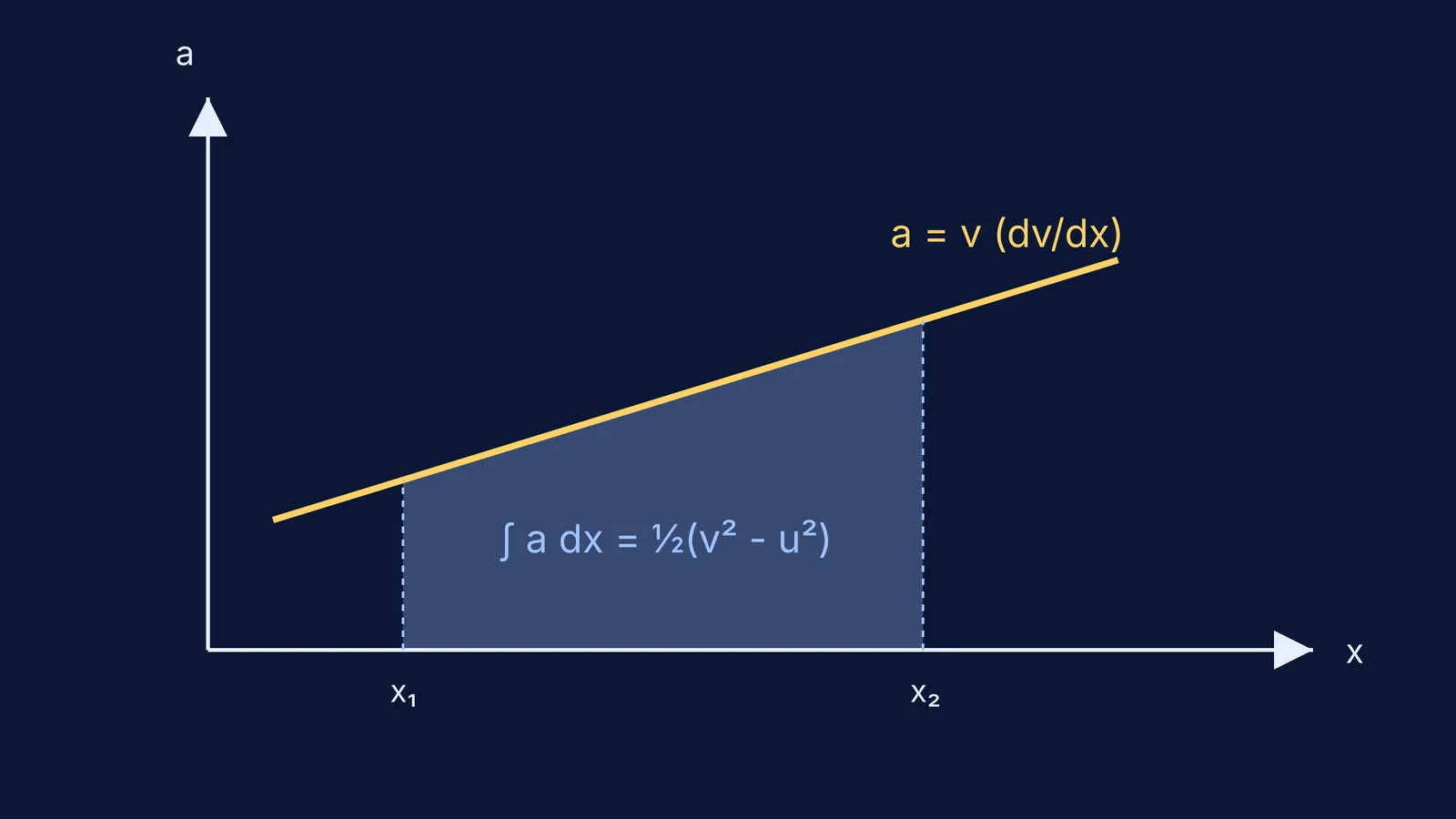
Since we know that dx/dt is simply the velocity v, we substitute v back into the equation: a = v (dv/dx)
This small substitution is one of the most powerful tricks in kinematics. It eliminates time (t) completely, leaving an equation that only involves acceleration, velocity, and position.
How to integrate acceleration as a function of position?
Once you have a = v (dv/dx), you can separate the variables to integrate. If you have an expression for acceleration, say a = f(x), you set it up like this: f(x) = v (dv/dx)
Multiply both sides by dx to get the x terms on one side and the v terms on the other: f(x) dx = v dv
Now, integrate both sides. You will typically integrate from an initial position x₁ with an initial velocity u, to a final position x₂ with a final velocity v: ∫ f(x) dx = ∫ v dv
The right side of this equation is always the same standard integral. The integral of v dv is v²/2. When you apply the limits from u to v, the right side becomes ½(v² - u²).
This reveals a deep connection to the work-energy theorem. The left side, ∫ f(x) dx, is essentially the work done per unit mass by the net force. The right side is the change in kinetic energy per unit mass. This means integrating a = v (dv/dx) is just a mathematical way of stating that work done equals the change in kinetic energy. If you are struggling with variable acceleration as a function of v or x, setting up these limits correctly is the most important step. Always double-check that your lower limit for x corresponds to your lower limit for v.
What is a worked example of v dv/dx integration?
Let's look at a practical example. Suppose a particle starts from rest at the origin (x = 0, u = 0) and its acceleration is given by a = 2x + 3. Find its velocity when x = 4.
Step 1: Choose the right formula Because a depends on x, we use a = v (dv/dx).
Step 2: Separate the variables 2x + 3 = v (dv/dx) (2x + 3) dx = v dv
Step 3: Set up the integral The particle starts at x = 0 with u = 0. We want the velocity v at x = 4. ∫ (2x + 3) dx = ∫ v dv
Step 4: Integrate and solve Left side: ∫ (2x + 3) dx = x² + 3x Evaluate from 0 to 4: (4² + 3(4)) - (0 + 0) = 16 + 12 = 28
Right side: ∫ v dv = v²/2 Evaluate from 0 to v: v²/2 - 0 = v²/2
Equating both sides: 28 = v²/2 v² = 56 v = √56 = 2√14 m/s
Step 5: Going further If a question also asks for the position at a specific time, you would take your new equation for velocity (in terms of x), replace v with dx/dt, and integrate one more time. However, many exams will only ask for the velocity at a given position because that second integration can be mathematically complex.
Practising this setup helps you spot the pattern quickly. When you see an acceleration equation with an x instead of a t, immediately think of the chain rule. If you want to work through more of these integrals with a step-by-step solver that explains the reasoning rather than just printing an answer, check out the Fermi Problem Library. Understanding how position and velocity link together will also make advanced topics, like finding the equation of trajectory of a projectile, much more intuitive.


