On this page
Class 12 biology students learn two ratios for one cross: 3:1 and 1:2:1. They are not rival answers. They are the same four Punnett-square boxes, counted two ways, and once you see that you stop mixing them up.
What happens in Mendel's tall × dwarf cross?
Start with two true-breeding parents: a tall plant (TT) and a dwarf plant (tt). The NCERT Class 12 biology chapter Principles of Inheritance and Variation uses exactly these symbols: T for tall and t for dwarf, with TT, Tt and tt as the possible genotypes.
The tall parent can only pass on T and the dwarf parent can only pass on t, so every F1 plant is Tt. All of them are tall, because T is dominant over t.
Mendel then let the F1 plants self-pollinate. In his own report, translated on MendelWeb, the stem-length experiment gave 1064 F2 plants: 787 with long stems and 277 with short ones, a ratio of 2.84:1. Across all seven traits he studied, the average was 2.98:1, which he rounded to 3:1.
How do you draw the F2 Punnett square?
Use this routine for any monohybrid question.
Write the cross: Tt × Tt.
List each parent's gametes. A Tt plant makes T and t gametes in equal numbers, because the two alleles separate during gamete formation (the law of segregation in the NCERT chapter).
Put one parent's gametes across the top and the other's down the side.
Fill each box with one letter from its row and one from its column.
Count genotypes.
Translate each genotype into what the plant looks like, then count again.
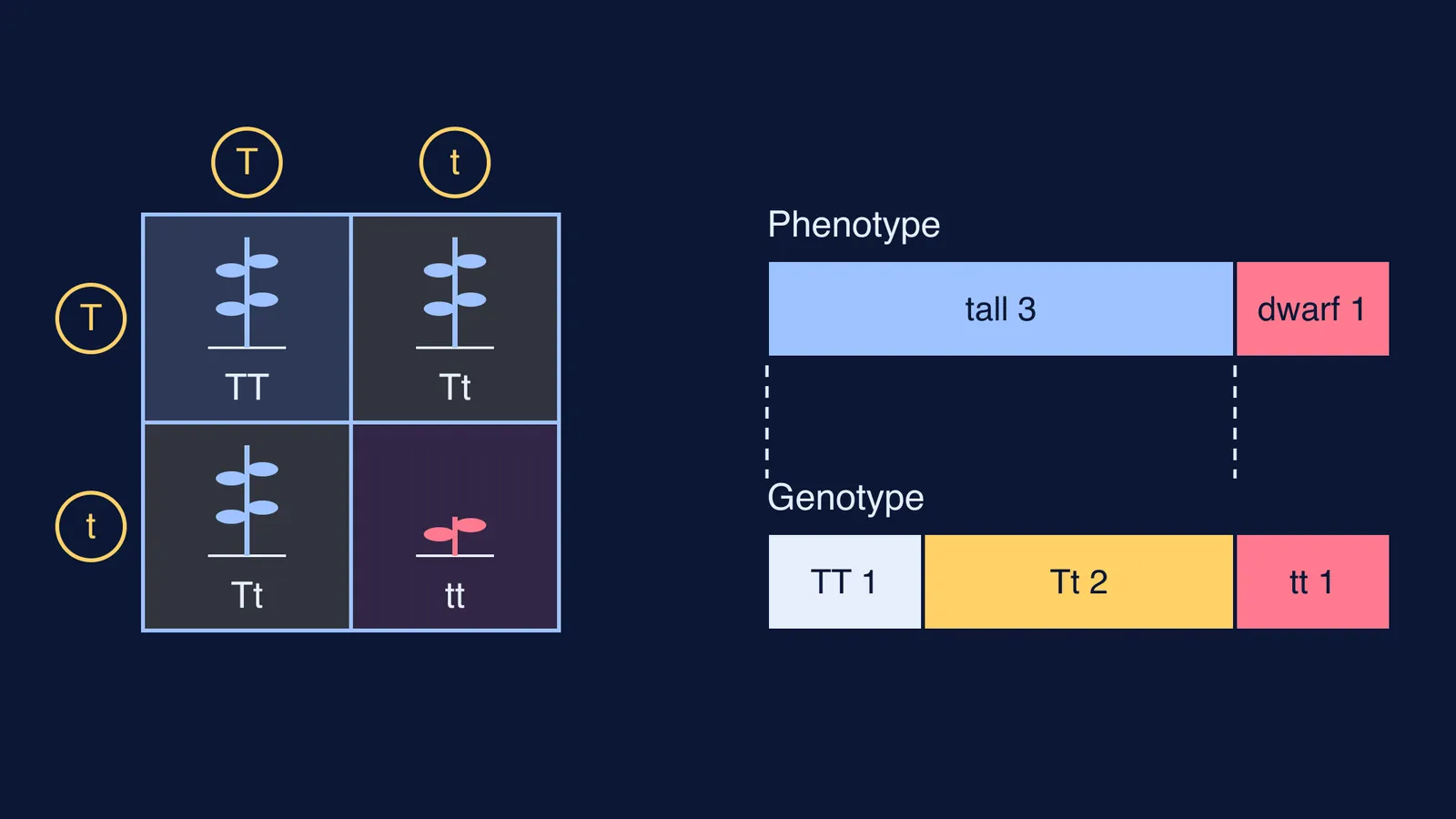
The filled square looks like this:
Row T: TT (tall), Tt (tall)
Row t: Tt (tall), tt (dwarf)
Count the genotypes and you get 1 TT, 2 Tt and 1 tt: the 1:2:1 genotypic ratio. Count the phenotypes and you get 3 tall and 1 dwarf: the 3:1 phenotypic ratio.
Why are the phenotype and genotype ratios different?
Genotype counts the letters. Phenotype counts what you can see. Two different genotypes, TT and Tt, give the same visible result, so they land in the same phenotype group.
The NCERT chapter puts it as fractions: 1/4 of F2 plants are TT, 1/2 are Tt and 1/4 are tt, so the tall plants make up 1/4 + 1/2 = 3/4 of the total (NCERT). It also shows the same result as a binomial: (1/2 T + 1/2 t)² = 1/4 TT + 1/2 Tt + 1/4 tt.
Compare a case where nothing is hidden. In snapdragons, red (RR) is incompletely dominant over white (rr), so Rr plants are pink. The NCERT chapter shows that the F2 is then 1 red : 2 pink : 1 white, so phenotype and genotype ratios are both 1:2:1.
How did Mendel prove the hidden 1:2:1 was there?
You cannot tell a TT plant from a Tt plant by looking. Mendel found out by growing the next generation. On MendelWeb, for the stem-length trait he took 100 tall F2 plants: the offspring of 28 were all tall, while the offspring of the other 72 included both tall and short plants.
That is close to 1 true-breeding plant for every 2 hybrids. In his seed-shape experiment the split was 193 to 372, a ratio of 1.93:1, and he concluded that two-thirds of the dominant F2 plants are hybrids (MendelWeb). Put the tall plants back together with the dwarfs and the 3:1 splits into 1:2:1.
The other way to check one plant is a test cross, which the NCERT chapter describes Mendel using on tall F2 plants: cross the tall plant with a dwarf (tt). If every offspring is tall, the plant was TT. If about half are dwarf, it was Tt (NCERT).
What should you check before answering a monohybrid question?
Read whether the question asks for phenotype or genotype before you write a ratio.
Check what you are dividing by: all F2 plants (four boxes) or only the tall ones (three boxes).
Write T and t, not T and d, so the two alleles of one gene look alike (NCERT's advice too).
Expect real counts to be close to 3:1, not exact. Mendel's 787:277 is 2.84:1 (MendelWeb).
If the heterozygote looks different from both parents, both ratios are 1:2:1.
If you keep picking the wrong ratio, the Fermi Problem Library has worked problems with a step-by-step solver that explains the reasoning rather than printing an answer. If the gap is in the ideas themselves (alleles, dominance, segregation), each one has its own lesson in the Fermi Concept Library.
Draw the four boxes, count them twice, and check which count the question wants.