

On this page
A pipe, a roller, a thick ring cut from a tube: JEE and board problems keep returning to the hollow cylinder with real wall thickness. The formula is short, but it is easy to flip its plus sign to a minus, or to forget that M is the mass of the material actually there. Here is the derivation in four lines, why the sign must be plus, and a worked example.
What is the moment of inertia of a thick-walled cylinder?
Take a uniform tube of mass M, inner radius R₁, outer radius R₂ and any length. About its central axis, I = ½M(R₁² + R₂²), as listed for a "thick-walled cylindrical tube with open ends" in the list of moments of inertia on Wikipedia. The same result appears as item 2, "hollow cylinder of inner radius R₁ and outer radius R₂", in the SKKU General Physics I notes on moments of inertia, next to the hoop (MR²) and the solid cylinder (½MR²).
The length does not appear. A long tube is just a stack of identical rings, so length changes M but not the shape of the formula.
How do you derive ½M(R₁² + R₂²)?
HyperPhysics describes the method: add up thin cylindrical shells, exactly as for a solid cylinder, except that the integration runs from the inner radius to the outer radius. Written out:
Cut the tube into thin shells of radius r, thickness dr and length L. Each has volume 2πrL dr, so dm = ρ·2πrL dr.
Every bit of one shell sits at the same distance r from the axis, so dI = r² dm = 2πρL r³ dr.
Integrate from R₁ to R₂: I = 2πρL(R₂⁴ − R₁⁴)/4 = ½πρL(R₂⁴ − R₁⁴).
The mass is M = ρπL(R₂² − R₁²). Factor R₂⁴ − R₁⁴ = (R₂² − R₁²)(R₂² + R₁²) and divide: I = ½M(R₁² + R₂²).
In step 4 the difference of squares cancels against the mass, leaving a plus sign. For more shells, rods and discs done the same way, see our guide to moment of inertia by integration.
Why is it a plus sign, not a minus?
The tempting wrong answer is ½M(R₂² − R₁²). It comes from subtracting "½MR₂² minus ½MR₁²" with the same M in both terms. But the solid cylinder you remove has less mass than the full one. Do the subtraction properly, with M₂ = ρπLR₂² for the full cylinder and M₁ = ρπLR₁² for the hole, and ½M₂R₂² − ½M₁R₁² gives the same plus-sign result. Our post on the subtraction method for a disc with a hole walks through that bookkeeping.
A sense check also kills the minus sign. Make the wall very thin, R₁ close to R₂, and ½M(R₂² − R₁²) goes to zero. A thin tube with all its mass at R₂ cannot have zero moment of inertia.
Does it reduce to the solid and thin-shell cases?
Yes, and it is worth checking every time you use it:
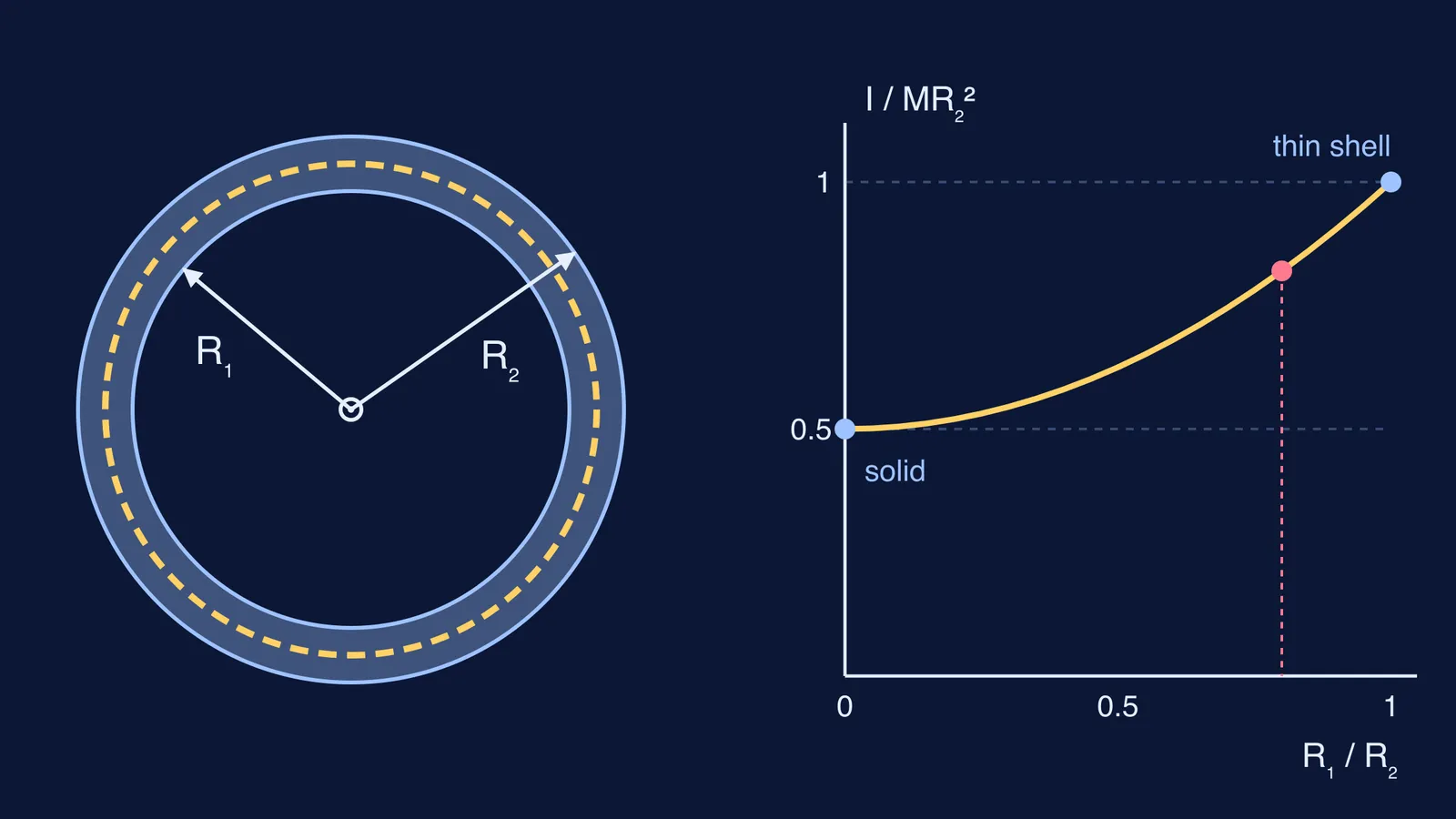
Solid cylinder: set R₁ = 0. I = ½MR₂², the disc result.
Thin shell or hoop: let R₁ approach R₂ = R. I = ½M(R² + R²) = MR².
In between: I = M × (average of R₁² and R₂²), so I/MR₂² = ½(1 + (R₁/R₂)²) climbs from 0.5 to 1 as the wall thins.
The Wikipedia table notes the same two limits.
Worked example: how does a hollow roller compare?
A steel roller has mass 2 kg, inner radius 4 cm and outer radius 5 cm. Work in metres.
I = ½ × 2 × (0.04² + 0.05²) = 0.0016 + 0.0025 = 0.0041 kg m².
Ratio check: I/MR₂² = 0.0041/(2 × 0.0025) = 0.82, which lies between 0.5 and 1.
Radius of gyration: k = √(I/M) = √0.00205 ≈ 0.045 m, so the tube acts like its whole mass sits about 4.5 cm out.
Compare at the same mass and outer radius: solid gives 0.0025 kg m², thin shell gives 0.0050 kg m².
Roll all three down the same slope without slipping. With a = g sin θ/(1 + I/MR²), the solid cylinder gets g sin θ/1.5, our roller g sin θ/1.82 and the thin shell g sin θ/2. The solid one wins, because rolling acceleration depends on I/MR², not on mass.
If the axis moves to a parallel line, for example one along the tube's outer surface, add Md² with the parallel and perpendicular axis theorems. About a diameter through the centre, the length does matter: Wikipedia gives I = (1/12)M[3(R₁² + R₂²) + h²] for a tube of length h.
When a problem mixes a tube with a rod or a removed hole, the Fermi Problem Library has worked problems with a step-by-step solver that explains the reasoning rather than printing an answer. If radius of gyration still feels shaky, the Fermi Concept Library covers every concept in physics, each with its own lesson and its place in the map.
Next, try one problem where you are given density instead of mass, so you must find M = ρπL(R₂² − R₁²) first.


